Welcome to the next step in your journey to mastering negotiation through game theory.
In our last lesson, we built a crucial tool: the payoff matrix. You learned how to map a simple, simultaneous negotiation by identifying the players, their strategies, and the resulting payoffs. This gives you a clear, single-page view of the strategic landscape. However, a map is only useful if the details are accurate. The most important detail—the numbers in the payoff cells—is what we'll focus on today. Where do those numbers, which represent value and drive decisions, actually come from?
The answer lies in the single most important source of power in any negotiation: your Best Alternative to a Negotiated Agreement (BATNA). This lesson will connect the foundational concept of BATNA directly to the game theory framework we're developing. You will learn to analyze how discovering, evaluating, and—most importantly—changing a player's BATNA can fundamentally alter the payoffs and reshape the entire strategic landscape of a negotiation.
Your BATNA: The Ultimate Source of Negotiation Power
Before we can analyze how a BATNA changes the game, we must be crystal clear on what it is. It's not just a "Plan B"; it's a strategic anchor that determines your willingness to accept a deal. A strong BATNA gives you the power to walk away from a poor offer, while a weak BATNA can force you to accept unfavorable terms.
The following article from Harvard Business School Online provides an excellent overview of this concept.
What Is BATNA in Negotiation? - HBS Online
This article frames BATNA as the primary source of leverage in a negotiation. It uses a compelling case study to show that a strong BATNA isn't always the most obvious alternative.
First, read the introduction from the beginning to get a firm definition. Then, focus on the section Why a Strong BATNA Determines Leverage. The Brims vs. Easterly case is particularly insightful. Notice how Brims' leverage didn't come from their high probability of winning in court, but from identifying a better, less obvious alternative: selling the land and finding a new site.
The core takeaway is that power in negotiation doesn't come from aggression or bluster; it comes from having an attractive alternative. Your BATNA determines your reservation price (also called a walk-away point)—the absolute minimum you'll accept (if you're selling) or the maximum you'll pay (if you're buying).
This relationship is visualized perfectly in the following diagram.
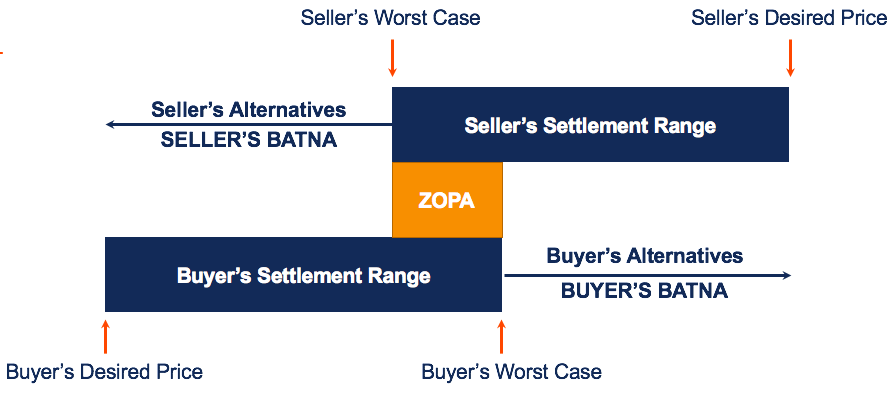
As the diagram shows, your BATNA anchors your entire settlement range. If your BATNA improves, your "worst case" point shifts, your entire settlement range moves, and the ZOPA shrinks or expands accordingly. The strategic landscape changes.
Quantifying Your BATNA: From Alternative to Payoff
To use your BATNA in a game theory model, you need to translate it into a number—a payoff value. This forces analytical rigor and prevents poor decisions based on emotion or miscalculation, a common trap for even experienced negotiators.
The following case study from the Program on Negotiation at Harvard Law School demonstrates this process precisely. It shows how a business owner, Shapiro, made a multi-million dollar mistake by failing to properly calculate the value of his BATNA.
BATNA Basics: Boost Your Power at the Bargaining Table
This document provides a simple, powerful formula for calculating the value of a complex BATNA involving uncertainty, such as litigation.
Read the first part of the document, which details the case of a business partnership dissolving. Pay close attention to the section Assessing your BATNA. The crucial part is the formula used to calculate the expected value of Shapiro's litigation alternative. This calculation reveals his true reservation price was $7.4 million, not the $10 million his "righteous indignation" led him to believe. He should have accepted the $8.5 million offer.
Shapiro's story provides a stark lesson. His intuitive sense of fairness told him his shares were worth $10 million. However, the analytically derived value of his BATNA (going to court) was only $7.4 million. By rejecting an $8.5 million offer, he chose an alternative that was objectively $1.1 million worse.
This is how a BATNA directly informs the payoffs in your game matrix. If you're Firm A in the pricing duel from our last lesson, the payoff you assign to the outcome where you set a "High Price" and your competitor sets a "Low Price" is determined by your BATNA. What happens in that scenario? If the resulting profit of 5 is better than closing up shop or pursuing another venture (your BATNA), you might play the game. If it's worse, you wouldn't even enter the market. Your BATNA sets the floor for all payoffs you're willing to accept.
Changing the Game by Improving Your BATNA
Since your BATNA determines your power and sets your reservation price, it follows that improving your BATNA is the most effective way to change the strategic landscape in your favor. A better BATNA raises your reservation price, allows you to negotiate more assertively, and increases your share of the final bargain.
This is not a passive analysis; it is an active strategy.
Professor Bob Bordone, a leading expert in negotiation, explains this dynamic with a fantastic real-world example from his coaching practice.
How Do I Negotiate When the Other Side Has More Power? | Negotiation 101 with Bob Bordone
In this segment, Professor Bordone makes a direct link between having a better BATNA and having more power. The story he shares is a perfect illustration of how to actively change the negotiation game.
Watch the section from 07:04 to 09:28. He tells the story of a publishing executive who was stagnating in her career. Notice how her strategic situation changed completely once she secured a job offer from a rival company. That new offer became her improved BATNA, giving her the leverage she previously lacked to secure an internal promotion. She didn't just analyze her situation; she actively changed it.
The executive's story demonstrates the core of today's lesson.
- Initial Landscape: Her BATNA was to continue in her current role. Her power was low, and her negotiation for a promotion was unsuccessful.
- Strategic Action: She invested time and energy to find an outside job offer.
- Altered Landscape: Her BATNA became "accept a better job at a competitor." This new, stronger BATNA fundamentally increased her power, raised her reservation point (the minimum she'd accept to stay), and forced her employer to concede.
This principle is universally applicable, whether you're negotiating a salary, a business deal, or a corporate acquisition. Power flows to the party that has better alternatives.
Here is a short, practical video that summarizes the steps you can take to actively find and strengthen your BATNA.
BATNA and WATNA: your key to success in negotiation
This video provides a simple, memorable framework for thinking about and acting on your BATNA.
Watch from 02:35 to 05:35. The key idea is in Step 5: "Act to boost your BATNA." The video's protagonist, Angie, doesn't just identify her alternative of finding another shop; she sends her partner out to actively look for one, strengthening her position before the negotiation even begins.
The Other Side of the Coin: Assessing Their BATNA
Finally, remember that negotiation is a game with at least two players. Just as your BATNA determines your strategy, your counterpart's BATNA determines theirs. A complete analysis requires you to assess their alternatives as rigorously as you assess your own.
If you discover their BATNA is weak, you know they have little leverage and are more likely to make concessions. If you find out their BATNA is strong, you know you will have to make a very attractive offer to close the deal. Information about their BATNA is one of the most valuable assets you can possess. The Mississippi farmer in the "BATNA Basics" reading learned this lesson the hard way: by focusing only on his own BATNA (the land's agricultural value), he left millions on the table because he failed to consider the buyer's much more lucrative BATNA (the land's value for a casino).
Conclusion
Today, we've connected the abstract numbers in a payoff matrix to the concrete reality of your negotiation power. You've seen that the strategic landscape is not fixed; it is shaped directly by the alternatives available to each player.
Key Takeaways:
- Your BATNA is your Best Alternative to a Negotiated Agreement and the primary source of your negotiation power.
- Your BATNA determines your reservation price, which sets the floor for the payoffs you will accept in a negotiation. This is how you quantify the values in a payoff matrix.
- Improving your BATNA is the most powerful strategic move you can make. It fundamentally alters the game by increasing your leverage and allowing you to claim more value.
- A savvy negotiator analyzes not only their own BATNA but also their counterpart's BATNA to understand the true balance of power.
You are now equipped to see a negotiation not as a static event, but as a dynamic field of play that you can actively shape to your advantage. In our next lesson, we will build on this by learning how to analyze the completed payoff matrix. We will identify dominant and dominated strategies, which will allow you to simplify complex scenarios and begin predicting the rational moves of your counterpart.