Welcome to your first lesson in applying game theory to negotiation tactics. This course is designed to shift your focus from the purely psychological aspects of persuasion, which you are already familiar with, to the underlying structural and analytical tools that govern strategic interactions. We will begin this journey with the single most important concept in negotiation theory, one that forms the bedrock of your power at the bargaining table.
This lesson addresses the first learning outcome of our course: to define the Best Alternative to a Negotiated Agreement (BATNA) and establish it as the primary source of your negotiation power. By the end of this hour, you will understand what a BATNA is, why it's more than just a "backup plan," and how it fundamentally determines your leverage in any negotiation, long before you even speak to the other party.
What is a BATNA?
The term BATNA, or Best Alternative to a Negotiated Agreement, was popularized by Roger Fisher and William Ury in their seminal book, Getting to Yes. At its core, a BATNA is the specific course of action you will take if you fail to reach an agreement in your current negotiation.
It is not a vague wish or a list of possibilities; it is a concrete, actionable plan. Thinking you can "find another supplier" is not a BATNA. Having a signed, conditional contract with another supplier that becomes active if the current deal fails is a BATNA.
To get a quick overview of the concept, let's watch a short introductory video.
This video from The Training Minute provides a concise and clear definition of the BATNA method.
Watch the segment from the beginning until the end of the introduction. Pay attention to how it's described as a "fallback solution" that provides "negotiating power."
As the video highlights, the BATNA method is a foundational technique. It is your strategic anchor in the turbulent waters of negotiation. It prevents you from accepting a deal you shouldn't and gives you the strength to push for one you should.
BATNA as Your Primary Source of Power
Your experience in business and sales has likely shown you that power dynamics are central to any deal. But where does this power truly come from? It's tempting to think it comes from a position of authority, a larger company, or more aggressive tactics. Game theory, however, teaches us that real, structural power comes from having excellent alternatives.
The party with the better BATNA has more power. It's that simple. Your power is not determined by the other party's weaknesses but by the strength of your own options away from the table.
This infographic provides a strong visual summary of this principle.
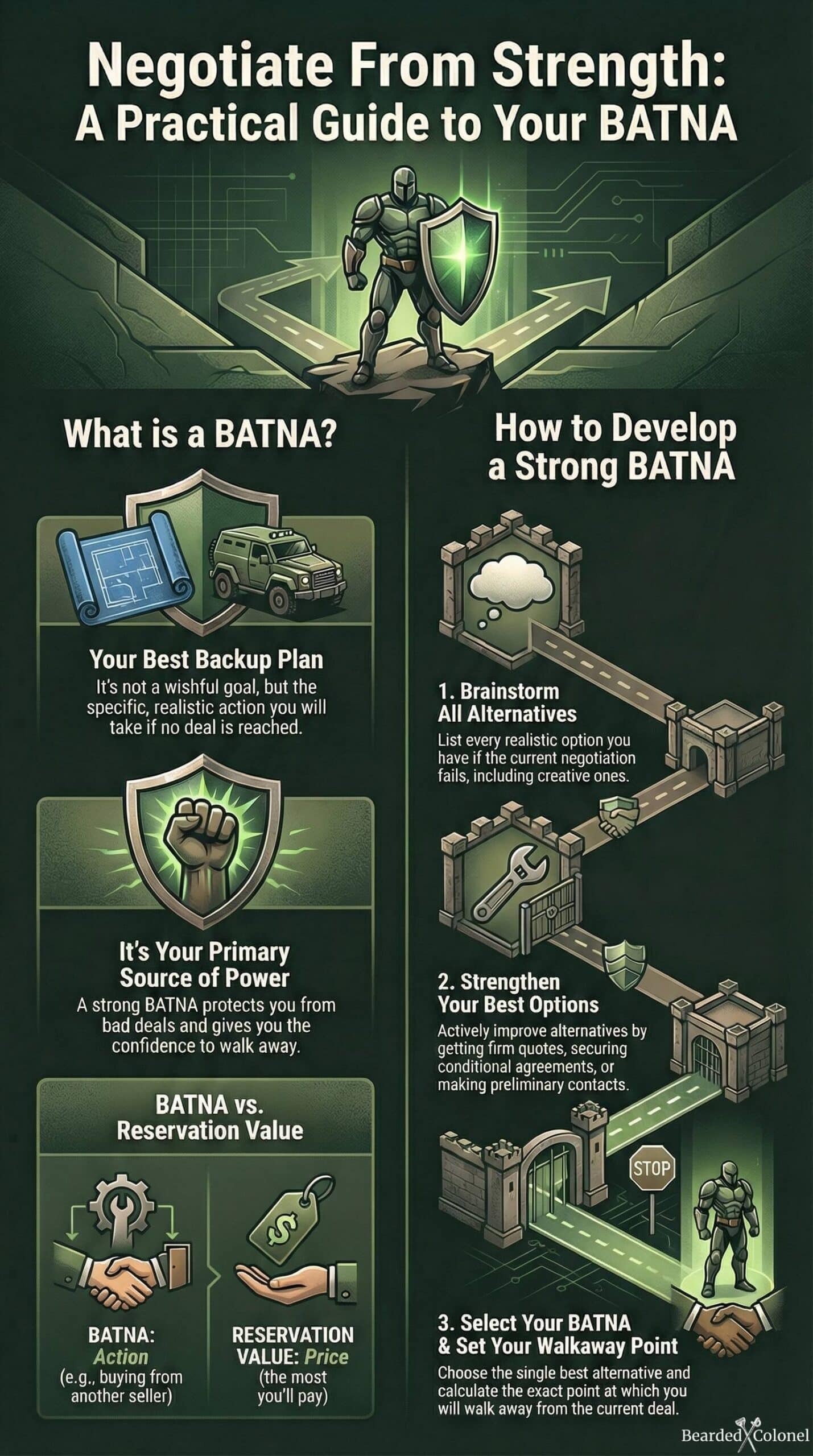
As you can see, a strong BATNA is described as your "Primary Source of Power." It's what protects you from being forced into a bad deal and gives you the confidence to walk away. This ability to walk away is the ultimate leverage. If you are not afraid to let the deal fail, you are in a position of strength. If you need the deal to happen, you have already ceded most of your power.
Let's explore the practical reasons why BATNA is so crucial.
A Complete Guide to BATNA, ZOPA & the Reservation Point
This article from Karrass, a negotiation training company, provides an excellent breakdown of why BATNA is so important for a negotiator.
Please read the section titled "Why is BATNA Important?" You will find it right after the main definition of BATNA. Focus on the list of reasons provided, such as Risk Mitigation, Empowerment, and Enhanced Decision-Making.
The points in that article—Empowerment, Risk Mitigation, Reduced Pressure—all circle back to a single theme: a strong BATNA frees you from dependence on the other party. This independence is the essence of negotiation power.
A Case Study: When the Obvious Alternative Isn't the Best
A common mistake is to think of your BATNA in simplistic, often adversarial terms (e.g., "If they don't agree, I'll sue them"). However, the best BATNA is the one that best serves your underlying strategic interests, which may not be the most combative option.
A well-known case study from Harvard Business School illustrates this perfectly.
What Is BATNA in Negotiation? - HBS Online
This article from HBS Online uses a business scenario to demonstrate that identifying the true source of leverage requires looking beyond surface-level options.
Read the section titled "Why a Strong BATNA Determines Leverage." The core of the section is the story involving Brims and Easterly. Pay close attention to why litigation, despite an 80% chance of success, was not Brims' best alternative. Think about the non-financial costs involved.
The Brims case is a powerful illustration of our main point. Brims' power didn't come from their high probability of winning in court. Their true leverage came from identifying a better alternative—selling the land and finding another site—that completely bypassed the conflict and aligned with their long-term goal of expansion. The moment they realized they had an alternative that was better for them than fighting, they were no longer dependent on Easterly's cooperation. They could negotiate from a position of genuine strength because the outcome of the negotiation no longer dictated their success.
From Concept to Action
Understanding your BATNA is the first step. The true value comes from actively working to improve it. As we saw in the "Negotiate From Strength" infographic, this involves a clear process:
- Brainstorm All Alternatives: List every possible course of action you could take if the deal fails. Be creative and realistic.
- Strengthen Your Best Options: Don't just list alternatives; develop them. Get quotes, make preliminary agreements, explore other opportunities. Turn possibilities into concrete, viable plans.
- Select Your Best Alternative: Choose the single course of action that provides the most value. This is your BATNA.
You are constantly negotiating, whether it's with suppliers, clients, partners, or employees. The discipline of continuously identifying and improving your BATNAs for these various negotiations is one of the most valuable strategic activities you can undertake as a business owner.
Conclusion
In this lesson, we established the foundational concept of BATNA. We have moved beyond a simple definition to understand its strategic implications.
Key Takeaways:
- BATNA (Best Alternative to a Negotiated Agreement) is the concrete, actionable plan you will execute if no agreement is reached.
- It is the primary source of negotiation power. Your leverage is directly proportional to the strength of your BATNA compared to your counterpart's.
- A strong BATNA provides the confidence to walk away, reduces the pressure to accept unfavorable terms, and enables you to make rational, strategic decisions.
- Your best alternative may not be the most obvious or confrontational one. It is the option that best serves your long-term strategic interests.
Now that you understand that your power comes from your BATNA, the next logical question is: How do you use it to set your limits in a negotiation? Your BATNA allows you to calculate a precise "walk-away point." In our next lesson, we will build directly on this foundation to define and determine your reservation price, the point at which a deal is no longer better than your BATNA.