In our last lesson, we established that your BATNA, or Best Alternative to a Negotiated Agreement, is the true source of your power. It's the concrete plan you'll execute if talks fail, and its strength dictates your ability to negotiate effectively. Now, we will connect this strategic alternative to a practical, numerical limit that will guide your every move at the bargaining table.
This lesson focuses on using your BATNA to determine your reservation price—the precise point at which you should walk away. This is a crucial step in translating the abstract power of your BATNA into a concrete decision-making tool. You will learn how to move from "what I'll do if there's no deal" to "what is the absolute worst deal I'm willing to accept."
From Alternative to Absolute Limit
While your BATNA is an action you take outside the negotiation, your reservation price is a value you hold inside the negotiation. It is your bottom line, your walk-away point. For a seller, it's the absolute minimum price you'll accept. For a buyer, it's the absolute maximum price you'll pay.
Crucially, your reservation price is not an arbitrary number or a desired target; it is logically derived from your BATNA. Any offer on the table must be better than your BATNA, otherwise you should simply walk away and execute your alternative.
Let's clarify the distinction between these two foundational concepts.
Reservation Price vs BATNA in Negotiation
This article from Karrass clearly defines and separates the concepts of reservation price and BATNA.
First, read the sections defining reservation price and defining BATNA. Then, pay close attention to the section on The Key Differences, which succinctly explains their relationship.
The key takeaway is that your BATNA informs your reservation price. The value of your BATNA sets the threshold for your reservation price. An offer that is worse than your reservation price is, by definition, worse than your BATNA. Accepting it would be an irrational decision. This principle protects you from making concessions under pressure or accepting a bad deal out of desperation.
Calculating Your Reservation Price: A Case Study
Determining your reservation price isn't guesswork; it's a calculated process of valuing your BATNA. For a business owner, this often involves assessing uncertain outcomes, potential costs, and probabilities—a core discipline in game-theoretic thinking.
A classic case from Harvard illustrates how a failure to properly calculate the value of a BATNA can lead to a costly mistake.
BATNA Basics: Boost Your Power at the Bargaining Table
This document presents a case study of a business partnership buyout that went wrong because one party relied on emotion rather than a calculated reservation price.
Please read the first section, up to the end of the Shapiro case. Focus on the four-step process described, and especially on the formula used to calculate the value of Shapiro's BATNA involving litigation.
Let's break down the mistake made by Shapiro. His BATNA was to go to court. He had a 70% chance of winning $10 million and a 30% chance of winning only $3 million, with litigation costs of $500,000.
The expected value of his BATNA was therefore:
This $7.4 million figure is the monetized value of his BATNA. Therefore, his reservation price should have been exactly $7.4 million. He should have been willing to accept any offer above this amount and reject any offer below it.
Stevenson's final offer was $8.5 million. This was significantly better than Shapiro's BATNA. By rejecting it based on an emotional sense of "fairness" ($10 million) rather than a rational calculation of his alternative, Shapiro effectively lost $1.1 million ($8.5M offer - $7.4M BATNA value). This is a perfect example of why a rigorously calculated reservation price is essential. It acts as a shield against poor, in-the-moment decisions driven by emotion or ego.
Beyond the Numbers: Incorporating Intangible Interests
The Shapiro case involved quantifiable, monetary outcomes. However, as you know from your experience in business, not all value can be captured in a spreadsheet. Your interests often include non-monetary factors: reputation, relationships, time, stress, and strategic positioning. A sophisticated analysis of your BATNA must account for these intangibles.
For example, your BATNA might be to switch to a different supplier who is cheaper. But what if that supplier is less reliable, or working with them could damage a long-standing relationship with your current partner? These factors must be "priced" into your evaluation.
A leading negotiation expert, Bob Bordone, provides a framework for thinking about this.
How Do I Decide When to Walk Away in Negotiation? | Ask a Negotiator with Bob Bordone
In this video, Bob Bordone explains how to decide when to walk away by assessing a deal against your BATNA, incorporating a wide range of interests.
Please watch the segment from this point in the video. He explains how to evaluate an offer by breaking down your interests into four categories: Short-term tangible Long-term tangible Short-term intangible Long-term intangible Pay attention to how prioritizing these interests allows you to compare a complex deal with your BATNA more effectively.
By categorizing your interests as Bordone suggests, you can more systematically evaluate both the offer on the table and your BATNA. The goal is to determine which option—the deal or the BATNA—better serves your most important interests, both tangible and intangible.
Your reservation price, therefore, is the value at which the current deal is equivalent to your BATNA, all things considered. If the deal offers less money but a much better long-term strategic partnership (an intangible), it may still be superior to a BATNA that offers slightly more money but sours a key relationship. The calculation is an art as well as a science.
Mapping the Negotiation Landscape: The ZOPA
Once you've determined your reservation price, and the other party has determined theirs, you have defined the boundaries of the negotiation. The space between the buyer's reservation price (the most they will pay) and the seller's reservation price (the least they will accept) is known as the Zone of Possible Agreement (ZOPA).
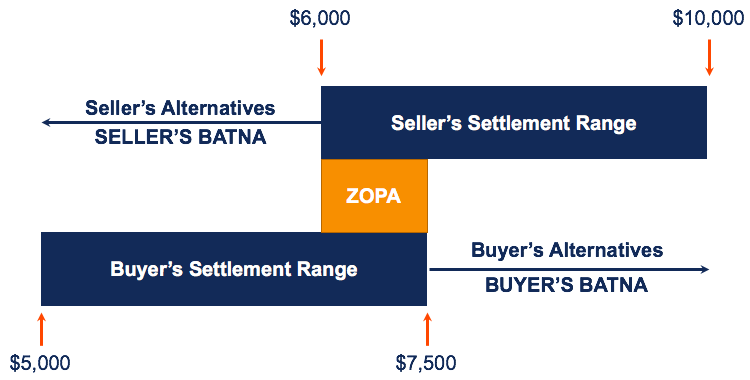
In the example shown in the "BATNA and ZOPA" image, the seller's BATNA leads them to a reservation price of $6,000. The buyer's BATNA leads them to a reservation price of $7,500. The ZOPA is the range between $6,000 and $7,500. Any agreement within this range is beneficial for both parties compared to their respective BATNAs. If the buyer's reservation price were lower than the seller's (e.g., if the buyer would only pay $5,000), there would be no ZOPA, and a deal would be impossible.
Conclusion
In this lesson, we have forged the critical link between your BATNA and your reservation price. This transforms your "plan B" into a disciplined, analytical tool that prevents you from accepting bad deals and gives you the clarity to recognize good ones.
Key Takeaways:
- Your reservation price is your walk-away point in a negotiation, and it is derived directly from the value of your BATNA.
- To calculate your reservation price, you must rigorously evaluate your BATNA, considering all potential outcomes, costs, and probabilities to find its expected value.
- This evaluation must include not only tangible, financial factors but also crucial intangible interests like time, risk, relationships, and reputation.
- Your reservation price is a hard limit that should be kept private. It's the boundary that tells you when an offer is no longer better than your best alternative.
- The gap between the buyer's and seller's reservation prices creates the Zone of Possible Agreement (ZOPA).
So far, we have focused on your own position: defining your power (BATNA) and your limits (reservation price). Now, we will broaden our view to formalize the structure of the negotiation itself. In the next lesson, we will define the core components of a game—players, strategies, and payoffs—setting the stage to analyze negotiation as a strategic, interactive system.