Hello! Welcome to your next lesson.
In our last session, we dug into the memory layout of a single struct, learning how compilers add padding to satisfy alignment requirements. We saw that reordering members can drastically reduce a struct's memory footprint. The reason for all this, we briefly touched on, was the CPU cache.
Today, we're zooming out. We'll move beyond single objects and explore the profound impact that CPU caches have on how we access collections of data. This lesson is the cornerstone of Data-Oriented Design and is absolutely critical for achieving the high-performance goals of your telemetry engine. Our learning outcome is to explain how CPU cache lines impact the performance of data access patterns.
Let's begin by understanding the problem that caches were designed to solve.
The Great Divide: CPU Speed vs. Memory Speed
Modern CPUs are incredibly fast, capable of executing billions of instructions per second. Main memory (RAM), by comparison, is incredibly slow. If a CPU had to wait for data to arrive from RAM for every operation, it would spend most of its time idle. This widening gap between processor speed and memory speed is often called the "Memory Wall".
To bridge this gap, hardware designers introduced CPU caches: small, extremely fast, and expensive memory banks located directly on the CPU chip.
The following video by Scott Meyers, a renowned C++ expert, provides an excellent introduction. He starts by showing a simple matrix traversal problem with two implementations that do the same work but have drastically different performance. This discrepancy is entirely explained by the CPU cache.
code::dive conference 2014 - Scott Meyers: Cpu Caches and Why You Care
In 'Cpu Caches and Why You Care,' Scott Meyers demonstrates why understanding caches is fundamental to performance.
Please watch from 0:43 to 4:09. Pay close attention to the performance graph comparing row-major and column-major traversal. The goal is to appreciate that how you access memory can be more important than how much work you do.
To understand why the access order mattered so much, we need to look at the cache hierarchy and the massive differences in access speeds.
code::dive conference 2014 - Scott Meyers: Cpu Caches and Why You Care
Continuing with the same talk, Scott Meyers now explains the different levels of cache and their respective latencies.
Watch from 14:08 to 19:42. Focus on these key points: The different cache levels (L1, L2, L3) and their tiny sizes compared to main memory. The animation at the end that visualizes the extreme latency difference between accessing the cache versus main memory. This is a very memorable illustration of the problem.
Cache Lines: The Unit of Memory Transfer
As you just saw, accessing main memory is a performance disaster. The system is designed to avoid it at all costs. The primary mechanism for this is how data is moved. The CPU doesn't fetch individual bytes from RAM. Instead, it pulls in fixed-size chunks of data called cache lines.
On virtually all modern processors, a cache line is 64 bytes.
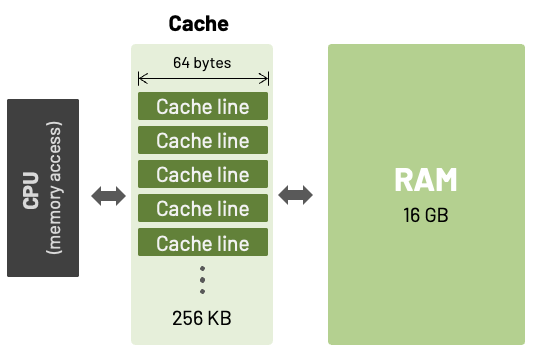
This has a simple but profound consequence: when you access a single byte, you are effectively pre-loading the next 63 bytes into the high-speed cache for free. This principle is called spatial locality.
Now, let's connect this directly back to the matrix traversal example. A matrix stored in memory is just a flat, one-dimensional array. A row-major traversal accesses elements contiguously, one after another.
// Row-major: Good spatial locality
for (int row = 0; row < N; ++row) {
    for (int col = 0; col < M; ++col) {
        process(matrix[row][col]); // Accesses matrix[0][0], [0][1], [0][2]...
    }
}
When matrix[0][0] is accessed, the CPU fetches a 64-byte cache line. This line also contains matrix[0][1], matrix[0][2], ..., up to matrix[0][15] (assuming 4-byte integers). The subsequent loop iterations find their data already in the L1 cache, resulting in blazing-fast execution.
A column-major traversal, however, jumps through memory.
// Column-major: Poor spatial locality
for (int col = 0; col < M; ++col) {
    for (int row = 0; row < N; ++row) {
        process(matrix[row][col]); // Accesses matrix[0][0], [1][0], [2][0]...
    }
}
After accessing matrix[0][0], it jumps to matrix[1][0], which is M elements away in memory. This is almost certainly on a different cache line. The CPU fetches a whole cache line for matrix[0][0], uses one element, and throws the rest away. Then it fetches another cache line for matrix[1][0], uses one element, and throws the rest away. This is cache-catastrophic.
The hardware that detects these linear access patterns and automatically fetches the next cache line for you is called the hardware prefetcher. It's a key reason why linear access is so fast.
Data-Oriented Design: From Theory to Practice
This brings us to the core philosophy of your project: Data-Oriented Design (DoD). The central idea is to arrange your data in memory according to how it will be processed, to maximize cache hits. This is often contrasted with Object-Oriented Programming (OOP), where data is often grouped by logical concepts.

A common performance pitfall in OOP-style code is pointer chasing. Structures like linked lists, trees, or graphs of heap-allocated objects are terrible for cache performance because each node can be in a completely random memory location. Following a pointer to the next node very often results in a cache miss.
For your telemetry engine, which needs to process millions of events per second, you must avoid this. Let's look at a practical example.
Data Locality · Optimization Patterns
The book 'Game Programming Patterns' has a fantastic chapter on Data Locality. This section will show you how to apply these ideas to a common game engine problem that is very similar to what you'll face.
Please read the sections titled 'Contiguous arrays' and 'How do you handle polymorphism?'. The first section provides a perfect example of transforming a cache-unfriendly array of pointers (AoS-like) into highly efficient, contiguous component arrays (SoA). The second section discusses the trade-offs with polymorphism, which is important given your CS background where OOP is heavily taught.
Test your understanding!
Imagine you are designing a system to manage particles. A typical OOP approach might look like this:
class Particle {
public:
    void update(float deltaTime) {
        position += velocity * deltaTime;
        // ... more logic
    }
private:
    Vector3 position;
    Vector3 velocity;
    float lifetime;
    Color color;
};

// In your main loop:
std::vector<Particle*> activeParticles;
for (Particle* p : activeParticles) {
    p->update(0.016f);
}
Here, activeParticles is a vector of pointers to Particle objects, which could have been allocated anywhere on the heap.
- Explain why this design is not cache-friendly.
- How would you refactor this using a Data-Oriented (Struct of Arrays) approach to maximize cache performance when updating all particle positions? Provide a C++ code snippet for the new data structure.
Show answer
-
Why it's not cache-friendly: The
std::vector<Particle*>stores pointers, not theParticleobjects themselves. These objects are likely scattered all over the heap. As the loop iterates, accessing eachpinvolves dereferencing a pointer, which is highly likely to cause a cache miss. The hardware prefetcher cannot predict the location of the next particle, so it can't help. We are engaging in classic pointer-chasing. -
Data-Oriented Refactoring (SoA):
We would separate the components of theParticleinto their own contiguous arrays.struct ParticleData { std::vector<Vector3> positions; std::vector<Vector3> velocities; std::vector<float> lifetimes; std::vector<Color> colors; size_t count = 0; }; // In your update loop for positions: void updatePositions(ParticleData& particles, float deltaTime) { for (size_t i = 0; i < particles.count; ++i) { particles.positions[i] += particles.velocities[i] * deltaTime; } }In this design, when we update the positions, we iterate through two perfectly linear, contiguous blocks of memory (
positionsandvelocities). This results in maximum spatial locality, very few cache misses, and allows the hardware prefetcher to work at peak efficiency.
False Sharing: A Multi-threading Nightmare
So far, we've considered a single thread of execution. When multiple threads enter the picture, a new and insidious problem arises from the way cache lines work: false sharing.
False sharing occurs when:
- Multiple threads are running on different CPU cores.
- They access different and independent variables.
- These variables happen to be located on the same cache line.
- At least one of the threads is writing to its variable.
When one core writes to its portion of the cache line, the cache coherency protocol must mark that entire line as "dirty" or "invalid" in all other cores' caches. If another core then wants to access its own independent variable on that same line, it finds the line is invalid and is forced to fetch it again from main memory (or a higher-level cache). If both threads are writing frequently, they will constantly fight over the cache line, invalidating each other's caches and causing performance to plummet, even though there is no logical data race in your code.
This concept is absolutely essential for your project goal of building a lock-free ring buffer, where a producer thread and a consumer thread will be modifying head and tail indices.
code::dive conference 2014 - Scott Meyers: Cpu Caches and Why You Care
Scott Meyers' talk provides one of the clearest explanations of false sharing available.
Please watch from 32:29 to 37:50. He uses a fantastic example from Herb Sutter to demonstrate how false sharing can destroy scalability and shows the simple fix.
To prevent false sharing, you can intentionally insert padding to ensure that variables accessed by different threads are on different cache lines. In C++, you can use alignas(64) on a variable to force it to start on a new 64-byte boundary, pushing other variables off the line. This is a direct, practical application of the alignment concepts from our previous lesson.
Conclusion
You now have a solid mental model of how your code interacts with the CPU cache. This is not an obscure, low-level detail; it is one of the most important factors for writing high-performance C++ code. As you build your telemetry engine, every data structure decision should be made with the cache in mind.
Key Takeaways:
- The Memory Wall: CPUs are much faster than RAM, and caches exist to hide this latency.
- Cache Lines: All data is moved between RAM and the cache in 64-byte blocks. Accessing data already in the cache (a cache hit) is orders of magnitude faster than fetching from RAM (a cache miss).
- Spatial Locality: Code that accesses memory addresses that are close to each other will perform better. This is why contiguous data structures like
std::vectorare your best friend. - Data Access Patterns: Linear, sequential access is ideal. Pointer-chasing (e.g., linked lists) is disastrous for cache performance.
- Data-Oriented Design: Structure your data for how it will be processed. The "Struct of Arrays" (SoA) pattern is a powerful tool for this.
- False Sharing: A critical multi-threading bug where threads contend over a cache line, not a variable. You can prevent it by aligning data to cache line boundaries.
In our next lesson, we will begin to put this knowledge into practice. We've learned why a specific memory layout is crucial. Now, we'll learn how to achieve it. We will explore placement new, a C++ feature that allows you to construct an object at a specific memory address you provide, giving you ultimate control over data layout and paving the way for implementing your own high-performance memory allocators.