Welcome to the final lesson in our first module. In our last session, you learned how to construct a robust checklist to verify a prospect's legitimacy and credibility. You can now confidently distinguish a professional, authentic coach from one who isn't, by analyzing their brand ecosystem, social proof, and potential red flags.
So far, our focus has been on identifying prospects who are credible. Today, we pivot to a more strategic question: which of these credible prospects actively need your services? A coach can have a fantastic, legitimate offer but still have a leaky sales process. These leaks are your opportunities.
This lesson will teach you how to analyze a prospect's content and engagement to diagnose their need for a DM setter. We are moving from a detective investigating credibility to a consultant identifying growth opportunities. This final layer of analysis will ensure you focus your outreach on coaches you can genuinely help, making your value proposition incredibly compelling.
The Two Funnels: Where Your Value Lies
Before we dive into the "how," let's establish the "why." Your ultimate goal as a high-ticket DM setter is not just to book calls, but to improve the quality of your client's entire sales pipeline.
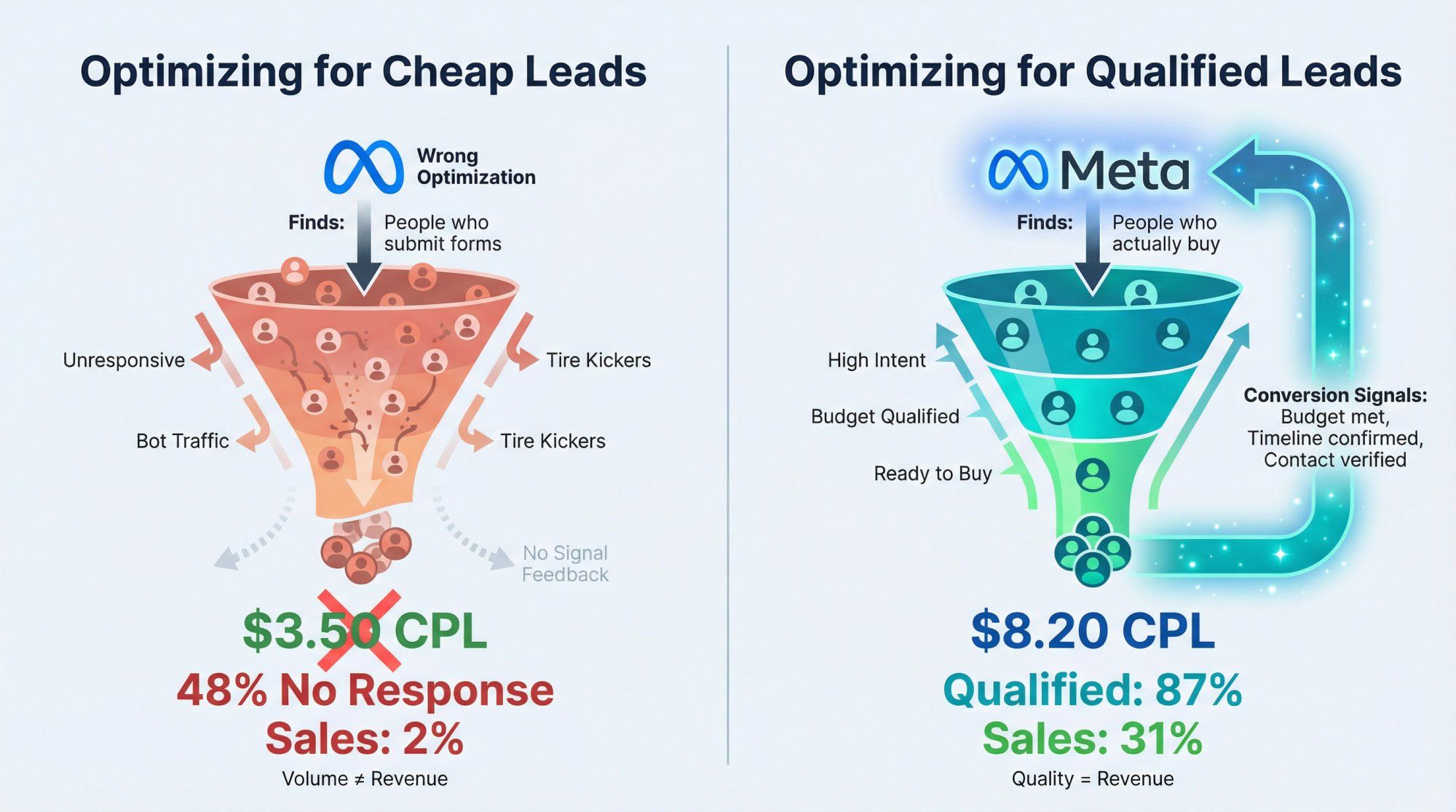
When you analyze a prospect, you are looking for signs that they are stuck in the left "cheap leads" funnel. Your analysis is the diagnosis, and your service is the cure.
1. The Storefront Analysis: Auditing the Profile & Bio
A prospect's Instagram or Facebook profile is their digital storefront. If it's confusing, vague, or unprofessional, potential customers will walk away. For a high-ticket coach, this means losing tens of thousands of dollars.
The French article from Ekklo provides an excellent framework for what an optimized bio for a coach should look like. While it's focused on sports coaches, the principles are universal. A weak "storefront" is often the first and most obvious sign that a coach needs help managing their inbound interest.
Sports coach Instagram bio: methods, examples and checklists | Ekklo
This article breaks down the essential elements of a high-converting Instagram bio. We will focus on the common mistakes, as each one represents an opportunity for a DM setter.
First, familiarize yourself with the 5 key blocks of a converting bio. This gives you a benchmark for what "good" looks like. Then, pay close attention to the section Frequent errors. These five mistakes are exactly the gaps you are looking for. A prospect making these errors is almost certainly leaving leads and money on thetable.
When you see these errors, don't just see a mistake—see an opportunity.
- Error 1: Too Vague? If their bio says "Mindset Coach" without specifying who they help (e.g., "I help female founders overcome burnout"), their inbound DMs are likely full of unqualified, confused people. This is your opening. You can help them by professionally qualifying inbound traffic, saving them hours.
- Error 4: Confused Link/No CTA? If their link-in-bio is a messy collection of links or goes to a generic homepage, the path to booking a call is broken. This is your opening. You become the human call-to-action (CTA), guiding interested followers to the next step through conversation.
Analyzing the "storefront" is your first, fastest way to qualify their need. If the front door to their business is confusing, they need a concierge—and that's you.
2. The Content Analysis: Reading Between the Lines
Once you've assessed their storefront, it's time to look at the products on the shelves—their content. You aren't just looking to see if the content is "good." You are looking for signals of a disconnect between their content, their audience, and their sales process.
Given your background in mathematics, you can appreciate that we can quantify some of this analysis. Let's borrow some concepts from a formal social media audit.
Social media audit template + guide - Zapier
This Zapier article is a guide for auditing one's own social media, but we'll use its principles to analyze our prospects. We'll focus on the concepts of engagement and audience identification.
Review the definitions under Engagement metrics to formalize your understanding of terms like engagement rate. Then, read the list of user characteristics under point #6, Identify your audiences. This will help you spot mismatches between a prospect's intended audience and their actual followers.
Here's how to apply these concepts in a rapid analysis:
-
Engagement Rate vs. Quality: A simple engagement rate is
(Likes + Comments) / Followers. A prospect with 100k followers but only 200 likes and 10 comments per post has a problem. As the Tyson 4D video warned, this could mean fake followers. But if the content is genuinely good, it could mean they have a large, passive audience they don't know how to activate. This is your opening. Your role is to start conversations and "activate" that dormant audience. -
The Goldmine in the Comments: The comments section is where you'll find the strongest signals of need. Look for:
- Unanswered Questions: Questions like "How much is this?" or "Do you offer this for people in Australia?" that are ignored for days are pure gold. These are active leads dissolving in public.
- Generic Replies: If the coach replies to a specific question with a lazy "DM me," they are creating friction. A potential client has to do more work. This is your opening. A professional setter would have replied, "Great question! I've just sent you a DM with the details."
- DM Mentions: Comments like "I DMed you last week" or "Checking my DMs, hope to hear back!" are signs of an overwhelmed coach with a chaotic inbox. This is a massive green light. They desperately need someone to manage that flow.
-
The Buyer's Pyramid: In his training, Artem GSS introduces the Buyer's Pyramid, which states that at any time, only 3% of your market is actively looking to buy now.
DM Appointment Setter Job Training Free Course - LinkedIn Tutorial
This clip from the LinkedIn setter training explains a crucial marketing concept: the Buyer's Pyramid.
Watch from where the video introduces the pyramid. Understand that most of the audience is not ready to buy right now.
Does the prospect's content only cater to the 3% with "Buy Now!" posts? If they lack content that educates, nurtures, and engages the other 97% of the pyramid, they have a huge gap. A DM setter's job is to have conversations with the "not ready yet" majority, building relationships so that when they are ready, your client is their first choice.
3. Synthesizing Your Findings: A "Need-for-Setter" Scorecard
Let's consolidate this into a quick scorecard. As you analyze a prospect, look for these signals.
🟢 Green Lights (They likely need a setter):
- Comment Goldmine: Buying-intent questions in comments are ignored or receive lazy replies.
- CTA Gap: Their bio is vague, or the link-in-bio is a confusing mess.
- Overwhelmed Signals: They post stories about being "flooded with DMs" or you see comments from people waiting for a reply.
- High Followers, Low Engagement: A large, passive audience exists but isn't being activated through conversation (provided the follower base looks real).
- "Buy Now" Content Only: Their content strategy ignores the vast majority of the Buyer's Pyramid.
🟡 Yellow Lights (Proceed with caution; more research needed):
- The "True Fan" Method is Working: In our final video, the creator describes a method of finding genuine inspiration in a prospect's content to start a conversation. If you find it easy to do this, it's a good sign they have strong content, which is a great foundation to work from.
How To Get Clients With Instagram (3 Cold Outreach Methods)
This video on Instagram outreach details a method that relies on analyzing a prospect's content to find a genuine point of connection. This is a great example of the kind of analysis you should be doing.
Watch the method described between "true fan to video intro". Notice how the analysis of their posts (looking for inspirational content or their personal story) is the key to crafting a compliment that isn't empty flattery. If a prospect's content gives you this kind of material, it's a very positive sign.
🔴 Red Lights (Likely not a good fit):
- A Pro is Already There: You notice that comments are handled swiftly and professionally by another person. Some DMs might even be signed by a setter. Don't waste your time trying to replace someone who is already doing a good job.
- Engagement is All Bots: The comments are generic ("Great post!") from fake-looking accounts. This is a sign of a fraudulent or ineffective presence.
- Bad Offer: Tying back to our last lesson, if the offer itself is weak, unethical, or based on hype, no amount of setting will fix it.
Conclusion
You have now completed the foundation of your prospecting strategy. You know how to identify a great high-ticket offer, how to verify the credibility of the person behind it, and now, how to diagnose their specific need for your skills. This analytical approach separates you from other setters who just spam "I can book you 10 calls a week." You can now approach a prospect with a precise understanding of the gaps in their process.
Key Takeaways:
- Your value is in moving a client from a low-quality, high-volume lead funnel to a high-quality, revenue-focused one.
- Analyze a prospect's "storefront" (their bio and profile) for vagueness and broken CTAs—these are opportunities.
- The comments section is a goldmine. Look for unanswered buying questions and signs of an overwhelmed coach.
- Use the Buyer's Pyramid to assess if their content strategy has a gap that conversational selling can fill.
In our next module, we will put this knowledge into action. Now that you have a crystal-clear picture of your ideal client profile—a credible coach with a great offer and visible gaps in their sales process—our next lesson will focus on executing advanced search strategies on Instagram to find them.