Hello! In our previous lessons, we've built a powerful prospecting toolkit, moving from the visual landscape of Instagram, through the communities of Facebook, and into the professional database of LinkedIn. You've learned to search, filter, and analyze prospects on platforms where they broadcast their status.
Today, we explore a different, and in many ways, more direct environment: Skool. Think of it not as a social network, but as a curated collection of digital businesses. On Skool, creators don't just post content; they build entire ecosystems for their paying customers. Our goal in this lesson is to navigate this platform to discover active, paid communities run by the high-ticket creators you want to work with. This is where you can find validated offers and creators who are already successfully selling premium programs.
What is Skool? The Anatomy of a Modern Community
Before we dive into finding clients, it's essential to understand the Skool environment. Unlike the sprawling feeds of other platforms, a Skool community is a self-contained unit with several key components. Understanding these components is crucial because they are the very features a successful creator uses to deliver their high-ticket offer.
The video "What is Skool & How Does it Work" by Evelyn Weiss provides an excellent tour of these features. As you watch, notice how each feature—the forum, classroom, calendar, and leaderboards—comes together to create a premium experience for members. This is the "product" your potential clients are selling.
What is Skool & How Does it Work (Full Guide)
This video breaks down the core building blocks of any Skool community.
Watch the section from the beginning of the tour. Pay attention to the description of the: Community/Forum: The central discussion area. Classroom: Where course content is hosted. Calendar: For live events and coaching calls. Gamification (Leaderboards & Levels): Tools to drive member engagement. These are the elements that successful creators use to justify their high prices.
The Hunt: Using Skool Discovery to Find Prospects
Skool's main advantage for prospecting is its Discover page. This is essentially a searchable marketplace of communities, categorized by topic. For you, it's a directory of potential clients.

This is your starting point. You can filter by categories that are ripe for high-ticket offers, such as Business, Health, Self Improvement, and Tech.
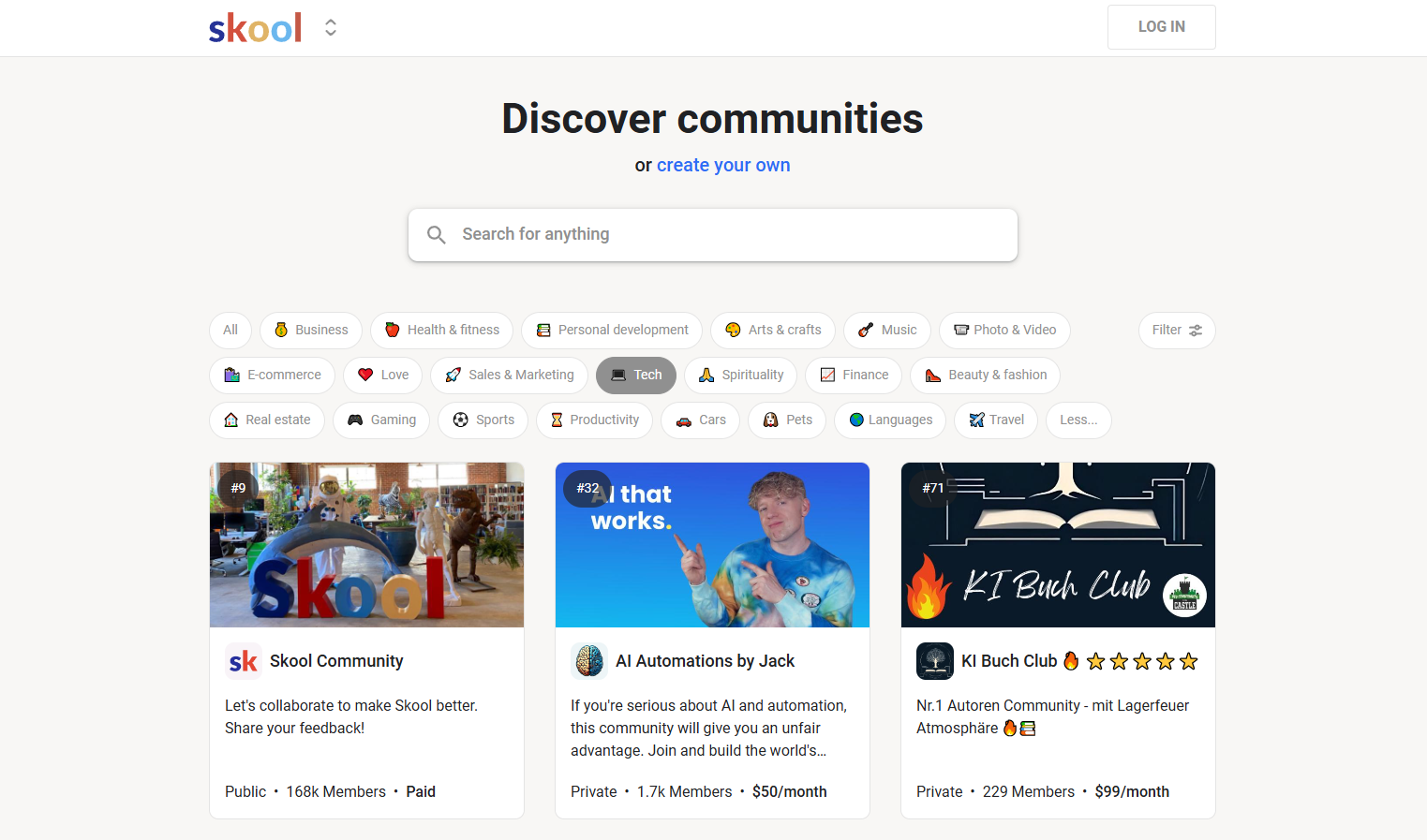
The video "How to use Skool to find high ticket sales clients" by Luke Alexander is a masterclass in using this feature for exactly your goal. He treats it like an investigator, moving from discovery to verification.
How to use Skool to find high ticket sales clients
This video demonstrates a practical, step-by-step process for finding high-ticket clients on Skool.
Watch the first part of the video, from the beginning to the end of the overview. The key concept here is that Skool acts like Amazon's marketplace, bringing traffic and customers directly to the creators. This centralizes your search.
Qualifying Prospects: Paid, Free, and Cross-Referencing
Now that you know where to look, how do you identify the best opportunities? This requires combining the information on Skool with some external investigation—a process Luke Alexander demonstrates perfectly.
Strategy 1: The Obvious Signal (Paid Communities)
A community with a high monthly fee and a large number of members is the most direct signal of a successful high-ticket operation. The creator is successfully charging for access, which means they have a proven offer and likely a steady stream of new members—exactly what a DM setter supports.
Strategy 2: The Hidden Signal (Free Communities)
Don't dismiss free communities. As you'll see in the video, a popular free community is often the top of a very profitable sales funnel. The marketing principle is simple: if the front-end product is free, the creator is making their money on a high-ticket back-end offer (e.g., a coaching program, mastermind, or agency service). These creators are often overwhelmed with leads from their free group and are prime candidates for needing a setter.
Luke Alexander's video shows you how to execute both strategies.
How to use Skool to find high ticket sales clients
This is the most critical part of the lesson. You'll see how to find a lead on Skool and then verify their high-ticket status.
Watch these two key examples: First, watch how he finds a paid e-commerce group, then cross-references the creator on Instagram to confirm they have a high-ticket "apply now" funnel. Watch from the first example. Next, watch how he finds a free course, identifies the creator, and explains the critical concept that a free front-end offer signifies a high-ticket back-end. This is a goldmine for setters. Watch from the second example.
Advanced Signals: The Skool Games Leaderboard
For an even more direct path to top earners, Skool provides a literal leaderboard. The "Skool Games" ranks communities based on their monthly recurring revenue (MRR). This is an unfiltered, data-driven list of the most successful creators on the platform.
The blog post "They Made $300k Per Month With Skool" shows you exactly what this leaderboard looks like and the kind of revenue figures we're talking about.
They Made $300k Per Month With Skool (Just Copy Them) | Episode 399 – Professor Game
This article section reveals the "cheat code" for finding top-tier clients by showing you the Skool Games leaderboard.
Read the section that begins with the heading Rob Alvarez (12:55). Focus on the part where he shows the leaderboard, explains what the revenue numbers mean, and shows the price and member count for the top community. This is your "hot list" of potential clients.
Accessing this leaderboard requires being part of the "Skoolers" community (which is free for anyone with a Skool account), but knowing it exists tells you where the biggest players are.
Prospecting Etiquette and Your Next Move
It's crucial to understand that Skool communities are not public forums for prospecting. Most have strict rules against direct selling or unsolicited messages. Attempting to pitch the creator inside their own paid community is the fastest way to get banned.
Your strategy is to use Skool for identification and intelligence gathering, not for outreach.
- Identify: Use the Discover page and Skool Games leaderboard to find promising creators.
- Qualify: Investigate them. Is their community paid or free? What is the member count? Cross-reference them on Instagram, LinkedIn, and their personal website. Do they have a "Book a Call" or "Apply Now" button?
- Gather Intel: If they have a free community, join it. Don't sell. Listen. Understand the language, the problems their students face, and the results they promise. This is invaluable information you will use to craft a highly personalized outreach message on a different platform (like Instagram DM or email).
The final part of Luke Alexander's video reinforces this professional approach.
How to use Skool to find high ticket sales clients
This short clip explains the proper etiquette for engaging in these communities.
Watch from this final segment. The key takeaway is to join, engage authentically, build relationships, and take the "ask" offline to a more appropriate channel.
Conclusion
You've now added a powerful and unique platform to your prospecting arsenal. While Instagram and LinkedIn are about finding individuals in a vast sea, Skool is about finding concentrated hubs of commercial activity. You've learned to see the platform not as a user, but as a strategist.
Key Takeaways:
- Skool is a marketplace of validated businesses, not just a social network.
- Use the Discover page and its categories to find communities in high-value niches.
- A paid community with many members is a direct sign of a successful offer.
- A free community often serves as the top of a funnel for a high-ticket back-end program, making the creator a prime prospect.
- The Skool Games leaderboard is a direct, data-driven list of the top-earning creators.
- Your strategy is Identify and Research on Skool, then conduct your outreach on other platforms.
With this, our tour of prospecting platforms is complete. You now know how to find high-ticket clients on Instagram, Facebook, LinkedIn, and Skool. The next step is to integrate all of this knowledge into a sustainable, repeatable system.
In our next lesson, we will focus on building your daily prospecting routine, creating a structured process that combines these different platforms into an efficient system for generating a consistent flow of opportunities.