Hello! Welcome back to your second lesson.
In our first session, we reviewed the accounting equation and established that for every business transaction, what a company owns (Assets) must equal the claims against it (Liabilities + Equity). We saw that the equation always balances, but we didn't cover how accountants ensure this balance is maintained.
Today, we'll answer that question by diving into the fundamental mechanism of double-entry bookkeeping: debits and credits. This lesson will explain the rules that govern debits and credits and show how they are the language used to record the increases and decreases in accounts, ensuring the accounting equation remains in perfect balance after every single transaction.
1. Deconstructing Debits and Credits
Before we get into the rules, it's crucial to clear up some common misconceptions. Debits and credits are not inherently "good" or "bad," nor do they always mean "increase" or "decrease." They are neutral, directional terms:
- Debit (dr): An entry made on the left side of an account ledger.
- Credit (cr): An entry made on the right side of an account ledger.
The "why" behind this two-sided system is the concept of a transaction having two parts: a source and a destination. Every transaction involves a flow of economic benefit.
To understand this core idea, let's watch a short video.
ACCOUNTING BASICS: Debits and Credits Explained
This video from Accounting Stuff provides an excellent conceptual framework for understanding debits and credits as the source and destination of economic benefit.
Please watch from 00:32 to 01:56. Focus on the idea that debits and credits reflect the two-sided nature of every financial transaction.
As the video explains, a debit represents the destination where economic benefit flows to, and a credit represents the source where it flows from. For example, when you buy a computer (an asset), the benefit flows to your business; when you pay for it with cash, the benefit flows from your cash account.
2. The Rules of Engagement
The effect a debit or credit has—whether it increases or decreases an account—depends entirely on the type of account it is applied to. Last lesson, we reviewed the five main account types. Now, let's learn the rules for each.
The table below is a concise guide that you will use constantly as a bookkeeper.

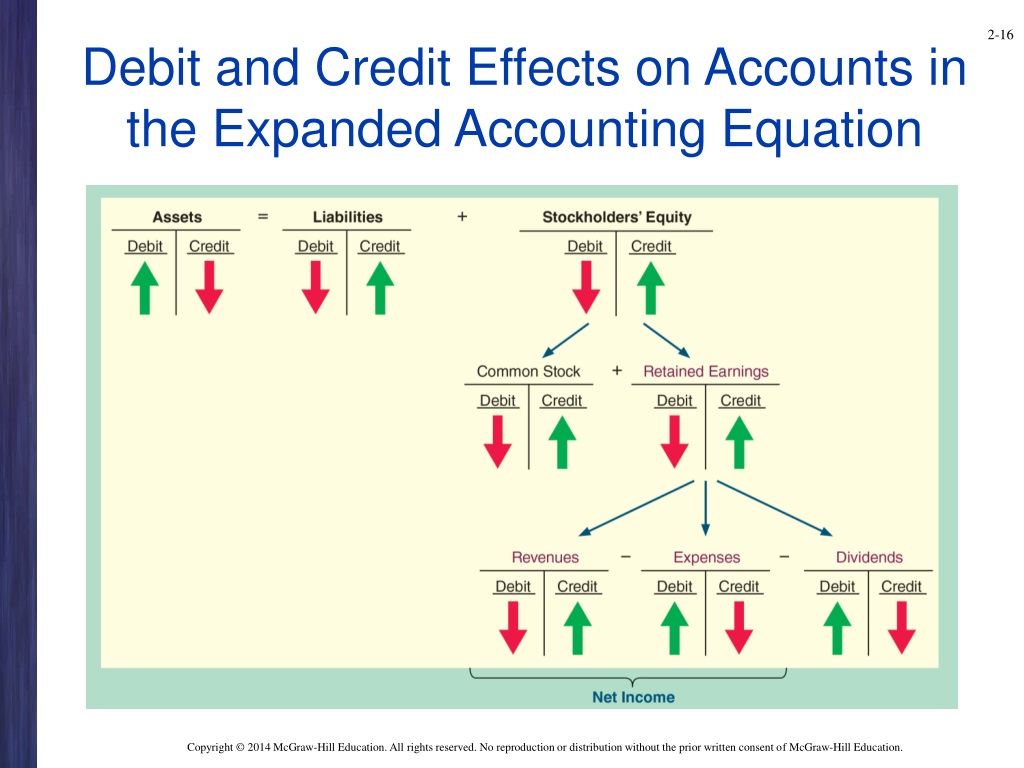
To make this easier to remember, we can use a mnemonic device built around the expanded accounting equation. A popular one is DEALER:
- Dividends (or Draws), Expenses, Assets: These accounts increase with a Debit.
- Liabilities, Equity (Capital), Revenue: These accounts increase with a Credit.
To decrease an account, you simply do the opposite. For example, since an Asset account increases with a debit, it will decrease with a credit.
For a slightly more detailed look at these rules, let's turn to a resource from QuickBooks.
Debit vs. credit in accounting
This article from the QuickBooks blog clearly outlines how debits and credits function for different account types. Since your goal is to master QuickBooks, it's helpful to see concepts explained from their perspective.
First, read the sections 'Differences between debit and credit' and 'Function of debits vs. credits'. Then, scroll down and read the section 'How do debits and credits affect different accounts?'. This provides a clear breakdown for each of the five account types.
The image below ties everything together, showing the rules of debit and credit in the context of the expanded accounting equation we discussed in the previous lesson.
3. Debits and Credits in Action
Now, let's put theory into practice. We'll analyze several common business transactions and see how they are recorded using debits and credits, always ensuring the accounting equation stays balanced.
A simple way accountants visualize this is with T-Accounts, which are just graphical representations of individual accounts, with the "T" separating the debit (left) side from the credit (right) side.
For instance, if a company borrows $5,000 from a bank:
- Cash (an Asset) increases. An increase to an Asset is a debit.
- Notes Payable (a Liability) increases. An increase to a Liability is a credit.
The T-accounts would look like this:
| Cash (Asset) | |
|---|---|
| Dr. | Cr. |
| $5,000 |
| Notes Payable (Liability) | |
|---|---|
| Dr. | Cr. |
| $5,000 |
Notice that the total debit ($5,000) equals the total credit ($5,000).
The following video walks through several transactions, showing the debit/credit entries and how they affect the accounting equation grid we used in the last lesson. This will directly connect the concepts from both lessons.
Accounting Equation | with Debits and Credits | Explained with Examples
The channel Counttuts provides excellent, step-by-step examples. We'll watch a few clips to see how different transactions are recorded.
Please watch the following segments: Paying an Expense (02:48 - 05:13): See how paying for advertising affects Cash (Asset) and Equity (Expense). Purchasing on Credit (05:13 - 07:22): Watch how buying inventory on credit affects Inventory (Asset) and Accounts Payable (Liability). Paying a Supplier (10:42 - 12:05): Observe the entry for paying off a liability with cash. Receiving Income (13:21 - 14:27): See how receiving rent income affects Cash (Asset) and Equity (Revenue). For each example, pay close attention to which account is debited, which is credited, and how the accounting equation remains balanced.
These examples demonstrate the fundamental rule of double-entry bookkeeping:
For every transaction, the total value of debits must equal the total value of credits.
This is the mechanical rule that enforces the balance of the accounting equation (Assets = Liabilities + Equity).
4. Practice Exercise
Let's apply these rules to the same transactions from our last lesson. This time, identify which account is debited and which is credited. The first one is done for you.
| Transaction | Account Debited | Account Credited |
|---|---|---|
| 1. Owner invests $20,000 cash. | Cash | Owner's Capital |
| 2. Purchases a computer for $2,500 cash. | ? | ? |
| 3. Borrows $10,000 from a bank. | ? | ? |
| 4. Provides services and bills a client $1,500. | ? | ? |
| 5. Pays $500 for monthly office rent. | ? | ? |
| 6. Receives $1,500 cash from the client billed in #4. | ? | ? |
Click here to see the solution
| Transaction | Account Debited | Account Credited |
|---|---|---|
| 1. Owner invests $20,000 cash. | Cash (Asset ↑) |
Owner's Capital (Equity ↑) |
| 2. Purchases a computer for $2,500 cash. | Equipment (Asset ↑) |
Cash (Asset ↓) |
| 3. Borrows $10,000 from a bank. | Cash (Asset ↑) |
Loan Payable (Liability ↑) |
| 4. Provides services and bills a client $1,500. | Accounts Receivable (Asset ↑) |
Service Revenue (Revenue ↑) |
| 5. Pays $500 for monthly office rent. | Rent Expense (Expense ↑) |
Cash (Asset ↓) |
| 6. Receives $1,500 cash from the client billed in #4. | Cash (Asset ↑) |
Accounts Receivable (Asset ↓) |
Arrows indicate the effect on the account balance (↑ for increase, ↓ for decrease).
Conclusion
You've now learned the fundamental "how" of bookkeeping. Debits and credits are the syntax of accounting, allowing us to systematically record financial events while ensuring the books are always balanced. With your background in financial management, you can appreciate how this structured system is essential for producing reliable financial reports.
Key Takeaways:
- Debit means left, and Credit means right. They are directional, not judgmental.
- The effect of a debit or credit (increase or decrease) depends on the account type. The DEALER mnemonic is a helpful tool: accounts on the left side of the equation (Assets, Expenses, Draws) increase with debits, while accounts on the right side (Liabilities, Equity, Revenue) increase with credits.
- For every transaction, Total Debits must equal Total Credits. This is the core of the double-entry system and is how the accounting equation remains balanced.
Preview of the Next Lesson:
We now know how to record transactions using debits and credits. The next logical question is when do we record them? Is it when cash changes hands, or when the activity actually occurs? In our next lesson, we will explore the answer by differentiating between cash-basis and accrual-basis accounting.