Hello! Welcome to your third lesson.
In our last session, we mastered the "how" of bookkeeping by learning the rules of debits and credits. We saw how this double-entry system ensures the accounting equation always remains balanced.
Today, we'll address the equally important question of when to record transactions. Is it when a client pays you, or when you finish the work? Is an expense recorded when you get the bill, or when you actually pay it? The answer depends on the accounting method a business uses.
This lesson will differentiate between the two primary methods: cash-basis accounting and accrual-basis accounting. Understanding this distinction is fundamental for any bookkeeper, as it directly impacts how a company's financial performance is measured and reported. It's also a critical setting you'll manage in QuickBooks.
1. The Core Difference: Timing
The fundamental difference between cash and accrual accounting is the timing of when revenue and expenses are recognized (i.e., formally recorded in the books).
To get a great overview of this concept, let's start with a video that explains the two methods through a simple story.
Cash vs Accrual Accounting Explained With A Story
This video from Leila Gharani uses a story about a beach vendor to clearly illustrate the practical differences between cash and accrual accounting.
Please watch the introduction from 00:00 to 00:58. It sets the stage perfectly by explaining that the key difference is all about timing.
Now that you have the main idea, let's explore each method in detail.
2. Cash-Basis Accounting: Following the Money
Cash-basis accounting is the more intuitive of the two methods. It's simple:
- Revenue is recorded only when cash is received.
- Expenses are recorded only when cash is paid.
Think of it like managing your personal checking account. You record deposits when money arrives and withdrawals when money leaves. This method provides a clear, real-time picture of a business's cash balance.
Let's continue with the video to see how this works in the story.
Cash vs Accrual Accounting Explained With A Story
Let's see how the cash method is applied in the video's example.
Now, watch the section on cash accounting from 00:58 to 02:44. Notice how it focuses exclusively on the cash that has changed hands.
As the video explains, the cash basis is simple and gives you a great handle on your cash flow. However, it has significant limitations.
Pros of Cash-Basis Accounting:
- Simple: It's easy to maintain because it mirrors the company's bank statements.
- Cash-focused: It clearly shows how much actual cash the business has on hand.
- Tax Deferral: You don't pay income tax on revenue until you've actually received the cash.
Cons of Cash-Basis Accounting:
- Incomplete Picture: It doesn't show money that is owed to the business (Accounts Receivable) or money that the business owes to others (Accounts Payable). This can present a misleading view of the company's true financial health.
- Limited Use: The IRS has rules that restrict its use. Generally, it's only for businesses with no inventory or those with average annual gross receipts under a certain threshold (currently $25 million).
3. Accrual-Basis Accounting: The Full Picture
Accrual-basis accounting provides a more comprehensive view of a company's financial position. This is the method required by Generally Accepted Accounting Principles (GAAP) for most companies. Given your background in financial management, you are likely already familiar with the principles that underpin this method.
Under accrual accounting:
- Revenue is recorded when it is earned, regardless of when payment is received. This is guided by the Revenue Recognition Principle.
- Expenses are recorded when they are incurred, regardless of when payment is made. This is guided by the Matching Principle, which dictates that expenses should be matched to the revenues they helped generate.
Let's see how this changes the story.
Cash vs Accrual Accounting Explained With A Story
Now, let's watch the rest of the story to see how accrual accounting provides a very different, and more complete, picture of the day's business.
Watch from 02:44 to 09:13. Pay close attention to how the sale on credit (to Mario) and the purchase on credit (the plates) are handled. Notice how the final profit figure is completely different from the cash-basis calculation.
Pros of Accrual-Basis Accounting:
- Accurate Picture: It provides a more realistic view of a company's profitability for a period by showing all revenues earned and all expenses incurred.
- Better for Analysis: It allows for better long-term financial planning and analysis because it shows obligations and receivables.
- Required for Growth: It's required for companies seeking loans from banks or investments, as it's the standard for formal financial statements.
Cons of Accrual-Basis Accounting:
- More Complex: It requires tracking accounts like Accounts Receivable and Accounts Payable.
- Divorced from Cash: A company can look profitable on paper but have a serious cash flow problem if its customers are not paying on time. This is why the Statement of Cash Flows is a critical report for businesses using the accrual method.
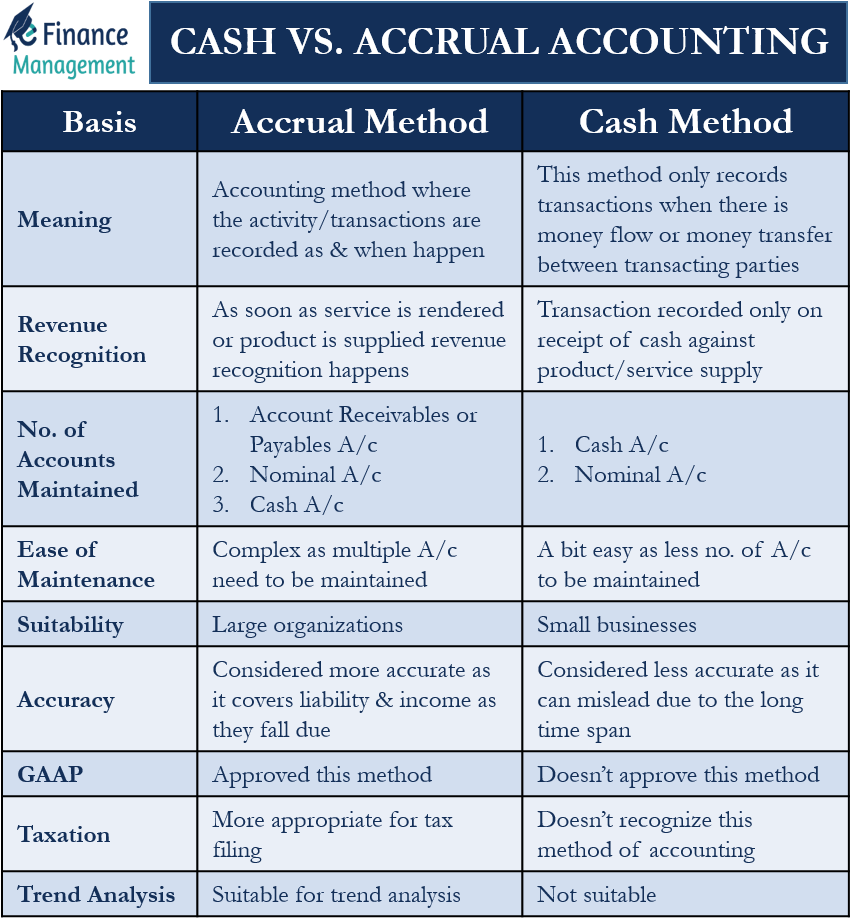
The following table provides a clear, side-by-side comparison of the two methods.
4. A Practical Example: Cash vs. Accrual Profit
Let's solidify the difference with a clear numerical example. Imagine you run a consulting business and have the following transactions in March:
- You complete a project and send an invoice for $5,000 to your client.
- You receive a bill for $1,000 for subcontracting work related to that project.
- You pay $75 for office supplies that you were billed for in February.
- You receive $1,000 cash from a client for a project you completed and invoiced in February.
How would your March profit look under each method?
Cash-Basis Calculation:
- Income: You only count the cash you received: $1,000 (Transaction #4).
- Expenses: You only count the cash you paid: $75 (Transaction #3).
- March Profit (Cash Basis) = $1,000 - $75 = $925
Accrual-Basis Calculation:
- Income: You count the revenue you earned this month: $5,000 (Transaction #1).
- Expenses: You count the expenses you incurred this month to earn that revenue: $1,000 (Transaction #2).
- March Profit (Accrual Basis) = $5,000 - $1,000 = $4,000
As you can see, the reported profit is drastically different. The accrual method gives a truer picture of your March performance ($4,000 profit), while the cash method simply reflects the month's cash flow ($925 net cash increase).
5. Cash vs. Accrual in QuickBooks
This brings us to the practical application in QuickBooks, your target software. One of the powerful features of QuickBooks is its ability to toggle between cash and accrual reports, regardless of your company's default setting. This gives you and business owners incredible flexibility for analysis.
The following video is made by a bookkeeper and demonstrates this feature perfectly.
Cash vs. ACCRUAL system of accounting (which do I use as a bookkeeper?)
This video from FinePoints will show you exactly how to switch between cash and accrual reporting in QuickBooks and where to find the company's default accounting method.
Please watch from 07:07 to 08:01. This short clip is highly practical and shows you: How to switch a report's basis from cash to accrual (and vice versa) with a single click. Where to find the default accounting method in the 'Accounts and Settings' menu.
When you generate a report like the Profit and Loss statement, you can select which basis to use. This is what it looks like:

While you can switch reports easily, a business must choose one method as its official, default method for tax purposes and formal financial statements. Generally, small businesses without inventory may start with the cash basis, but they often switch to accrual as they grow, take on investors, or are required to by the IRS.
Conclusion
You've now learned the crucial difference between when transactions are recorded. This is not just a technical detail; it's a fundamental choice that shapes how the financial story of a business is told.
Key Takeaways:
- Cash Basis: Records transactions only when money changes hands. It's simple and shows the cash balance, but can be misleading about overall profitability.
- Accrual Basis: Records revenue when earned and expenses when incurred. It provides a more accurate picture of financial performance and is the standard for most businesses.
- The Key Principles: Accrual accounting is built on the Revenue Recognition Principle and the Matching Principle.
- QuickBooks Flexibility: QuickBooks allows you to run reports on either basis, providing valuable insights for different analytical needs.
Preview of the Next Lesson:
We've covered the "what" (account types), the "how" (debits/credits), and the "when" (cash/accrual). In our next lesson, we will focus on the "where." We'll explore the Chart of Accounts, which is the master list of all accounts a company uses to categorize its transactions, and look at the source documents (like invoices and receipts) that provide the evidence for these transactions.