Welcome to our next lesson. In our previous discussion, we explored the column space and null space, discovering how they reveal the output range of a matrix transformation and which inputs get mapped to zero. We concluded by hinting that a single number could tell us if a transformation "collapses" space. Today, we'll meet that number: the determinant.
This lesson will demystify the determinant of a square matrix. We will start by building a strong geometric intuition for what a determinant represents. Then, we will move from the "what" to the "how," learning the concrete steps to compute determinants for 2x2 and 3x3 matrices. This is a fundamental skill that connects many ideas in linear algebra and is a prerequisite for understanding concepts like matrix invertibility and eigenvalues.
1. The Geometric Meaning of the Determinant
Before we jump into formulas, it's crucial to understand what a determinant is. At its heart, the determinant is a scaling factor. When a matrix performs a linear transformation, it can stretch, squish, and rotate space. The determinant tells us by exactly how much the area (in 2D) or volume (in 3D) is scaled.
The phenomenal "Essence of linear algebra" series by 3Blue1Brown provides the best visual intuition for this concept.
The determinant | Chapter 6, Essence of linear algebra
This video masterfully illustrates the determinant as a measure of how a linear transformation scales area and volume.
Please watch the following segments: First, watch from the beginning to understand how the determinant is the factor by which area is scaled in a 2D transformation. Note what a determinant of zero implies about the transformation. This directly relates to our last lesson on rank and column space! Next, understand what a negative determinant signifies in terms of orientation. Finally, see how the concept extends to 3D, where the determinant measures the scaling of volume.
Let's summarize the key geometric insights from the video:
- Scaling Factor: The absolute value of the determinant, , tells you the factor by which area (in 2D) or volume (in 3D) changes after the transformation defined by matrix .
- Orientation: The sign of the determinant indicates whether the transformation flips the orientation of space.
- det(A) > 0: Orientation is preserved. In 2D, if was to the left of , it remains so after transformation.
- det(A) < 0: Orientation is inverted (like turning a sheet of paper over).
- Dimensionality Collapse:
- det(A) = 0: The transformation squishes space into a lower dimension (e.g., a plane into a line, or 3D space into a plane or line). This means the columns of the matrix are linearly dependent, and the matrix is not full rank. This is the crucial link to our last lesson!

2. Computing the Determinant
Now that you have the intuition, let's focus on the learning outcome: computing the value. We'll start with the simplest case and build from there.
For a 2x2 Matrix
The formula for a 2x2 matrix is straightforward. For a matrix , the determinant is:
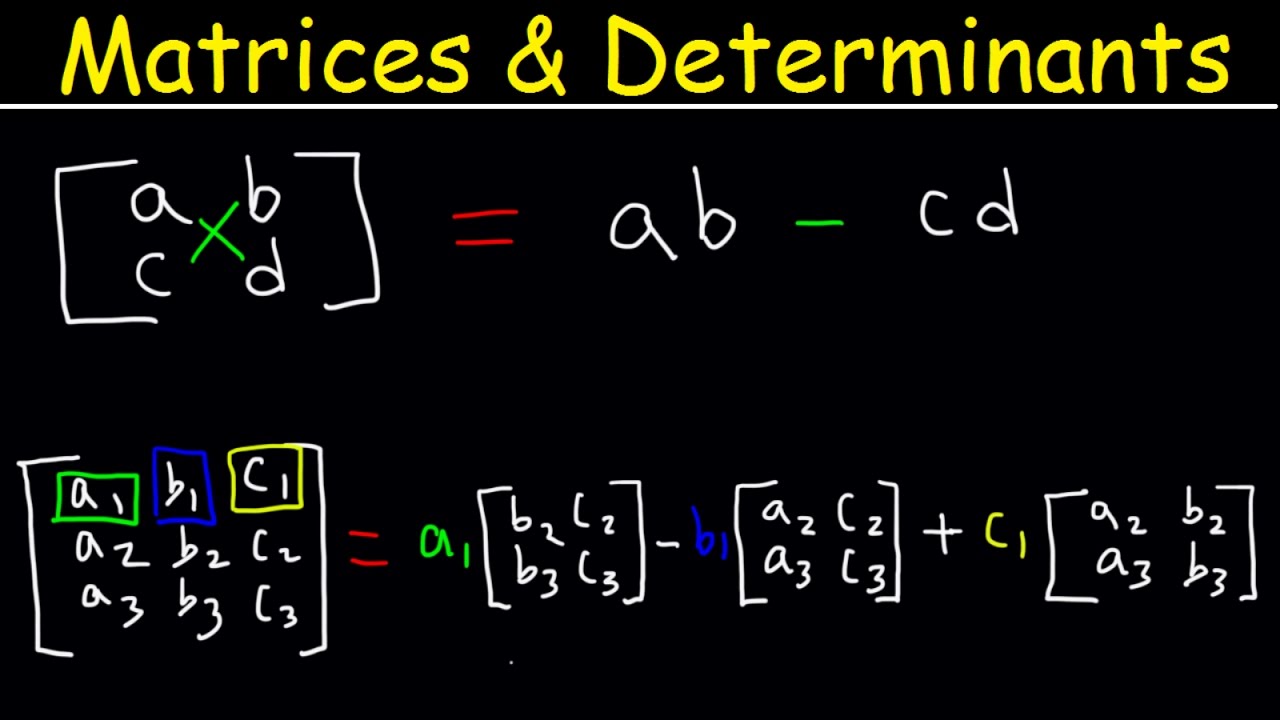
The following video provides a clear, step-by-step walkthrough of this calculation.
Determinant of 3x3 Matrices, 2x2 Matrix, Precalculus Video Tutorial
This tutorial from The Organic Chemistry Tutor provides clear, no-frills examples of calculating determinants.
Watch the first part of the video on 2x2 matrices. The two examples clearly demonstrate the ad - bc formula in action.
For a 3x3 Matrix: Cofactor Expansion
For matrices larger than 2x2, we need a more general method. The most common one is cofactor expansion. This method breaks down the determinant of an matrix into a sum of determinants of matrices.
For a 3x3 matrix , we can expand along the first row:
Notice the alternating signs (+, -, +). This pattern is crucial. Each element of the chosen row is multiplied by the determinant of the 2x2 "minor" matrix that remains after removing the element's row and column.
Let's see this method applied in practice.
Determinant of 3x3 Matrices, 2x2 Matrix, Precalculus Video Tutorial
The same video provides an excellent walkthrough of the cofactor expansion method for a 3x3 matrix.
First, watch the explanation of the general method. Then, follow the detailed worked example to solidify your understanding of the computation.
A handy shortcut that works only for 3x3 matrices is the Rule of Sarrus. You can learn more about it in the "Sarrus Rule for 3x3 Determinant Calculation" section of the mlforbeginners.com article (ID: LINK), which provides a quick visual way to compute the six products. While useful for quick hand calculations, it's more important to master cofactor expansion as it generalizes to any matrix size.
3. Key Properties and Practical Computation
Understanding a few key properties of determinants can simplify calculations and deepen your conceptual grasp.
The Determinant: How It Works and What It Tells Us
This article from DataCamp provides a concise summary of several important determinant properties.
Please read the section titled "Properties of Determinants". Pay special attention to these four properties: The determinant of an identity matrix is 1. Swapping two rows changes the sign. The determinant of a triangular matrix is the product of its diagonal elements. \det(AB) = \det(A)\det(B).
Given your interest in software tools, it's also worth knowing how to compute this in code. In Python, the NumPy library makes this trivial.
import numpy as np


# A 2x2 matrix
A = np.array([[3, 8],
              [4, 6]])


# A 3x3 matrix
B = np.array([[6, 1, 1],
              [4, -2, 5],
              [2, 8, 7]])


# Compute determinants
det_A = np.linalg.det(A)
det_B = np.linalg.det(B)

print(f"Determinant of A: {det_A:.1f}") # Output: -14.0
print(f"Determinant of B: {det_B:.1f}") # Output: -306.0
Notice that np.linalg.det() returns a floating-point number. As shown in the DataCamp article (section "The Determinant in Python and R"), this is the standard way to handle determinants in numerical computing.
Conclusion
In this lesson, we established both the "why" and the "how" of the determinant. You now understand it not just as a formula, but as a fundamental geometric property of a matrix transformation.
Key Takeaways:
- Geometric Meaning: The determinant of a matrix is the scaling factor of area/volume that its transformation applies to space. Its sign indicates if orientation is flipped.
- Linear Dependence: A determinant of zero means the matrix's columns are linearly dependent, and the transformation collapses space into a lower dimension.
- Computation (2x2): For , the determinant is .
- Computation (3x3): The method of cofactor expansion breaks the 3x3 determinant down into a signed sum of three 2x2 determinants.
In our next lesson, we will focus on solving systems of linear equations using matrix operations. You will see that the determinant plays the starring role in determining whether a system has a unique solution, which is directly tied to the concept of matrix invertibility.