Hello!
In our last lesson, we saw how Pericles used the vast wealth of the Athenian empire to fund the magnificent building program on the Acropolis. The Parthenon and its sister temples were not just religious monuments; they were glittering, tangible symbols of Athens' power, paid for by the tribute of subject states. This audacious display of wealth and dominance, however, came at a price.
This lesson directly follows that thread, focusing on the learning outcome: Analyze the growing tensions between Athens and other Greek states, particularly Sparta, caused by Athenian imperialism. We will examine how Athenian actions, from suppressing revolts to intervening in the affairs of others, created a climate of fear and resentment that set the Greek world on a path to its most destructive conflict: the Peloponnesian War. We will explore the "truest cause" of the war, as the great historian Thucydides famously put it: "the growth of the Athenians to greatness, which brought fear to the Lacedaemonians and forced them to war."
The Two Blocs: A Bipolar World
By the mid-5th century BC, the Greek world had consolidated into two major power blocs, creating a geopolitical landscape remarkably similar to the Cold War of the 20th century.

These two superpowers were fundamentally different:
| Athens & The Delian League | Sparta & The Peloponnesian League |
|---|---|
| Naval Power | Land Power |
| Democracy | Oligarchy |
| Commercial, Expansive | Agrarian, Conservative |
| Empire by Force | Alliance by Hegemony |
The Athenian Empire was a tightly controlled system where tribute-paying members were subject to Athenian authority. The Peloponnesian League was a looser military alliance where member states followed Sparta's lead in foreign policy but were largely autonomous. This fundamental opposition in values and political systems created a natural friction.
From Leader to Tyrant: The Nature of Athenian Imperialism
As we've discussed, the Delian League began as a voluntary alliance to fight Persia. However, Athens quickly began to assert its dominance.
- Suppression of Dissent: When league members like the island of Naxos (c. 471 BC) or Thasos (c. 465 BC) tried to leave, Athens responded with overwhelming military force, besieged them, confiscated their fleets, and forced them to pay tribute.
- Imposition of Athenian Standards: Athens began to impose its own currency, its system of weights and measures, and even its democratic political systems on allied states.
- The Treasury: As we covered last lesson, the movement of the league treasury from Delos to Athens in 454 BC was the ultimate symbol of this transformation. The money was no longer for the common good; it was for Athens' glory.
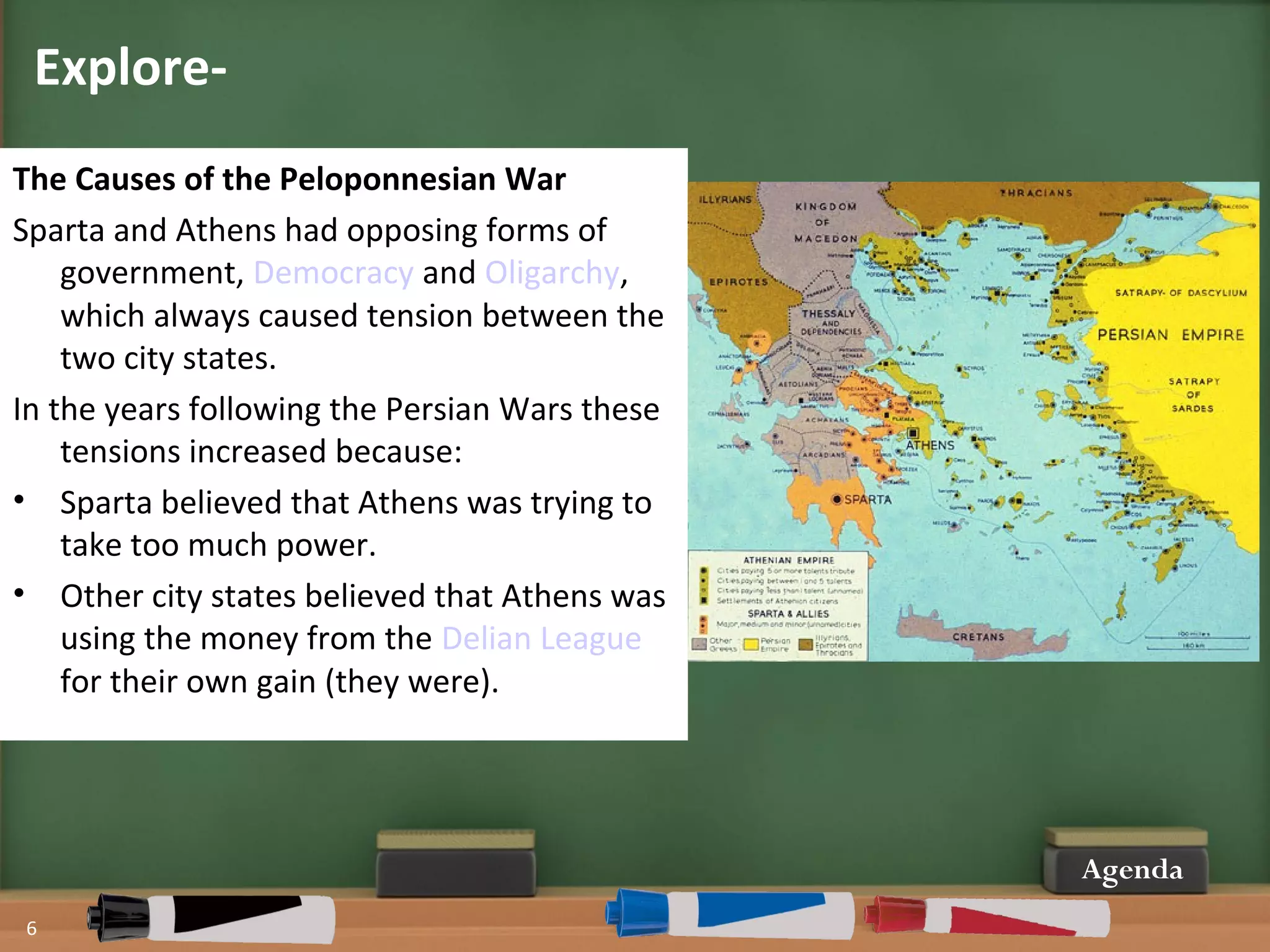
To get a clearer picture of how these imperial actions were perceived and how they escalated tensions, let's look at a few key events.
How and Why the Peloponnesian War Started - Ancient History DOCUMENTARY
The channel Kings and Generals provides a concise summary of how Athens consolidated its power and suppressed revolts, actions that did not go unnoticed by Sparta and its allies.
Watch the segment from 02:16 to 08:46. Pay attention to how the Delian League morphs into an empire, the specific actions that antagonized Sparta (like building the Long Walls and the Helot Revolt incident), and how Athens crushed revolts in cities like Samos.
The video you just watched mentions the "Helot Revolt" incident. This was a pivotal moment. Around 464 BC, a massive earthquake struck Sparta, triggering a large-scale revolt of their enslaved population, the helots. The Spartans, unable to storm the helots' mountain fortress, called on their allies for help, including Athens, who were known for their skill in siege warfare. Athens sent 4,000 hoplites. But the Spartans, fearing the "revolutionary" and "unorthodox" nature of the democratic Athenians, grew suspicious and sent them home—and only them.
This public dismissal was a grave insult. The Athenians, deeply offended, renounced their old alliance with Sparta and allied themselves with Sparta's arch-enemy, Argos. This diplomatic revolution set the stage for the first open conflict.
The First Peloponnesian War (c. 460–445 BC): A Dress Rehearsal
The tensions that had been simmering for years finally boiled over into a 15-year conflict that modern historians call the First Peloponnesian War. This was not yet the all-out "world war" that would come later, but a series of clashes that further hardened the lines between the two blocs.
To understand how this first war began and unfolded, we'll turn to a lecture by the renowned historian Donald Kagan.
17. The Peloponnesian War, Part I
Professor Donald Kagan masterfully narrates the chain of events that led from the Spartan snub to open warfare. His lecture explains how a local dispute spiraled into a major conflict, pulling in Athens and Sparta.
Please watch the segment from 14:31 to 28:52. Focus on how the quarrel between Megara and Corinth provided the 'spark' and why Athens' decision to ally with Megara was such a critical, escalatory step. Note Kagan's powerful conclusion about the origin of Corinth's 'bitter hatred' for Athens.
As Professor Kagan explained, the key events were:
- Corinth vs. Megara: A border war broke out between two of Sparta's allies.
- Sparta's Refusal: When Megara asked for help, Sparta, recovering from the helot revolt, refused to intervene.
- Megara's Defection: In a move that was only possible because there was now a second great power to turn to, Megara defected from the Peloponnesian League and allied with Athens.
- Athens' Gamble: The Athenians accepted the alliance. This was a huge strategic gain, as controlling Megara blocked the land route from the Peloponnese into Attica. But it was also an act of aggression against the Spartan alliance. Thucydides states that it was this event that began Corinth's deep-seated hatred for Athens.
The war that followed saw Athenian power reach its zenith. They conquered Boeotia, subjugated their old rival Aegina, and their fleet raided the Peloponnesian coast with impunity. However, a catastrophic defeat of an Athenian expeditionary force in Egypt in 454 BC, followed by revolts in their empire, forced Athens to the negotiating table.
The conflict ended with the Thirty Years' Peace in 446/445 BC. This treaty was a crucial moment. It wasn't a victor's peace but a recognition of the new bipolar reality.
- Athens gave up its land empire (like Boeotia).
- Sparta, in turn, formally recognized the legitimacy of the Athenian Empire.
- The treaty established clear spheres of influence and, crucially, included a clause for all future disputes to be settled by third-party arbitration.
On paper, this treaty should have ensured stability. In reality, it lasted less than 15 years.
Test your understanding!
Given your background, you can think of the Thirty Years' Peace as an API contract between two major systems (Athens and Sparta). The contract specified rules for interaction (no poaching allies) and an error-handling protocol (arbitration for disputes). Why might such a contract fail in the real world of geopolitics, even if the terms seem clear?
Show answer
Just like in software, a contract is only as good as the parties' willingness to adhere to it, especially when unforeseen edge cases arise or when one party feels the 'spirit' of the contract is being violated, even if the 'letter' is not. The system's stability depended on both Athens and Sparta acting in good faith. However, the underlying "codebase"—deep-seated rivalries, fear, ambition, and pressure from smaller allied "services" (like Corinth)—was fraught with potential bugs. A single provocative action, even if technically allowed by the treaty (like a neutral state joining one side), could trigger a cascade of failures that the arbitration protocol was too weak to handle.
The Peace Unravels: The Final Crises
The fragile peace was shattered by a series of crises in the 430s BC, each of which saw Athens act in a way that Sparta and its allies saw as aggressive and threatening. We'll examine these critical events through a detailed scholarly analysis.
The Causes of the Peloponnesian War
The article 'The Causes of the Peloponnesian War' by Jared McKinney provides an excellent, in-depth analysis of the three key events that led directly to the war's outbreak.
Please read the sections titled: 1. 'Stasis and Cuts of Meat: Epidamnus, Corcyra, and Corinth', 2. 'Cucumbers, Hares, and Suckling Pigs: Athens and Megara', and 3. 'The Straw that Broke the Camel’s Back: Potidaea'. These sections correspond to the three final crises.
Let's summarize the key points from your reading:
-
The Corcyra Affair (433 BC): A conflict between Corinth and its powerful but defiant colony, Corcyra. Corcyra was neutral but possessed the third-largest navy in Greece. When they sought an alliance with Athens, Pericles made a fateful choice. He forged a defensive alliance, trying to thread the needle: prevent Corinth from absorbing Corcyra's fleet without technically breaking the peace. However, when Athenian ships inevitably clashed with Corinthian ones at the Battle of Sybota, Corinth saw it as an act of war.
-
The Megarian Decree (c. 432 BC): Athens imposed a crippling economic embargo on its neighbor Megara (now back in the Peloponnesian League), banning them from all ports in the Athenian Empire. While Athens claimed this was for religious infractions, it was widely seen as a vindictive punishment and a way to strangle a Spartan ally without a direct military attack. It demonstrated Athens' willingness to use its imperial economic power as a weapon.
-
The Potidaea Dispute (432 BC): Potidaea had a unique and volatile status: it was a Corinthian colony but also a tribute-paying member of the Athenian Empire. Fearing a revolt influenced by Corinth, Athens issued an ultimatum demanding Potidaea tear down its walls and dismiss its Corinthian magistrates. This demand, backed by a Spartan promise to invade Attica if Athens attacked, led directly to Potidaea's revolt, which was immediately supported by Corinthian "volunteers." Athens besieged the city, putting them in direct military opposition to troops from Sparta's most important ally.
The Point of No Return
With Athenian and Corinthian-backed forces fighting at Potidaea, the Peloponnesian League convened at Sparta. The allies, led by a furious Corinth, demanded action.
The Causes of the Peloponnesian War
Let's return to the McKinney article to analyze the final debate at Sparta. This is one of the most famous and dramatic scenes in Thucydides' history.
Please read the sections 'The Spartan Decision for War', 'Corinth’s Desire for Vengeance and Pericles’ Hostility to Concessions', and 'Athens and The Last Chance for Peace'. This covers the speeches at the assembly and Pericles' final, unyielding stance.
The debate at Sparta laid bare the irreconcilable positions:
- Corinth accused Athens of being an insatiably aggressive power and shamed Sparta for its inaction.
- Athens, present on other business, argued that its empire was a necessary reality and that disputes should go to the arbitration promised in the peace treaty.
- The Spartan King Archidamus urged caution, warning that a war against a wealthy naval empire would be long and difficult.
- The Spartan ephor Sthenelaidas cut through the debate with a blunt appeal to honor: Athens was an aggressor, and they must be punished. "Vote for war," he commanded.
The assembly voted for war. Thucydides concludes that while they were influenced by their allies' arguments, the Spartans voted for war "because they were afraid of the further growth of Athenian power." In the final diplomatic exchanges, Sparta offered to keep the peace if Athens would simply revoke the Megarian Decree. Pericles, believing any concession would be seen as weakness and only invite further demands, refused. The path to war was now clear.
Conclusion
The spectacular growth of Athenian power, which funded the Acropolis and made Athens the cultural center of Greece, was the very thing that made war inevitable. Athenian imperialism was not a benign leadership; it was an aggressive and often brutal system of control that created deep-seated resentment among its subjects and profound fear in its rivals.
Key Takeaways:
- The Greek world became polarized between two blocs: the Athenian naval empire and the Spartan-led land alliance.
- Athenian actions—suppressing allies, intervening in disputes, and using its economic power as a weapon—were seen by Sparta and its allies, especially Corinth, as intolerably aggressive.
- The First Peloponnesian War was a "dress rehearsal" that ended in the Thirty Years' Peace, a treaty that recognized the bipolar world but failed to resolve the underlying tensions.
- A series of specific crises (Corcyra, Megara, Potidaea) shattered the peace, pushing a reluctant Sparta, goaded by its allies and its own fear, to declare that Athens had broken the treaty.
- Pericles' final refusal to make concessions, based on a strategy of unyielding firmness, closed the last door to a peaceful resolution.
Preview of the Next Lesson:
The debates are over. The die is cast. In our next lesson, we will enter the first phase of the Peloponnesian War itself: the Archidamian War. We will examine the opposing strategies of the two great powers—Pericles' plan to hide behind Athens' walls and use the navy, and Sparta's traditional strategy of invading and destroying the enemy's land.