Hello again!
In our last lesson, we explored the leadership of Pericles, who crafted a vision of Athens as both a radical democracy and a dominant empire. We saw how he justified Athens' imperial role by framing the city as the "School of Hellas," a cultural beacon for the Greek world. A key part of this vision was the transfer of the Delian League's massive treasury from the island of Delos to Athens.
Today, we will follow the money. This lesson focuses on the learning outcome: Explain how imperial tribute funded the construction of the Parthenon and the Acropolis building program. We will investigate how Pericles translated the silver and gold collected from subject states into the magnificent marble monuments that still define Athens today. This is where military and political power is converted directly into lasting cultural glory.
A Mountain of Silver: The Imperial Treasury
After the Persian Wars, the Delian League was formed for mutual defense, with member states contributing ships or money to a common treasury on the sacred island of Delos. As we've learned, Athens quickly turned this league into an empire. The decisive moment for our story today came in 454 BC.
City Minutes: The Athenian Empire
To quickly recap this crucial event, watch this very short clip from the Overly Sarcastic Productions' 'City Minutes: The Athenian Empire'.
Watch from 03:52 to 04:08. It bluntly states how Athens secured the league's treasury.
This act of "robbing the league," as the video puts it, placed a colossal fortune at Athens' disposal. But how much are we talking about? To understand the scale of the building program, we first need to appreciate the scale of the wealth that funded it.
History Summarized: The Acropolis
The video 'History Summarized: The Acropolis' provides an excellent sense of the sheer scale of the Athenian treasury and what that money was worth.
Watch the section from 02:05 to 02:54. Pay attention to the total amount in the treasury and the example given for the value of a single 'Talent' of silver.
As you just heard, the treasury contained nearly 10,000 talents of silver. A single talent—a standard unit of weight, roughly 26 kg or 57 lbs—could pay the wages for an entire warship's crew for a month. This was not just a city's budget; it was the war chest of an empire, now sitting in the heart of Athens.
Pericles' Grand and Controversial Proposal
Having this immense fortune was one thing; deciding to spend it on buildings was another. The funds were, officially, for the common defense of the league. The Persian threat, while diminished, was not entirely gone. Pericles had to persuade the Athenian Assembly to redirect this imperial income toward a domestic public works project of unprecedented scale.
This was a highly controversial move, and it faced stiff opposition.
Pericles' Economic and Architectural Policies
To understand the political battle Pericles fought, we'll turn to two excellent texts. The first, from Will Durant's 'The Life of Greece,' provides a vivid narrative. The second, from Britannica, offers a concise summary of the political arguments.
First, please read the text from 'The Life of Greece.' Start at the paragraph beginning with 'Since any form of government seems good that brings prosperity...' and read to the end of the paragraph that concludes with '...spare no cost till all were finished.' This section describes Pericles' motivations (including employing the citizens) and Plutarch's famous story of how he won the Assembly's support.
Pericles - Athenian Statesman, Restoring Preeminence
Now, let's read the Britannica article 'Pericles - Athenian Statesman' for a more direct account of the political opposition.
Read the three paragraphs starting from 'Whether to regain this tribute...' and ending with '...in actuality may not have influenced the voters very much.' This section details Pericles' proposal and the arguments made by his chief political rival, Thucydides, son of Melesias.
From these readings, we see the core of the debate. Pericles' opponents, led by Thucydides (not the historian!), accused him of "gilding and bedizening our city like a wanton woman" with funds that belonged to the allies.
Pericles' counter-argument was twofold:
- The Practical Argument: He framed the building program as a massive job creation scheme for the "undisciplined mechanic multitude," ensuring the state's wealth was shared among the citizens.
- The Imperial Argument: He asserted that as long as Athens provided the promised defense, it was not obliged to account for how the surplus tribute was spent.
As Plutarch's story shows, Pericles ultimately won the debate with a brilliant stroke of political theater, challenging the citizens' pride by offering to fund the project himself and put his own name on the buildings. They overwhelmingly voted for the city to bear the cost and claim the glory.
The Acropolis Reborn
With the funds secured and political opposition silenced, the work began around 447 BC. The site chosen was the Acropolis, the high rock in the center of Athens. This was not just prime real estate; it was a site of deep historical and religious significance. The temples that had once stood there had been destroyed by the Persians during their invasion in 480 BC, and their ruins had been left as a solemn reminder.
Pericles' program was therefore an act of reconstruction, defiance, and renewal—a statement that Athens had not only survived but had emerged stronger and wealthier than ever.
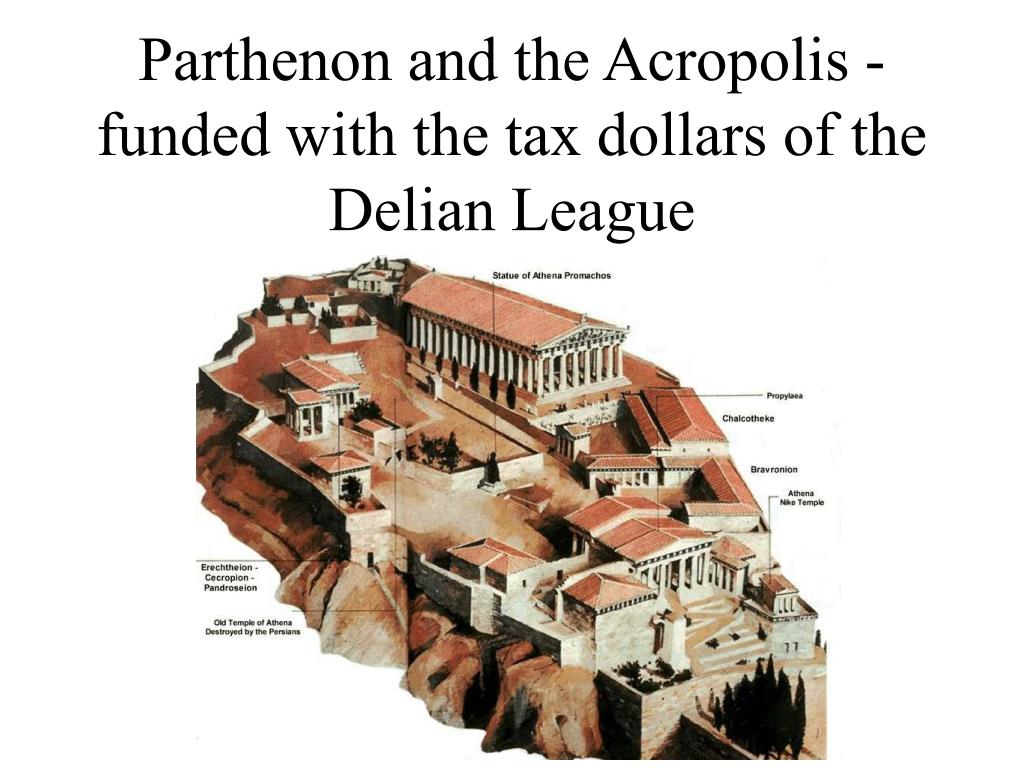
The Parthenon: Temple and Treasury
The centerpiece of the entire program was the Parthenon, the great temple dedicated to the city's patron goddess, Athena Parthenos (Athena the Virgin). It was an architectural marvel and a symbol of Athenian confidence. More than just a place of worship, it was also a tangible symbol of the empire's wealth.

Let's explore the Parthenon in more detail to see how deeply intertwined its construction and symbolism were with the imperial tribute that paid for it.
History Summarized: The Acropolis
Let's return to 'History Summarized: The Acropolis' for a look at the Parthenon itself. This segment explains its incredible architectural sophistication, its artistic themes, and its crucial role as a storehouse for wealth.
Watch from 04:03 to 06:52. Note the discussion of the building's cost, the symbolism of its sculptures, and what was kept inside.
The video highlights several crucial points:
- Immense Cost: The project was incredibly expensive. The colossal statue of Athena Parthenos alone, made of gold and ivory, likely cost 1,000 talents—more than the Parthenon building itself. This gold was designed to be removable, serving as a final emergency reserve for the state.
- Imperial Symbolism: The sculptures on the temple's exterior (the metopes) depicted mythological battles. These were clear allegories for the Greek—and specifically Athenian—victory over the "barbarian" Persians. The temple's art celebrated the military victory that had given birth to the empire.
- The Treasury: Crucially, the back room of the temple, the opisthodomos, was used to house the treasury of the Delian League. The tribute money was literally stored inside the monument it had paid for. The Parthenon was not just a symbol of Athena's glory, but a vault for Athens' power.
Test your understanding!
What message was Athens sending to its allies and rivals by moving the Delian League's treasury from Delos and eventually housing it within the Parthenon on its own Acropolis?
Show answer
By moving the treasury to Athens and placing it within the Parthenon, Athens sent a clear and unambiguous message: the league's funds were no longer a shared resource for mutual defense but were now Athenian property. Housing the treasury in their most sacred new temple, dedicated to their patron goddess, inextricably linked the empire's wealth with Athenian civic and religious identity. It was a powerful statement that Athens' glory and the empire's tribute were one and the same. For allies, it signaled their status as subjects; for rivals like Sparta, it was an arrogant display of power and wealth that they could not ignore.
Conclusion
The gleaming marble of the Acropolis was a direct product of Athenian imperialism. Pericles masterfully channeled the tribute—money collected for war—into a project that created jobs, solidified his political support, and left an unparalleled cultural legacy.
Key Takeaways:
- In 454 BC, Athens moved the Delian League's treasury to their city, gaining control of a massive fortune equivalent to thousands of talents.
- Pericles proposed using this surplus tribute to fund a grand building program on the Acropolis, overcoming political opposition by arguing it would provide employment and that Athens was not accountable for surplus funds as long as it provided defense.
- The Parthenon, the program's centerpiece, was both a temple to Athena and the new treasury, physically storing the imperial wealth that had built it.
- The entire project, from its funding to its artistic themes celebrating victory, was a powerful and deliberate statement of Athenian imperial power and cultural supremacy.
Preview of the Next Lesson:
While Pericles' building program turned Athens into an architectural marvel, it was built on a foundation of coercion and funded by what many Greeks saw as extortion. This spectacular display of wealth and power did not go unnoticed by Athens' great rival, Sparta, or by its increasingly resentful subjects. In our next lesson, we will analyze the growing tensions between Athens and other Greek states caused by Athenian imperialism, setting the stage for the devastating Peloponnesian War.