Hello! Welcome to the first lesson of our fifth module, "The Athenian Empire and the Age of Pericles."
In our last lesson, we concluded our study of the Second Persian War by analyzing the complex reasons for the stunning Greek victory. We saw how a combination of tactical superiority, strategic genius, unprecedented unity, and a bit of luck allowed a small coalition of city-states to defeat a superpower. That victory, however, left a power vacuum in the Aegean Sea. The Persian threat, though diminished, was still present, and the newly freed Greek cities of Ionia and the islands desperately needed a protector.
Today, we will explore how Athens stepped into that role. Our learning outcome is to explain the formation of the Delian League and its original purpose. We will trace the immediate aftermath of the Persian Wars, understand why the traditional Greek leader, Sparta, was unwilling to lead, and see how Athens seized the opportunity to create a new, powerful alliance that would define the next era of Greek history.
A Tale of Two Victors: Sparta's Retreat and Athens's Ambition
The victory in 479 BC was a shared one, but the two leading states, Sparta and Athens, had vastly different ideas about what should happen next. Sparta, a conservative land power, was primarily concerned with the security of the Peloponnese. Its hoplites were uncomfortable with long campaigns far from home, especially those requiring naval power. Athens, on the other hand, was now a dominant naval power, with its security and prosperity—especially its vital grain imports from the Black Sea—dependent on controlling the Aegean.
To understand how these diverging outlooks led to Athens taking charge, let's turn to a lecture from Professor Donald Kagan at Yale University.
14. The Athenian Empire (cont.)
In this segment from his lecture 'The Athenian Empire', Professor Kagan masterfully narrates the events immediately following the war. He explains the strategic disagreement between the allies and details the downfall of the Spartan commander, Pausanias, whose arrogance created the opening for Athens.
Please watch from 00:45 to 25:29 and then from 38:40 to 46:35. Focus on: The initial debate among the Greeks about whether to accept the Ionian island states into their alliance after the Battle of Mycale. The differing strategic interests of Sparta (insular, land-based) and Athens (maritime, commercial). The behavior of the Spartan regent Pausanias and how it alienated the other Greek allies. Why the allies ultimately rejected Spartan leadership and turned to Athens.
As the video explains, the situation came to a head with Pausanias. His tyrannical behavior and adoption of Persian luxuries discredited Spartan leadership. When the Spartans recalled him and sent a replacement, the allies, particularly the Ionian Greeks, refused him. They had lost faith in Sparta's commitment and competence to lead a naval campaign. The Spartans, reluctant to be there in the first place, accepted the rejection and effectively withdrew from the ongoing war against Persia.
This act created a leadership vacuum. The allies, still fearing a Persian return, needed a leader. They turned to the one state that had the power, the will, and the shared interest to protect them: Athens.
The Founding on Delos: "Hegemony by Invitation"
The result of this shift was a formal meeting in the winter of 478-477 BC on the sacred island of Delos, a central and religiously significant site for the Ionian Greeks. Here, a new alliance was born. Historians call it the Delian League.
Let's continue with Professor Kagan's lecture to understand the league's founding principles.
14. The Athenian Empire (cont.)
This next clip describes the formal creation of the Delian League. It details the league's objectives, its organizational structure, and the crucial fact that it was, at its outset, a voluntary alliance formed at the request of the members.
Watch from 46:35 to 1:01:25. Pay close attention to: The concept of 'hegemony by invitation.' The three stated aims of the league. The league's structure: the hegemon, the treasury (phoros), and the council (synod). The oath of perpetuity: 'until the iron floats.'
To solidify these key details, let's review a concise summary.
Delian League | Ancient Greek Alliance & History
This encyclopedia entry from Britannica provides a clear, factual summary of the Delian League's formation and structure.
Read the first two paragraphs of the article, which define the league, its leader, its headquarters, and its core organizational setup.
Let's summarize the key characteristics of the league at its founding:
- Leader (Hegemon): Athens. Athenian generals would command all league campaigns.
- Headquarters: The sacred island of Delos, where the league's treasury was kept and its council met.
- Purpose:
- To guarantee the freedom of the Greek states from Persian rule.
- To seek revenge on Persia for the destruction caused during the invasion.
- To plunder Persian lands as compensation for Greek losses ("to ravage the territory of the King").
- Membership & Contributions: Members swore a perpetual oath of allegiance. They had to contribute either ships and crews or an annual monetary payment (phoros). Aristides "the Just," an Athenian general renowned for his fairness, was chosen to assess the initial contributions for each member state.
- Governance: A council (synod) was established on Delos, where each member state, regardless of size, had one vote.
At first glance, the "one state, one vote" system seems remarkably fair. However, the reality was different. Athens, with its overwhelming naval power and prestige, held immense influence over the many small, vulnerable island states. These smaller states would almost always vote with Athens, ensuring Athens could pass any motion it desired.
This structure is reminiscent of some large open-source software projects. While there might be a democratic governance model on paper, a single large corporation that contributes the vast majority of the code and resources can effectively steer the project's direction. The smaller contributors align with the major power because their interests are tied to the project's success, which depends on that power. Similarly, the small Aegean islands needed Athens for their survival and had every incentive to follow its lead.
Test your understanding!
A wealthy island state like Naxos joins the Delian League in 478 BC. What was the most compelling reason for them to do so, and what were they agreeing to?
Show answer
The most compelling reason for Naxos to join was self-preservation. The Persian Empire, though defeated in mainland Greece, was still intact and powerful. As an island in the Aegean, Naxos was vulnerable to a Persian counter-attack. The league, led by the formidable Athenian navy, offered the only credible security guarantee. By joining, they were agreeing to a permanent alliance where they would contribute ships or money annually to a common military force, commanded by Athens, for the collective defense and liberation of all Greek states.
The New Power Blocs
The formation of the Delian League fundamentally reshaped the political map of the Greek world. What had been a temporary, pan-Hellenic alliance against Persia now split into two distinct and permanent spheres of influence.
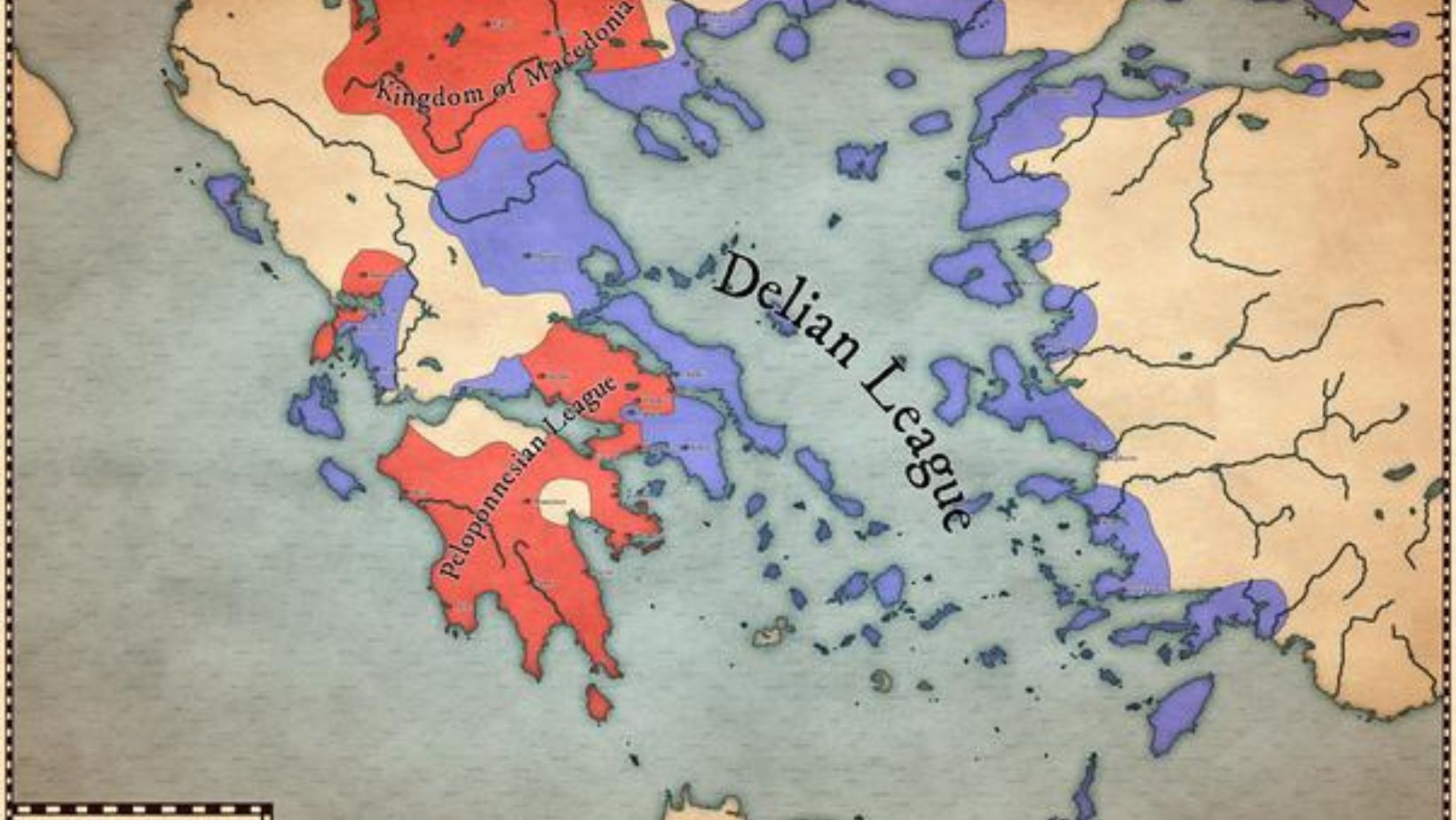
This division into two major power blocs—one a naval empire-in-the-making, the other a traditional land power—set the stage for the rivalry that would dominate the next 50 years of Greek history.
Conclusion
The Delian League was not born of Athenian aggression, but of a genuine need for collective security in the dangerous aftermath of the Persian Wars.
Key Takeaways:
- The Delian League was formed in 478/477 BC to fill the leadership vacuum created by Sparta's withdrawal from the ongoing conflict against Persia.
- Its original purposes were to protect Greek states from Persian reconquest, exact revenge, and gain compensation through plunder.
- It was initially a voluntary alliance, formed when the Ionian and island states "invited" Athens to become their hegemon (leader).
- The league was a naval alliance funded by contributions of ships or money (phoros) from its members, with its treasury and council originally on the sacred island of Delos.
- The league's structure, with Athens in permanent command and controlling the league's finances, contained the seeds of its eventual transformation into an Athenian empire.
Preview of the Next Lesson:
For the first few years, the league was a resounding success, liberating more Greek cities and securing the Aegean. But what happens when the common enemy begins to fade? What happens when a member state decides the threat is gone and wants to leave the "permanent" alliance? In our next lesson, we will see how Athens responded to these challenges, using the league's own power to enforce membership and beginning the transformation from a league of allies into an empire of subjects.