Hello! Welcome to your first lesson in our course on Ancient Greece. I'm excited to embark on this journey with you. Given your interest in both military history and the broader cultural context, we're going to start at a fascinating and foundational moment.
This lesson will explore the transition from the Greek Dark Ages to the Archaic period, covering roughly 1200 BCE to 800 BCE. Understanding this period is crucial because it's the crucible in which the defining features of Classical Greece were forged. The collapse of an older world gave way to new technologies, new social structures, and a new sense of identity that set the stage for the rise of the city-states (poleis), the hoplite warrior, and the cultural achievements we'll explore later. Let's begin our story.
The End of an Era: The Bronze Age Collapse
Our story starts not with a beginning, but with an ending. Before the "Dark Ages," Greece was dominated by the Mycenaean Civilization (c. 1700-1100 BCE). This was a world of powerful kings, massive palaces like the one at Mycenae, and extensive trade networks. They were the protagonists of Homer's epics, a Bronze Age culture of warriors and merchants.
Around 1200 BCE, this world fell apart. This event, part of a wider "Bronze Age Collapse" across the Mediterranean, saw the destruction of palaces, the breakdown of trade, and the disappearance of their complex writing system, known as Linear B.
To understand what happened and why this subsequent period is called "dark," please watch the first few minutes of the following video.
Scattered Candles in the Night – Civilization during the Greek Dark Age (c. 1100-750 BC)
This video from History with Cy provides a concise overview of the fall of the Mycenaeans and the beginning of the period we call the Greek Dark Age.
Please watch from the beginning until timestamp 02:43. Pay attention to the reasons why historians label this era a 'Dark Age'.
As the video explains, the term "Dark Age" primarily refers to the lack of written records and the decline in material culture compared to the preceding Mycenaean era and the later Archaic period. The population plummeted, trade ceased, and the grand structures of the past were abandoned.
Life in the "Darkness": Reset and Transformation
While the term "Dark Age" suggests a complete cultural void, the reality is more complex. It's better to think of it as a period of radical simplification and transformation. Society restructured itself from large, palace-centered kingdoms into small, isolated, and self-sufficient farming communities.
Let's look at the key characteristics of this period.
A New Social and Political Landscape
With the old kings and their bureaucracies gone, power devolved to local leaders. These figures, often referred to by the title basileus (which would later come to mean 'king'), were essentially chieftains or "big men" of their villages. Their authority was personal, based on their ability to provide protection, settle disputes, and lead raids.
The Iron Age Begins
One of the most significant changes was technological. The collapse of trade routes made it difficult to obtain copper and especially tin, the essential components of bronze. In response, Greek smiths turned to a more readily available local resource: iron.
This transition wasn't just a simple substitution. Iron, once mastered, produced harder and more durable tools and weapons. This shift laid the technological foundation for the agricultural recovery and military developments of the coming centuries.
To continue our exploration of life during this time, let's return to the video. It challenges the purely negative view of the Dark Age and highlights these important developments.
Scattered Candles in the Night – Civilization during the Greek Dark Age (c. 1100-750 BC)
This next segment delves into what society was actually like, highlighting the adoption of iron and the persistence of culture.
Watch from 02:43 to 15:38. Focus on: The migrations that occurred during this period. The crucial shift from bronze to iron. The evidence from sites like Nichoria and Lefkandi that shows a more complex picture than total collapse.
The discoveries at Lefkandi, with its large chieftain's house and graves filled with gold and exotic goods, are a powerful reminder that even in this period of general poverty and isolation, pockets of wealth, trade, and social hierarchy persisted. It shows that the flame of Greek civilization was not extinguished, but rather burned in scattered, smaller hearths.
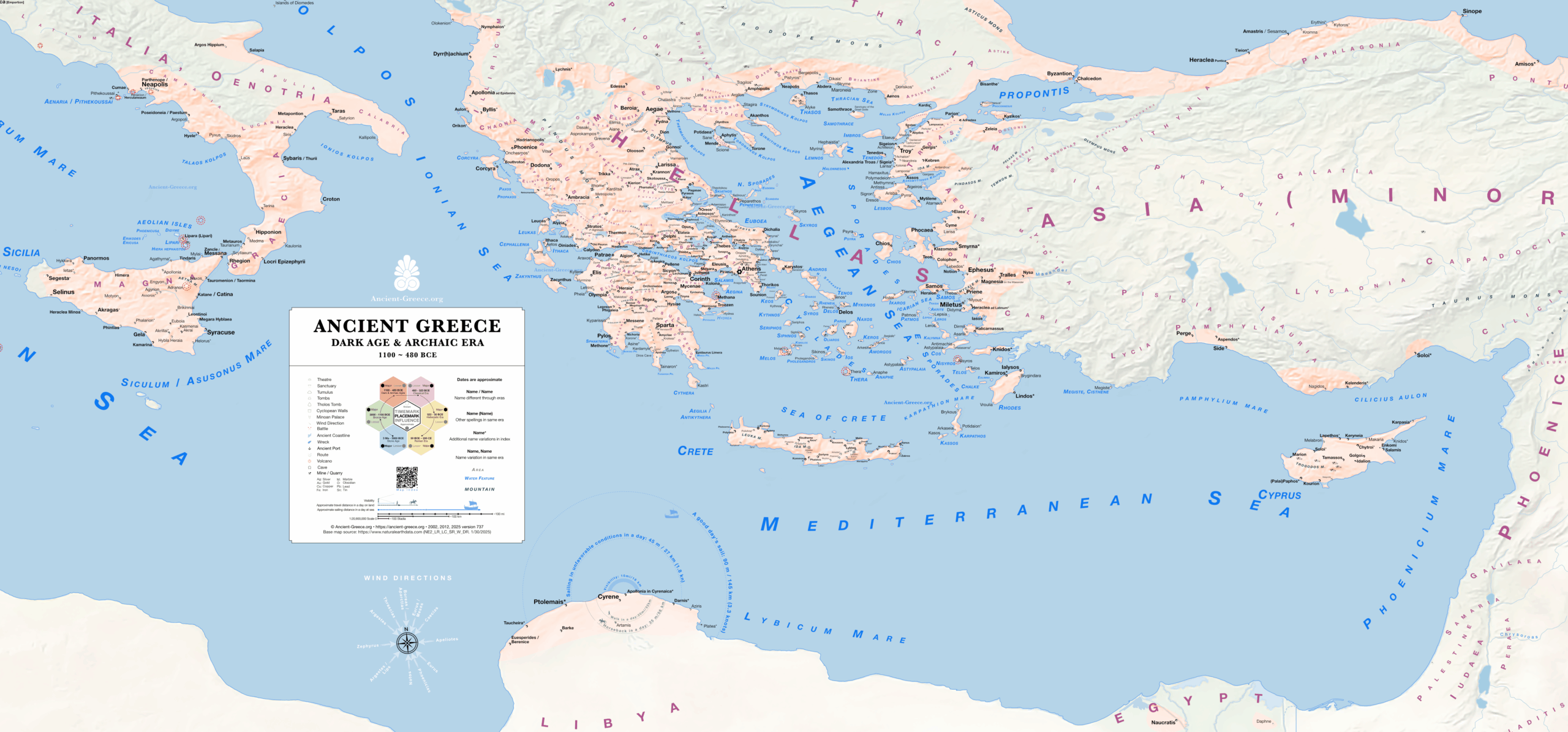
The Dawn of the Archaic Age (c. 800 BCE onwards)
Around the 8th century BCE, the pace of change accelerated dramatically, heralding a new era: the Archaic Period (c. 800 - 490 BCE). This was a time of explosive growth and innovation, driven by renewed contact with the wider world.
To get a clearer picture of this transition, please read the first section of the following web resource.
Chapter 5: The Archaic Age of Greece
This chapter from the text 'The Origins of the Modern World' clearly outlines the major developments that marked the end of the Dark Age and the beginning of the Archaic period.
Please read the section titled 'The Archaic Age and Greek Values'. Focus on the three major changes it identifies: renewed foreign contact, the adoption of the alphabet, and the writing down of the Homeric epics.
As the text highlights, three interconnected developments were particularly crucial in shaping this new age:
-
The Return of Literacy: Contact with the Phoenicians, master traders from the Levant, led to the single most important innovation of the era: the Greek alphabet. The Greeks borrowed the Phoenician script but critically adapted it by adding vowels, creating the first true alphabet. This process of borrowing and fundamentally improving a system might resonate with principles in software development, where existing libraries or frameworks are often adapted for new purposes. This new, easy-to-learn script unlocked the ability to record literature, law, and philosophy.
-
Panhellenism and a Shared Identity: For the first time, the scattered Greek-speaking communities began to see themselves as part of a single culture, a phenomenon we call Panhellenism ("all-Greek"). This was fostered by:
- The Homeric Epics: The Iliad and Odyssey, now written down, provided a shared history and a common set of heroic values, like aretê (excellence).
- Panhellenic Sanctuaries: Sites like Delphi (dedicated to Apollo) and Olympia (dedicated to Zeus) became centers where Greeks from all over the world would gather.
- The Olympic Games: First held in 776 BCE, this festival brought Greeks together for peaceful competition, reinforcing their shared identity.
-
Population Growth and Colonization: As farming techniques improved and society stabilized, the population boomed. The rocky terrain of Greece couldn't support everyone, leading to a massive wave of colonization. From about 750 BCE, Greeks founded new city-states across the Mediterranean, from the Black Sea to Sicily and southern Italy (Magna Graecia).

This combination of a new script, a shared cultural identity, and a rapidly expanding world laid the groundwork for the political and social innovations of the Archaic Age.
Test your understanding!
Imagine you are an archaeologist who has just excavated two small, separate settlement sites in Greece.
- Site A dates to 900 BCE. You find simple pottery with zigzag patterns, iron farming tools, and the foundations of a single large house that is bigger than the others. There are no written artifacts.
- Site B dates to 700 BCE. You find pottery decorated with stylized human figures, iron weapons, and a clay shard with a few letters of the Greek alphabet scratched into it. You also find a small statue that seems to have been imported from Egypt.
Based on what you've learned, how would you classify each site, and what do the artifacts tell you about the differences between these two moments in Greek history?
Show answer
-
Site A is a typical late Dark Age settlement. The iron tools show the technological shift of the period. The simple geometric pottery is characteristic of the era before renewed foreign influence. The single large house suggests the presence of a local basileus or chieftain, reflecting the social structure of the time. The lack of writing is a key indicator of the Dark Age.
-
Site B clearly belongs to the early Archaic Period. The more advanced pottery, showing human figures, reflects artistic development. The alphabet shard is a definitive marker of the return of literacy. Finally, the imported Egyptian statue is direct evidence of renewed long-distance trade and contact with other civilizations. The site as a whole points to a community that is more populous, wealthier, and more connected to the outside world than the one at Site A.
Conclusion
In this lesson, we've traced the remarkable transformation of the Greek world from the ashes of the Mycenaean collapse to the vibrant dawn of the Archaic Age.
Key Takeaways:
- The Greek Dark Age (c. 1200-800 BCE) was triggered by the Bronze Age Collapse, leading to depopulation, the loss of writing, and the end of long-distance trade.
- This era was not a void but a formative period of simplification and change, characterized by the rise of local chieftains (basileis) and the crucial technological shift from bronze to iron.
- The transition to the Archaic Period was marked by a set of interconnected developments around the 8th century BCE: renewed trade, the adoption of the alphabet, the rise of a Panhellenic identity through epics and games, and a wave of colonization across the Mediterranean.
These developments created a dynamic and interconnected Greek world, but they also gave rise to a new and revolutionary form of political organization.
Preview of the Next Lesson:
In our next lesson, we will explore the most important creation of the Archaic Age: the polis, or city-state. We will analyze how this unique political unit emerged and became the fundamental building block of Greek civilization, setting the stage for the epic conflicts and cultural achievements to come.