Hello! Welcome back to our study of Ancient Greece.
In our last lesson, we saw the Greek world emerge from the "Dark Age" with a new alphabet, a shared cultural identity, and a booming population that was beginning to expand across the Mediterranean. This rapid growth and newfound connectivity set the stage for one of the most significant developments in Western history: a new way of organizing society.
Today, we'll explore the learning outcome: Explain how the polis (city-state) emerged as the fundamental Greek political unit. We will discover that the polis was far more than just a city. It was a revolutionary concept of community, citizenship, and government that became the defining feature of Classical Greece and the bedrock upon which its achievements—and its conflicts—were built.
What Was a Polis?
At its most basic, a polis was a self-governing community that included an urban center and the surrounding agricultural land, or chora. Let's start with a video that introduces this monumental development.
Ancient Greek History - Archaic Greece and the Greek Polis - 04
The channel Historyden provides a clear introduction to the Archaic Period and the rise of the polis. This first segment will set the stage, connecting back to our previous lesson.
Please watch from the beginning to 02:51. This will serve as a quick bridge from the Dark Ages to the era of the polis.
The video re-emphasizes that the Archaic Period was a transition out of the Dark Ages, with the polis being a central feature. Now let's look at the physical structure.
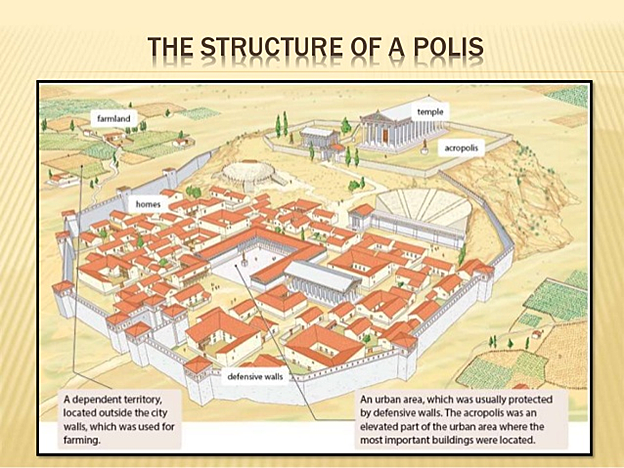
This physical integration of city and country was key, but the true innovation of the polis was conceptual. To the Greeks, the polis was not the stone walls or buildings, but the people themselves.
To explore this idea, let's turn to a lecture by the eminent historian Donald Kagan.
CLCV 205 - Lecture 4 - The Rise of the Polis
Professor Donald Kagan's lecture on the 'Rise of the Polis' offers fantastic insight into the Greek mindset. This excerpt explains the conceptual nature of the polis, which was a radical departure from other ancient city-states.
Please read from the beginning of the section titled 'Chapter 4. The Features and Importance of the Polis' down to the paragraph that discusses Themistocles and the plan to move Athens to Italy (the end of the sixth paragraph). Focus on the quotes from Alcaeus and Thucydides and the powerful idea that 'men are the polis.'
As Kagan explains, this idea had real-world consequences. The people of Phocaea, rather than submit to Persian rule, abandoned their physical city and sailed away to found a new one in France, believing they were taking their polis with them. Similarly, the Athenian commander Themistocles argued that the true Athens was its citizens aboard their ships, not the physical city left behind for the Persians to sack.
This leads to another revolutionary concept born from the polis: the citizen (polites). In the great empires of Egypt or Persia, an individual was a subject of the king. The polis, however, was a community of citizens who were, at least in theory, free men who shared in the governance of their community.
The Engine of Change: The Independent Farmer
So, how did this revolutionary idea come about? It wasn't designed by a committee; it grew organically from a fundamental change in how people lived and worked the land.
During the Dark Ages, society was dominated by aristocratic clans who controlled large estates, primarily for grazing and raiding. But as the population grew in the 8th century BCE, a new kind of agriculture took hold.
The following reading, from another of Professor Kagan's lectures, explains this crucial transformation, drawing on the work of historian Victor Davis Hanson. This shift is the socio-economic 'source code' for the polis.
CLCV 205 - Lecture 5 - The Rise of the Polis (cont.)
This reading explores the theory that the emergence of the independent family farm was the key driver behind the rise of the polis. It created a new kind of self-reliant individual who would become the future citizen.
Please read the sections 'Chapter 3. Greek Farmers and the Function of the Polis' and 'Chapter 4. Property Holding and Internal Colonization'. Focus on the concept of the oikos (household) obtaining its own plot of land (kleros) and why this stability incentivized investment and changed the farmer's mindset.
This was a profound shift. The emergence of the family farm—a small, privately-held plot of land (kleros) passed down through generations—created a new social class. These were not serfs or dependents, but independent farmers who owned their land.
This new kind of intensive farming, focused on the classic Mediterranean triad of grain, grapes, and olives, required year-round work and significant investment. The farmers who succeeded became self-sufficient and fiercely independent. They had a deep, personal stake in the land and the community's stability and defense. This new man—the independent, landowning farmer—was the prototype for the citizen-soldier (hoplite) who would become the military and political backbone of the polis, a topic we will dive into in a future lesson.
From Farming Community to Political Unit
These new, robust farming communities naturally needed a way to manage their affairs. How were they governed?
Initially, power remained with the traditional landowning aristocracy. These noble families formed councils that made decisions and interpreted the law. Let's watch a short clip that explains this early political structure.
An Introduction to Archaic Greece (c. 750-500 BC)
This clip from History with Cy provides a good overview of the typical government structure in the early Archaic polis.
Watch from 10:50 to 13:38. Pay close attention to the roles of the oligarchs (aristocrats), magistrates, the council, and the assembly.
As the video illustrates, the typical early polis was an aristocratic republic or oligarchy (rule by the few). Power was concentrated in a council of nobles, while a broader assembly of citizens had limited, though important, powers, especially concerning warfare.
Crucially, this system was not static. The growing class of independent, non-aristocratic farmers would eventually demand a greater voice in a state they were expected to defend. This tension between the aristocracy and the common citizen would be a major driver of political change throughout Greek history, leading to periods of tyranny and, most famously in Athens, the development of democracy.
Test your understanding!
Consider the worldview of three different individuals living in Greece:
- A palace scribe in Mycenae, c. 1300 BCE.
- A farmer in a small, isolated village, c. 900 BCE (the Dark Age).
- An independent farmer living near Athens, c. 700 BCE (the early Archaic Period).
How would their sense of community and loyalty differ? To whom or what would each feel the most allegiance?
Show answer
- The Mycenaean scribe's loyalty would be to the wanax (the king) and the palace bureaucracy. His community is the entire kingdom, but his identity and well-being are tied directly to the centralized power structure he serves.
- The Dark Age farmer's loyalty would be intensely local and personal: to his family and perhaps to the local chieftain (basileus) who offers protection. His world is small, and his sense of community likely extends no further than his village and its immediate neighbors.
- The Archaic farmer's loyalty is more complex and represents a new development. He has allegiance to his own family and land (oikos and kleros), but also a growing sense of allegiance to the wider community of fellow landholders—the polis. He understands that his personal prosperity and security are intertwined with the security and good governance of the entire community. He is beginning to think like a citizen.
Conclusion: The Birthplace of Justice and Identity
The polis was more than just a new political or economic structure; it became the very center of Greek culture and identity. The Greeks came to believe that a truly good and just life could only be lived as a citizen of a polis. It was the community that provided law, order, and the environment for human excellence to flourish. This was a radical idea: that human beings, through collective governance and good laws (eunomia), could shape their own character and create justice on earth.
Key Takeaways:
- The polis was a self-governing community of citizens, defined by its people rather than its physical location.
- Its emergence was driven by a social and economic revolution: the rise of the independent family farm, which created a new class of self-reliant individuals.
- Early poleis were typically aristocratic republics, where noble councils held power, but this set the stage for future political conflict and evolution.
- The polis became the core of Greek identity, seen as the only place where justice and a virtuous life were possible, and it demanded the fierce loyalty of its citizens.
Preview of the Next Lesson:
The Greek world was home to over a thousand of these independent city-states. Why did Greece develop as a collection of fiercely independent poleis instead of a single, unified empire like Egypt or Persia? In our next lesson, we will explore how Greece's unique and rugged geography shaped its political destiny, reinforcing the independence of the polis and fostering both intense rivalry and a reliance on the sea.
