Hello!
In our last lesson on Greek drama, we saw how playwrights, especially Euripides, brought complex and powerful women like Medea to the center of the stage. This might suggest a society where women had a prominent public voice. However, the reality of daily life in Classical Athens was starkly different. Today, we step away from the theater and into the Athenian home to understand the true social and legal position of women.
This lesson will focus on the learning outcome: Explain the position of women in Athenian society and their role within the oikos (household). We'll examine their limited rights in a male-dominated world and explore their crucial, though often invisible, responsibilities within the family home.
A key challenge in this topic, as the article "Well Behaved Women" notes, is that our sources were almost exclusively written by men. Their perspective shapes everything we know, often focusing on an idealized, silent, and secluded woman. Our task is to piece together a more complete picture from these biased accounts.
A World Without a Public Voice: Legal & Social Status
In the democracy that Athens pioneered, a citizen was a man. For women, the political world was completely inaccessible.
To get a clear, direct sense of their legal standing, let's start with a short video clip.
Historian Answers Google's Most Popular Questions About Ancient Greek Women
The historian in this History Hit video provides a direct and unambiguous answer to the question of women's involvement in Athenian democracy.
Please watch from 02:24 to 03:16. Notice how the male citizen's identity was defined in opposition to women, slaves, and foreigners.
As you just heard, women had no political rights. They could not vote, hold office, or even represent themselves in court. Their entire legal and economic existence was managed by a male guardian, their kyrios (κύριος), which translates to "lord" or "master."
- Initially, a woman's kyrios was her father.
- Upon marriage, her husband became her kyrios.
- If her husband died, her closest male relative (often her son or an uncle) would become her kyrios.
This guardianship controlled every major aspect of a woman's life, from marriage arrangements to financial transactions. The following video and reading expand on these profound limitations.
The Roles, Rights and Lives of Women in Ancient Greece
This video from World History Encyclopedia details the practical implications of this system for a woman's life, from birth to marriage and beyond.
Please watch from 02:32 to 05:58. Pay attention to the details of marriage, property (including the dowry), and divorce.
Athenian Women in the Classical Period
To add depth to what you've just seen, this article from Antiquity Reconsidered explains the patriarchal ideology that underpinned these laws, citing the philosopher Aristotle's view of women as naturally inferior.
Read the sections that begin with 'During the fifth century, society was patrilineal...' and 'Hesiod's outlook was that a man's suffering...'. These sections explain the concept of the Kyrios and the nature of marriage as a transaction.
From these resources, we can see a clear picture:
- Marriage: It was a transaction between men (the father and the husband), arranged when a girl was typically 13 or 14. Her consent was not required. The primary purpose was to produce legitimate male heirs to continue the family line.
- Property: A woman could not own property in her own right. Even her dowry, a sum provided by her father, was administered by her husband. Its main purpose was to support her and to be returned if the husband initiated a divorce, acting as a disincentive for him to do so lightly.
- Inheritance: If a father died with no sons, his daughter became an epikleros—an heiress. However, she was not the owner of the property but a conduit through which it passed. She was legally required to marry her nearest male relative to ensure the estate stayed within the family.
The Woman's Domain: The Oikos
While men operated in the public sphere of the agora and the assembly, the domain of a respectable Athenian woman was the oikos (οἶκος), the household. This was not merely a domestic space but the fundamental economic and social unit of Athenian society. The woman was its manager.
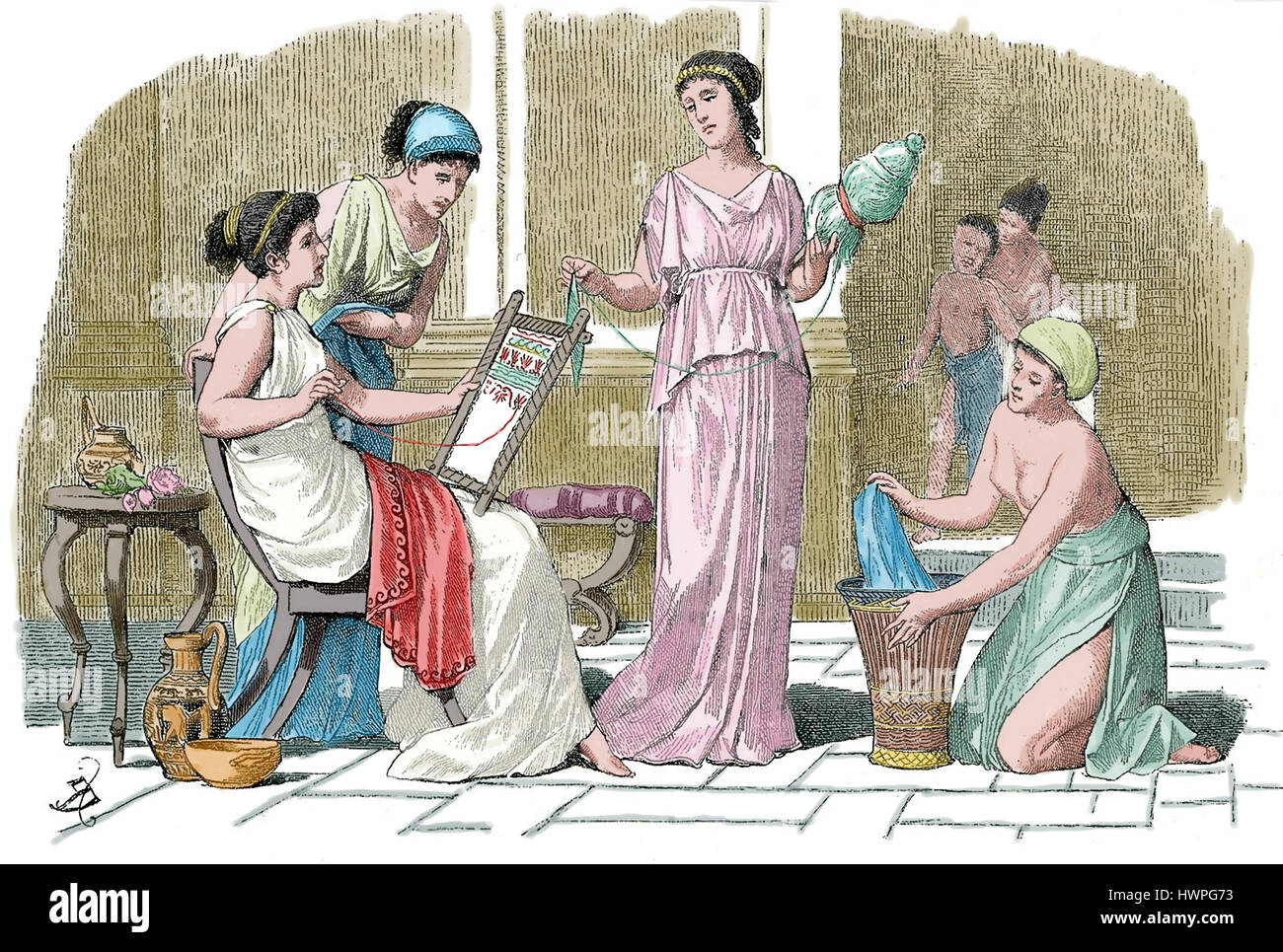
Her primary duties within the oikos included:
- Childbearing and Rearing: Producing children, especially male heirs, was her most critical function.
- Household Management: She supervised the family's supplies, managed the household slaves, and controlled the budget for daily affairs.
- Textile Production: Weaving cloth for the family's clothing and for sale was a major and respected female occupation, contributing significantly to the household economy.
The home was often physically divided to reflect this gendered separation.
Athenian Women in the Classical Period
Let's return to the 'Athenian Women in the Classical Period' article. It contains a quote from an ancient law court speech that provides direct evidence for the separation of space within the house.
Read the section that begins 'The ways in which women were treated...'. Note the mention of the 'Gynaeceum' (women's quarters) versus the 'Andron' (men's quarters).
This ideal of seclusion, however, was largely a luxury of the wealthy.
Historian Answers Google's Most Popular Questions About Ancient Greek Women
The historian in this video discusses the scholarly debate around female seclusion and how a woman's socioeconomic status determined her ability to remain indoors.
Please watch from 06:27 to 07:50.
For poorer women, the need to fetch water, sell goods in the market, or work as laborers meant that the ideal of staying unseen in the home was simply not practical.
Test your understanding!
An Athenian man dies, leaving behind his wife and one 14-year-old daughter, but no sons. His brother is his closest living male relative. According to Athenian law and custom, what is the most likely outcome for the daughter and the family property?
Show answer
The daughter becomes an epikleros. She cannot inherit the property herself, but she becomes the vessel through which it is passed. She will be legally compelled to marry her father's brother (her uncle) to keep the property and the family line intact. Her mother would now come under the guardianship (kyrios) of that same uncle.
Life Beyond the Oikos
While the oikos was their primary sphere, there were two key areas where women had a significant presence outside the home: religion and sex work.
1. Religion: A Sphere of Influence
Religion was the one area of public life where women were not only visible but held positions of great importance and respect.
The Roles, Rights and Lives of Women in Ancient Greece
This final segment from the World History Encyclopedia video highlights the striking contrast between women's limited secular rights and their prominent role in religious life.
Please watch from 09:41 to 12:28. Focus on the importance of goddesses like Athena and the exclusive female festivals like the Thesmophoria.
As priestesses and participants in major festivals, women were essential to maintaining the city's relationship with the gods. This granted them a degree of public dignity and agency unavailable to them anywhere else.
2. Courtesans and Prostitutes
At the other end of the social spectrum were women who lived entirely in the public eye. It is important to distinguish between two main groups:
- Pornai (πόρναι): Common prostitutes, often slaves, who had no social standing.
- Hetairai (ἑταῖραι): "Companions." These were educated, cultured courtesans who offered intellectual and artistic companionship as well as sex.
Because they operated outside the bounds of respectable society, some hetairai could achieve a level of fame and influence impossible for a wife or mother.
The article 'Well Behaved Women' provides fascinating examples of these women who, by defying convention, made their way into the historical record.
Read the section beginning 'Arguably the most well-known woman...'. Pay attention to the stories of Aspasia, partner of the great statesman Pericles, and the wealthy Phryne.
The stories of women like Aspasia show that while the formal structures of Athenian society were incredibly restrictive, some individuals could carve out extraordinary lives by defying those very structures.
Conclusion
The position of women in Classical Athens was one of profound contradiction. Legally and politically, they were minors, perpetually under the control of a male kyrios. Their value was measured by their contribution to the oikos: their ability to manage the household and, most importantly, to bear legitimate sons. The ideal citizen-wife was one who was, as Pericles famously said, "least talked of among men, whether for good or for bad."
Key Takeaways:
- Athenian women had no political rights and were legally dependent on a male guardian, their kyrios.
- Their primary domain was the oikos (household), where they managed domestic affairs, raised children, and performed economically vital tasks like weaving.
- Marriage was an economic and social contract arranged between men, not a personal choice based on affection.
- The one public sphere where women held significant and respected roles was religion, participating in festivals and serving as priestesses.
- Women who lived outside the family structure, such as the educated courtesans (hetairai), could achieve a level of public influence and independence unthinkable for a respectable wife.
Preview of the Next Lesson:
We now turn our attention to the event that would define the end of the 5th century and shake Athenian society to its core: the Peloponnesian War. As we explore the long and brutal conflict between Athens and Sparta, keep in mind the silent role of the oikos. The domestic stability and economic productivity managed by Athenian women was the essential foundation that enabled the men of the city to wage war for decades. The immense strain this war placed on every aspect of Athenian life would be felt just as deeply inside the home as on the battlefield.