Hello!
In our last lesson, we walked through the agora with Socrates, seeing how he turned philosophy into a public, critical examination of life. He used dialogue to probe the foundations of morality, justice, and knowledge. Today, we move from the public square to another great Athenian institution: the theater. Here, the same profound questions were explored not through dialectic, but through myth, poetry, and powerful human stories.
This lesson will address the learning outcome: Describe the origins of Greek drama and the major themes in the works of Aeschylus, Sophocles, and Euripides. We'll discover how religious festivals evolved into grand dramatic competitions, and how three legendary playwrights used the stage to grapple with the timeless conflicts of fate, justice, and human suffering, all before an audience of thousands.
From Ritual to Theater: The Birth of Tragedy
Just as Socratic philosophy had a specific home in the streets of Athens, Athenian tragedy was born from a particular event: the City Dionysia, a major annual festival held in honor of Dionysus, the god of wine, revelry, and fertility. What began as choral hymns sung to the god, known as dithyrambs, evolved into one of the most powerful art forms in history.
To understand this transformation and what it was like to be in the audience, let's start with a foundational video.
Ancient Greek Tragedy: History, Playwrights and Performances
The following video from World History Encyclopedia provides a concise overview of how tragedy emerged from religious rituals honoring Dionysus and grew into a massive civic event at the heart of Athenian life.
Please watch from the beginning (00:41) to 05:57. Focus on the connection to Dionysus, the structure of the dramatic competitions, and the scale and social importance of the performances.
As the video explained, attending the theater was not casual entertainment; it was a central part of a citizen's life. For days, the city would shut down to watch plays that explored its most deeply held values and most profound anxieties.

The crucial leap from choral singing to drama is credited to a man named Thespis in the 6th century BC. He stepped out from the chorus and began impersonating a character, engaging in dialogue. From this innovation—the creation of the first "actor"—drama was born.
The Three Masters of Tragedy
The 5th century BC was the golden age of Athenian tragedy, a period dominated by three playwrights whose works have defined the genre ever since.
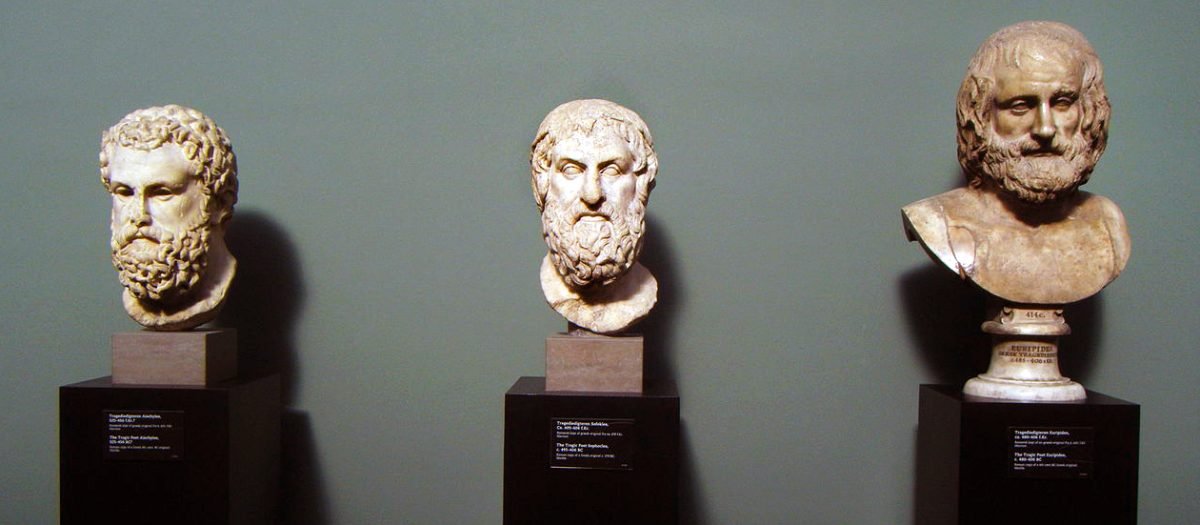
Let's delve into their individual contributions and styles. The following comprehensive video will be our guide. We will watch it in sections as we discuss each playwright.
How to Read Ancient Greek Tragedy: Aeschylus, Sophocles, Euripides
This video by Benjamin McEvoy offers a rich analysis of the tragedians. We'll start with a segment that highlights a crucial aspect of their background: they were not just writers, but citizens deeply involved in the life of their polis, including its wars. This will be particularly interesting given your focus on military history.
Please watch from 06:25 to 11:54. Pay attention to the discussion of the playwrights' military service—Aeschylus at Marathon, and Sophocles as a general. This context is key to understanding why themes of civic duty and the trauma of war are so present in their plays.
As you just saw, these men wrote from experience. Their plays were forged in a city that had recently fought for its existence against the Persian Empire and was grappling with the rise of its own empire and democracy.
Now, let's distinguish their unique artistic contributions.
The Three Major Greek Tragedians
This article from Queen Mary University of London provides a clear, concise summary of the key innovations and styles of the three tragedians. It's a great way to solidify the core differences between them.
Please read the sections titled 'Aeschylus,' 'Sophocles,' and 'Euripides.' This short reading will give you a framework for understanding each playwright's specific dramatic techniques.
With that framework in mind, let's explore their styles with more specific examples.
Aeschylus (c. 525 – c. 456 BC): The Theologian
Aeschylus is the earliest of the three. As a veteran of Marathon, his work is imbued with a sense of grandeur and solemnity.
- Innovations: Added a second actor, allowing for direct conflict on stage. He pioneered the trilogy, telling a single story across three plays.
- Themes: His plays feel like grand, religious ceremonies. They explore divine justice, the inheritance of guilt across generations, and the evolution of justice from personal vengeance to civic law.
- Major Work: The Oresteia. This trilogy follows the bloody saga of the House of Atreus. It begins with the murder of King Agamemnon by his wife, continues with their son Orestes's matricide to avenge his father, and concludes with the establishment of the first law court in Athens to end the cycle of violence.
Sophocles (c. 496 – c. 406 BC): The Dramatist
Sophocles represents the height of classical tragic form. His plots are masterfully constructed, and his characters are more developed.
- Innovations: Added a third actor, allowing for more complex interactions. He also increased the size of the chorus and introduced painted scenery.
- Themes: Sophocles focuses on the human condition. His heroes are great figures brought low by fate and their own tragic flaw (hamartia), often hubris (excessive pride). His plays masterfully use dramatic irony, where the audience knows a terrible truth that the character does not.
- Major Work: Oedipus Rex. Often called the perfect tragedy, it's a gripping story of a king who, in trying to discover the source of a plague on his city, discovers he himself is the cause, having unknowingly killed his father and married his mother.
Euripides (c. 480 – c. 406 BC): The Psychologist
Euripides is the most "modern" of the three. He was controversial in his time for his realism and his willingness to question traditional myths and social norms.
- Innovations: He is known for his psychologically complex characters, especially his powerful female protagonists. His dialogue is more naturalistic, and he often challenges the audience's sympathies.
- Themes: Euripides delves into the dark corners of the human psyche, exploring the destructive power of passion, revenge, and the irrational. Writing during the Peloponnesian War, his plays often reflect the suffering and moral decay caused by conflict.
- Major Work: Medea. This play is a stunning psychological study of a woman who, betrayed by her husband Jason, takes an unimaginable revenge by murdering their children. Euripides forces the audience to sympathize with a character who commits a horrific act.
Let's watch a final video segment that brilliantly contrasts the styles of these three masters.
How to Read Ancient Greek Tragedy: Aeschylus, Sophocles, Euripides
Returning to the video 'How to Read Ancient Greek Tragedy,' this section provides a direct comparison of the three playwrights, summarizing their distinct approaches to character, plot, and language.
Please watch from 47:08 to 53:17. This will help you synthesize the differences between Aeschylus's 'regal and epic' style, Sophocles's 'perfectly plotted' stories, and Euripides's 'psychological complexity.'
Test your understanding!
Imagine you are an Athenian playwright competing at the City Dionysia. You want to write a play about the Trojan War. Based on their styles, which of the following ideas would most likely be written by Aeschylus, Sophocles, and Euripides?
- A play focusing on the Trojan women taken as slaves after the fall of the city, exploring their immense suffering and loss.
- A play about King Priam's devastating pride, showing how his refusal to heed warnings leads directly to the destruction of his family and kingdom.
- A grand, three-part epic that traces the divine curse that caused the war, shows the gods' involvement in the fighting, and ends with the establishment of a new order after Troy's fall.
Show answer
- This is classic Euripides. His focus on the marginalized (women, slaves) and the brutal human cost of war is perfectly captured in this idea. In fact, he wrote a play called The Trojan Women on this very theme.
- This is a perfect subject for Sophocles. It centers on a great man brought down by a tragic flaw (hubris), a hallmark of his work. The tight focus on the hero's personal failing and its consequences is his specialty.
- This sprawling, theological, and generation-spanning story is quintessential Aeschylus. His interest in divine justice and the grand sweep of myth makes him the ideal author for this epic trilogy.
The Architecture of Tragedy: Aristotle's Analysis
About a century after these playwrights, the philosopher Aristotle analyzed their work in his book Poetics. He identified key components that made tragedy so powerful. For someone with a mind for systems and structure, Aristotle's breakdown is a fascinating look at the "source code" of effective storytelling.
The most important concept is catharsis, or the purging of emotions. Aristotle argued that by watching terrible events unfold on stage, the audience experiences pity and fear in a controlled way, leaving them feeling cleansed and renewed.
He also identified key plot devices:
- Peripeteia (Reversal): A sudden turn of events, where a character's actions have the opposite of their intended effect.
- Anagnorisis (Recognition): The moment of critical discovery, where a character moves from ignorance to knowledge—often about their own identity or the true nature of their situation.
These two elements often work together to create the tragic climax, as in Oedipus Rex, where the messenger's arrival (the intended good news) is the very thing that triggers Oedipus's recognition of the horrifying truth.
Conclusion
In classical Athens, the theater was far more than entertainment. It was a democratic space where the entire community gathered to confront the most difficult questions of human existence. Through the monumental works of Aeschylus, Sophocles, and Euripides, Athenians explored themes of justice, fate, personal responsibility, and the profound suffering that can define a human life.
Key Takeaways:
- Greek tragedy originated from religious rituals for the god Dionysus and evolved into a massive civic festival, the City Dionysia.
- The plays were not just stories; they were public forums for exploring complex moral, political, and religious issues.
- Aeschylus, the earliest master, wrote grand, theological tragedies about divine justice and generational curses.
- Sophocles perfected the tragic form with tightly constructed plots, noble heroes, and a focus on fate and human fallibility.
- Euripides, the "modern" of the three, pushed boundaries with his psychological realism, challenging themes, and focus on marginalized characters.
Preview of the Next Lesson:
The anxieties, the hubris, and the human suffering that we've seen explored on the tragic stage are about to erupt in the real world. In our next module, we will begin our study of the Peloponnesian War. We will see how the clash between Athens and Sparta was not just a military conflict, but an ideological one, and how its long and brutal course would challenge every value the Athenians held dear, a reality reflected starkly in the plays of Euripides.