Hello! Welcome back to our exploration of the conflicts that shaped the classical world.
In our last lesson, we witnessed the stunning rise of the Achaemenid Persian Empire. We saw how Cyrus the Great's conquest of Lydia brought the Greek city-states of Ionia under Persian rule for the first time, and how Darius the Great's expansion into Europe established a direct border with mainland Greece. For decades, the proud, independent-minded Ionian Greeks chafed under the authority of a distant "King of Kings."
Today, we will examine the moment this simmering tension erupted into open war. Our learning outcome is to explain the causes and course of the Ionian Revolt against Persian rule. This was the first major clash between Greeks and Persians, a six-year struggle that acted as the direct catalyst for the Persian invasions of Greece. We'll dissect the long-term grievances that fueled the rebellion, identify the immediate trigger that set it off, and follow the dramatic course of the war, from its initial successes to its brutal conclusion.
1. The Seeds of Discontent: Life Under Persian Rule
When the Persians conquered Ionia in 546 BC, they did not fundamentally change the local culture or religion. In line with their policy of tolerance, they allowed the Greeks to continue their way of life. However, they made one critical political change: to ensure loyalty and stability, they installed or supported pro-Persian tyrants in each city.
This created a deep-seated political tension. While many city-states in mainland Greece were experimenting with more inclusive forms of government and moving away from tyranny, the Ionians found themselves stuck with autocratic rulers who answered not to their own citizens, but to a foreign governor (the satrap) in Sardis.
To understand this friction and the other factors that led to the revolt, let's watch a short video.
The Ionian Revolt | Greco-Persian Wars, Episode 4
The video 'The Ionian Revolt' from Atlas History provides a concise overview of the political situation in Ionia under the Persians and the growing desire for liberty.
Please watch from 01:04 to 03:48. This segment explains: The Persian system of ruling through local tyrants. The problems this system created, trapping the Persians in local Greek factionalism. The growing disillusionment of the Ionian populace, who saw their tyrants as puppets. The impact of new taxes introduced by Darius I.
As you saw, the Ionian Greeks came to resent the tyrants as "stooges of their foreign overlords." This resentment was compounded by economic pressures from new taxes and the increasing demands for military service, particularly during Darius's major campaign against the Scythians in Europe around 513 BC.
A key figure in this period was Histiaeus, the tyrant of Miletus, the wealthiest and most powerful Ionian city. His story perfectly illustrates the complex web of personal ambition and political maneuvering that underpinned the coming revolt.
The article 'Revolt of the Ionians' from HistoryNet tells this story brilliantly. Let's read about an incident during the Scythian campaign that set the stage for Histiaeus's future actions.
Please read the section that begins 'In 513 bce, Darius... launched an ill-fated punitive campaign against the nomadic Scythians...' up to the part where Aristagoras is introduced. Focus on how Histiaeus's loyalty to Darius was both rewarded and ultimately contained.
By ensuring Darius's army could escape from its disastrous Scythian campaign, Histiaeus earned the king's favor. However, his ambition was so transparent that Darius's general, Megabazus, saw the danger. The result was Histiaeus being "promoted" to a royal advisor in the distant Persian capital of Susa—a gilded cage designed to keep him far from the coast and his power base in Miletus. As we will see, his burning desire to return home would become a primary driver of the revolt.
2. The Spark: A Failed Expedition and a Desperate Gamble
With Histiaeus in Susa, his son-in-law and nephew, Aristagoras, ruled Miletus. Like his uncle, Aristagoras was ambitious, and an opportunity soon arose that he believed would secure his fame and fortune: the conquest of the wealthy Aegean island of Naxos. This venture would become the immediate trigger for the Ionian Revolt.
Let's watch how this plan unfolded and ultimately backfired.
The Greco-Persian Wars - PART I: The Rise of Persia and the Ionian Revolt (550-493 BC)
The video 'The Greco-Persian Wars - PART I' by History with Cy provides a detailed account of the failed Naxos expedition.
Please watch from 39:13 to 40:53. Pay attention to the quarrel between Aristagoras and the Persian commander, and the consequences of the expedition's failure for Aristagoras personally.
Aristagoras was now in a desperate position. He had failed to deliver on his promise to the Persian satrap Artaphernes, he was deeply in debt from the expedition, and he feared he would be stripped of his rule over Miletus. It was at this critical moment that a message arrived from his uncle Histiaeus in Susa, delivered via one of history's most famous secret messages.
Let's return to the 'Revolt of the Ionians' article to see how Aristagoras, pushed into a corner, made a brilliant and radical decision to save himself.
Please read the section that begins 'Aristagoras was now in a very bad position...' and continues to the end of the section. This part covers both Histiaeus's tattooed slave and Aristagoras's calculated political move.
This is a crucial point to understand. As the historian Herodotus portrays it, the Ionian Revolt was not initially a noble uprising for freedom. It was instigated by two self-serving tyrants:
- Histiaeus, who was homesick and hoped a rebellion would force Darius to send him back to Ionia to quell it.
- Aristagoras, who started the revolt to escape the consequences of his own failed ambition.
His decision to step down as tyrant and declare Miletus a democracy was a masterful political stroke. It tapped into the genuine anti-tyrant sentiment of the populace, unified the Milesians behind him, and inspired other Ionian cities to overthrow their own Persian-backed rulers and join the cause. The revolt had begun.
3. The Course of the War (499-494 BC)
Realizing he could not face the might of the Persian Empire alone, Aristagoras sailed to mainland Greece to seek allies.
- In Sparta, he failed. He showed the Spartan king Cleomenes a bronze map of the world and tempted him with the riches of Persia. But when Cleomenes learned that the Persian capital was a three-month march from the coast, he dismissed the idea as foolhardy.
- In Athens, he found a more receptive audience. The Athenians had recently overthrown their own tyrant, Hippias, who had since taken refuge with the Persians. When the Persian satrap demanded they reinstall Hippias, the Athenians refused, effectively making themselves an enemy of Persia. Capitalizing on this, Aristagoras persuaded the Athenian assembly to help their "kin" in Ionia.
The Athenians voted to send 20 warships, and the city of Eretria added 5. Herodotus ominously wrote that "these ships turned out to be the beginning of evils for both Greeks and barbarians."
The Burning of Sardis
With their new allies, the Ionians launched a bold preemptive strike in 498 BC. They marched inland and attacked Sardis, the regional Persian capital.
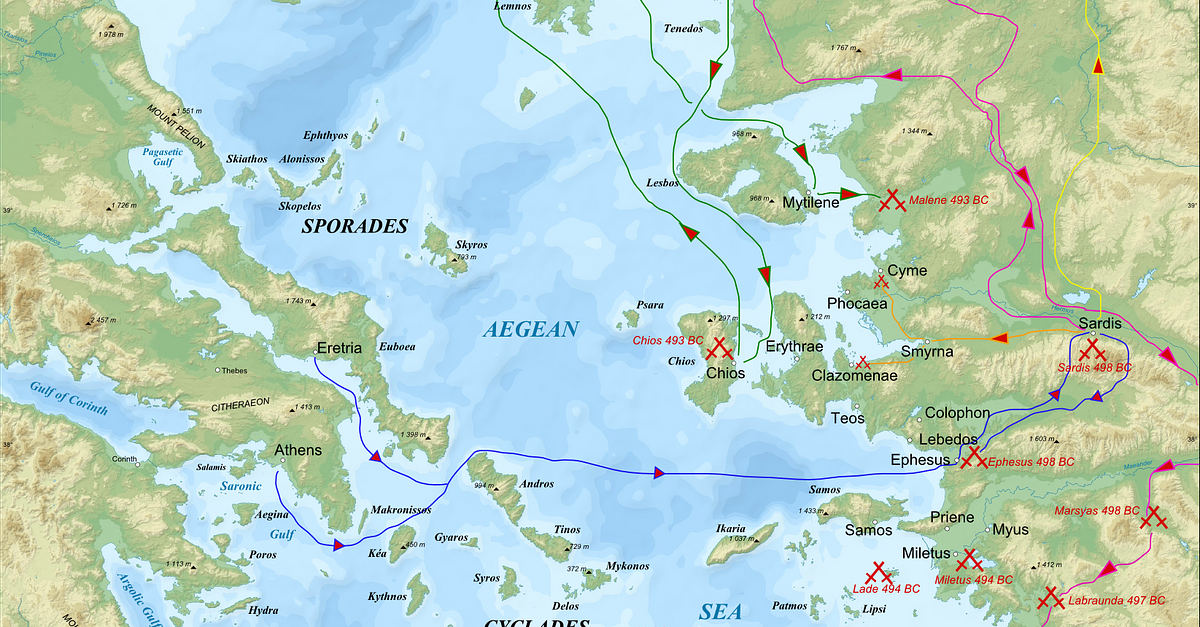
The rebels captured the lower city and, in the chaos, a fire broke out that destroyed Sardis, including the temple of the Lydian goddess Cybele. This act of sacrilege would be used by the Persians as a powerful justification for their later invasion of Greece.
Though a symbolic victory, the attack was a strategic failure. The Ionians were unable to take the acropolis where the satrap Artaphernes held out. Laden with no plunder and with Persian reinforcements converging, they began to retreat. A Persian army caught them near Ephesus and inflicted a severe defeat. Spooked by the loss, the Athenians sailed home and took no further part in the revolt.
The news of the burning of Sardis enraged King Darius. He famously ordered a servant to repeat to him three times at every dinner: "Master, remember the Athenians."
Test your understanding!
What is the difference between the long-term causes of the Ionian Revolt and its immediate trigger?
Show answer
-
Long-term causes were the underlying grievances that created a volatile situation over several decades. These included the Greek resentment of Persian-backed tyrants, economic burdens from tribute and taxes, and a general cultural and political desire for autonomy (eleutheria or freedom).
-
The immediate trigger was the specific event that sparked the conflict. This was the failure of Aristagoras's expedition to Naxos in 499 BC, which put him in a desperate personal and financial position, leading him to incite the revolt as a way to save himself.
The Persian Counter-Attack and the Battle of Lade
Although the Athenians had left, the sack of Sardis inspired other regions like Cyprus and Caria to join the revolt. For several years, the war was a stalemate. The Persians, however, methodically mobilized their vast resources and began to reconquer rebel territories one by one. Aristagoras, seeing the tide turn, fled to Thrace where he was unceremoniously killed in a minor skirmish.
The decisive confrontation came at sea in 494 BC. The Persian fleet of 600 ships cornered the remaining Ionian fleet of 353 ships near the island of Lade, just off the coast of Miletus.
The Battle of Lade was the climax of the revolt. Let's read a detailed description of the battle and its grim aftermath from the 'Revolt of the Ionians' article.
Please read from the part that begins 'Elsewhere, Persian diplomats worked hard to detach rebel cities...' all the way to the end of the section, which describes the capture of Miletus.
As you read, the Ionian alliance proved fatally fragile. Bribed by Persian agents, the ships from Samos deserted as the battle began, causing the Greek battle line to collapse. The Ionian fleet was annihilated.
The path to Miletus, the heart of the rebellion, was now open. The Persians besieged the city, sacked it, killed most of its men, and deported the surviving women and children to Mesopotamia. The brutal destruction of Miletus sent a shockwave of terror through the Greek world and served as a stark warning to any others who might defy the Great King. By 493 BC, the last embers of the revolt were extinguished.
Conclusion
Today we've traced the dramatic arc of the Ionian Revolt, from its origins in political discontent and personal ambition to its fiery conclusion. While the revolt itself was a failure, its consequences were monumental.
Key Takeaways:
- The revolt was caused by long-term Ionian resentment of Persian-backed tyrants and economic pressures, combined with the personal ambitions of its leaders, Histiaeus and Aristagoras.
- The immediate trigger was the failure of the Naxos expedition, which pushed Aristagoras into a desperate gamble to start the rebellion.
- The rebels' main success was the burning of Sardis, an act that won them more allies but also guaranteed the unforgiving wrath of King Darius.
- The revolt was ultimately doomed by Greek disunity and overwhelming Persian military superiority, culminating in the decisive naval defeat at the Battle of Lade and the subsequent destruction of Miletus.
Preview of the Next Lesson:
The Ionian Revolt was over, but for Darius, the matter was not settled. One city had interfered where it had no business, had helped burn his provincial capital, and had insulted the Persian Empire. He had not forgotten his vow. In our next lesson, we will see the consequences of that vow as Darius launches his first punitive invasion of mainland Greece, culminating in one of history's most famous battles: the Battle of Marathon.