Last lesson, you built a readiness profile from the running you have sustained, rather than from a single strong outing. That profile also has a place for unusual symptoms. This lesson explains what to do if a warning sign appears during or around a run—especially chest pain, fainting, severe breathlessness, confusion, or collapse.
The distinction is between stopping and obtaining clinical advice before running again and calling emergency services now. You do not need to identify the cause of a symptom before taking the safer action. This is general guidance, not a diagnosis or a substitute for individual medical advice.
Stop first; assess urgency second
When a concerning symptom begins, end the run. Do not use a slower pace as a test of whether it is safe to continue, and do not try to finish the route before deciding what to do. Get somewhere safe, ask another person to stay with you if possible, and assess what is happening.
Some signs make the decision immediate: fainting during exercise, collapse, new confusion, severe difficulty breathing, or chest discomfort that could signal a heart problem require emergency help. If a symptom has settled but remains unexplained—such as an episode of unusual breathlessness or a faint after exercise—stop training and obtain clinical advice before resuming. When you are unsure whether a potentially serious symptom meets an emergency threshold, err toward emergency help.
A short film makes an important point about chest symptoms:
Watch Your Own Heart Attack Film (British Heart Foundation)
Watch “Watch Your Own Heart Attack Film (British Heart Foundation),” posted by andiee2990. It illustrates why a person might dismiss chest discomfort and delay seeking help.
Watch the symptoms, paying attention to pressure or discomfort that is not necessarily dramatic and to pain spreading beyond the chest. Then watch the response: the film argues against waiting out possible heart-attack symptoms.
Chest pain or pressure during a run is not something to “train through.” Call your local emergency number for ongoing or concerning chest pain, tightness, or heaviness, particularly if it spreads to an arm, back, neck, or jaw, or occurs with breathlessness, faintness, or feeling very unwell. You cannot rule out a serious cause because the discomfort seems mild. If a brief, unexplained chest symptom has fully resolved, do not resume the run: arrange prompt clinical assessment before exercising again. If it returns or you are uncertain about its severity, seek emergency help.
Fainting and collapse: the circumstances matter
Fainting means briefly losing consciousness. Feeling light-headed is not the same as fainting, but it is still a reason to stop and sit or lie down safely rather than continue running. An actual loss of consciousness needs medical assessment, even if recovery seems complete. Fainting while exercising is an emergency.
Read the NHS guidance to distinguish a faint that needs clinical follow-up from one with features requiring an emergency call.
In “Fainting,” read the opening explanation, “Causes of fainting,” “Symptoms of fainting,” and “Non-urgent advice: See a GP if,” from the opening guidance. Then continue through “Things you can do to prevent fainting,” “If you see someone faint,” and “Immediate action required: Call 999 if,” reading the emergency list in full. Focus particularly on the difference between fainting in general and fainting while exercising. The NHS number is specific to its service area; use your local emergency number.
Consider two running situations. Someone becomes light-headed immediately after stopping, sits down, and remains alert; they should not restart the run, and recurring or unexplained symptoms warrant clinical advice. Someone passes out while still running and then wakes up; apparent recovery does not lower that event to a routine appointment. Call emergency services. The NHS also flags a faint accompanied by chest pain or an irregular heartbeat, failure to recover fully, or difficulty speaking or moving as an emergency.
Treat collapse with unresponsiveness as an emergency without waiting to find out whether it is a simple faint. Call your local emergency number, or direct a specific bystander to call. Follow the dispatcher’s instructions. If the person is not breathing normally, begin CPR and use an automated external defibrillator (AED) if one is available, following your training or the dispatcher’s directions. If they are breathing, keep monitoring them and follow emergency-service instructions. Do not give food or drink to someone who is unconscious or confused.
Breathlessness: compare it with the task, then look for danger signs
Breathing harder while running is expected; severe difficulty breathing is not merely a hard effort. A person who is gasping, choking, or unable to get words out needs emergency help. Chest tightness or heaviness, pain spreading beyond the chest, or sudden confusion alongside breathing difficulty are also emergency signs.
Read the NHS guidance for the boundary between emergency breathing symptoms and breathlessness that still needs medical advice.
In “Shortness of breath,” read the opening and the adult list under “Immediate action required: Call 999 or go to A&E immediately,” from the emergency signs. Then read “Urgent advice: Contact NHS 111 if” and “Non-urgent advice: See a GP if,” beginning at the advice thresholds. Focus on severe difficulty breathing versus being more short of breath than usual. Use equivalent local services rather than assuming the NHS numbers apply where you are.
Suppose you are unexpectedly much more breathless than usual on an easy run, but you can speak, remain alert, and recover after stopping. End the session and seek prompt clinical advice rather than treating the episode as a failed workout. If instead you cannot get words out, have a heavy or tight chest, or become confused, call emergency services. The useful comparison is not a fixed running pace; it is whether the symptom is unusual for the effort and whether emergency features are present.
Confusion is not a pacing problem
Confusion can be harder to recognize in yourself than chest pain. On a run, signs may include being unable to follow simple directions, speaking or behaving unusually, or becoming disoriented. A running partner who notices these changes should act even if the affected person insists on continuing. New confusion during exertion calls for emergency help, particularly in hot conditions; do not wait to see whether rest or a drink fixes it.
The infographic below contrasts heat exhaustion with heat stroke. Its heat-stroke side places confusion and unconsciousness among the signs for immediate action. The printed “911” is one emergency number; use the number appropriate where you are.
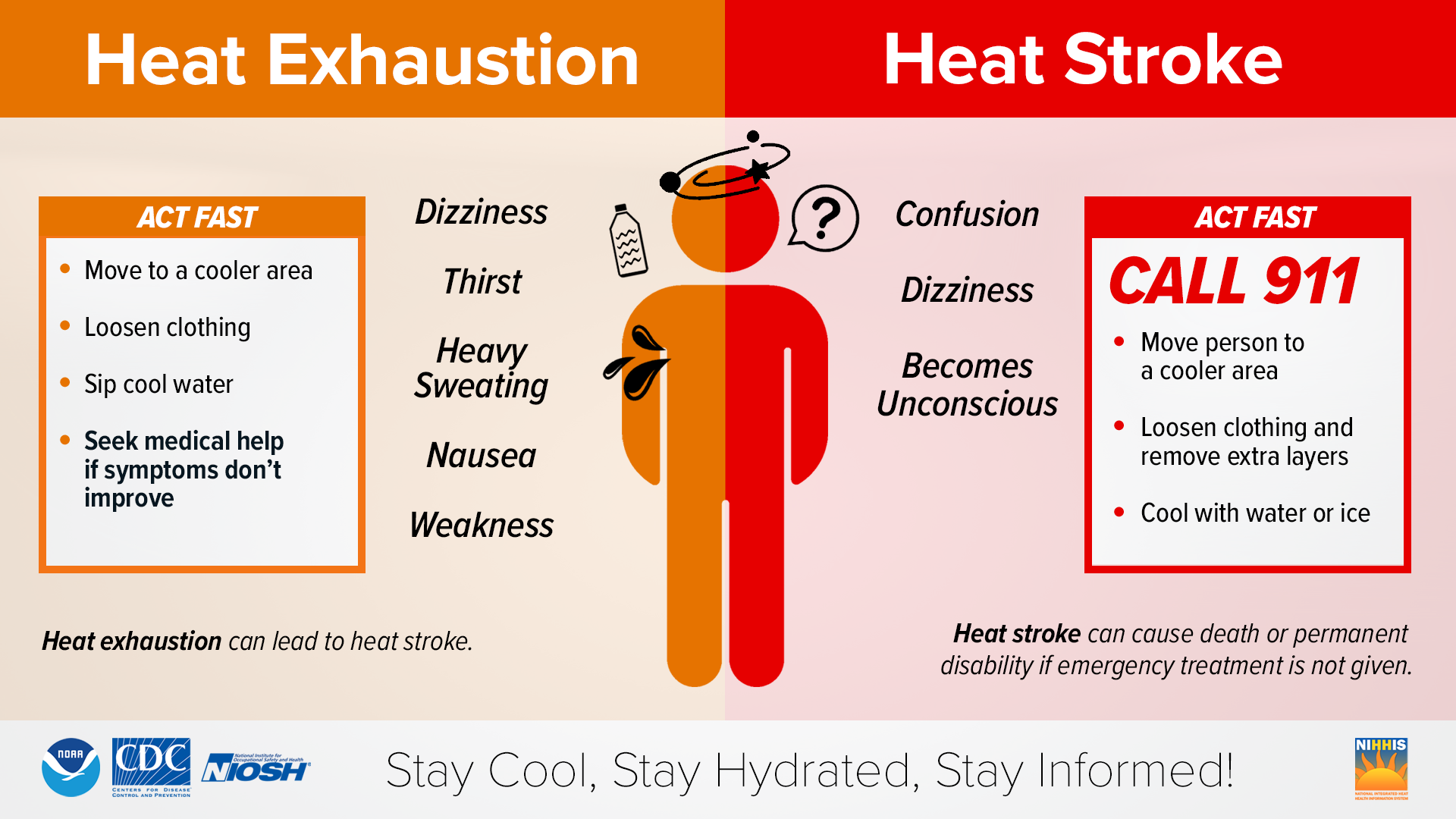
While emergency help is being arranged for a person with suspected heat illness, move them to a cooler place if it is safe and begin cooling them with water or ice where available. Do not give fluids by mouth if they are confused, drowsy, or unconscious. A later lesson will address how conditions can change a planned run; the rule here is simpler: altered awareness means stop and escalate, whatever the weather.
Keep the decision rule usable
These examples are a guide to action, not a way to diagnose the underlying cause.
| What happens during or around a run | Appropriate response |
|---|---|
| Unexplained chest discomfort that has fully resolved, without other emergency signs | Stop; obtain prompt clinical advice before running again. If it recurs, persists, or you are unsure, seek emergency help. |
| Ongoing or concerning chest pain, pressure, tightness, or heaviness—especially with spreading pain, breathlessness, or faintness | Stop and call your local emergency number. |
| A faint while exercising, even if the person wakes up | Call your local emergency number. |
| A faint after exercise with full recovery and no emergency features | Stop training and obtain clinical assessment; escalate if recovery is incomplete or other emergency signs appear. |
| Unusual breathlessness on an easy run, but able to speak and fully alert | Stop and seek prompt clinical advice before resuming training. |
| Gasping, inability to get words out, new confusion, or collapse | Call your local emergency number. |
The governing principle is that stopping the run comes before explaining the symptom. Clinical advice is appropriate for unexplained warning signs that have resolved without emergency features; emergency help is appropriate for the severe signs above, including fainting during exercise even after recovery. Do not make up missed training afterward to compensate for stopping.
Next, you will use the talk test and perceived effort to distinguish ordinary easy running from harder work—without treating pace as a reason to ignore a warning sign.