Hello. Your readiness profile describes the running you have recently sustained, and the previous lesson established that warning symptoms take priority over a workout. Now you need a way to judge an ordinary run while it is happening. This lesson combines the talk test with a rating of perceived exertion (RPE) so you can tell whether an intended easy run is actually easy—even when your pace changes.
Why an easy run cannot have one fixed pace
Imagine running a familiar route on a cool day, then taking the same route when you are tired or the weather is warmer. Matching yesterday’s pace might require more effort today. A hill can produce the same effect within a single run. Pace tells you how fast you are moving; it does not, by itself, tell you how hard that movement feels.
Watch the short portions of Train Smarter, Run Faster: Making Sense of Pace vs. RPE vs. HR from Running With Jane. The useful distinction here is between pace as information and pace as an instruction you feel obliged to obey on an easy day.
Train Smarter, Run Faster: Making Sense of Pace vs. RPE vs. HR
Watch how the runner introduces perceived effort as an alternative to directing every run by pace.
Start with pace rigidity, then watch running by feel for the explanation of RPE, breathing, and conversation. Finish with practical uses for easy runs, variable terrain, and walking intervals. Focus on why the same intended effort need not produce the same speed.
For marathon preparation, this distinction lets you protect the purpose of an easy session. If the goal is easy running, slowing on a hill is not falling behind the workout. It may be exactly how you keep the workout easy.
The talk test: what can you say comfortably?
The talk test uses speech as a practical indicator of breathing demand. At an easy effort, you can speak in complete sentences without straining to fit words between breaths. You are breathing more than at rest, but conversation remains comfortable. You need not actually have a running partner: you can say a familiar sentence aloud when it is safe to do so.
The American Council on Exercise describes how speech changes across broad effort levels. Read only the short three-zone passage in its ACE IFT Model for Cardiorespiratory Training; you do not need the article’s testing protocols or heart-rate terminology for this lesson.
ACE IFT® Model for Cardiorespiratory Training | Certified News | ACE
Read the American Council on Exercise’s description of speech at easier and more demanding efforts. It gives the talk test a useful structure without requiring a pace target.
In “Three-zone Training Model,” find the three short zone definitions near the end of the section’s explanation of breathing. Read the zone comparison, ending with the paragraph that contrasts easy talking, uncertain comfort, and single-word speech. Focus on comfort, not just whether you can force out words.
For your own runs, the distinction is more useful than assigning a precise physiological “zone”:
| Speech while running | What it suggests |
|---|---|
| Complete sentences feel comfortable | Usually consistent with an easy effort |
| You can talk, but conversation feels interrupted or uncomfortable | More demanding than an easy conversational run |
| Only short phrases or isolated words are manageable | Hard effort, not an easy run |
Notice the middle category. Being able to speak at all is not the same as passing the easy-run talk test. If you can produce a sentence only by waiting for the next breath, the effort has probably risen beyond what you intended for an easy session. Reduce your speed, or take a walk break, and allow your breathing to settle.
Give the feeling a number
RPE adds a second description: How hard does this feel to you right now? You can judge it from breathing, leg effort, and the overall sense of how demanding the run is. It is subjective by design. There are several RPE scales, so a number makes sense only alongside the scale being used.
Read the scale descriptions from Cleveland Clinic’s Rate of Perceived Exertion (RPE) Scale. For this course, use the 0-to-10 scale, where 0 is rest and 10 is maximal effort; do not mix its numbers with those of the separate 6-to-20 Borg scale.
Rate of Perceived Exertion (RPE) Scale
Cleveland Clinic presents both common numbering systems. Read just enough of the first to recognize that it is different, then study the 0-to-10 ratings you will use here.
Under “What are the types of RPE scales?”, read the scale distinction. Then find “Modified Borg CR10 RPE scale” and read the 0-to-10 scale through the first rating table. Focus on the progression from light to moderate, vigorous, and maximal effort rather than memorizing every number.
For running, a working guide is roughly 2–4 out of 10 for an easy, conversational effort, depending on how you use the scale. Around 4–5 may begin to feel moderately demanding; 6–7 is clearly harder; 8–10 describes very hard to maximal work. These are approximate descriptions, not speed prescriptions. A rating of 3 is useful because it records your experience of that run, not because every runner’s rating of 3 corresponds to the same pace.
The infographic below pairs perceived effort with speech. Its number boundaries are somewhat different from Cleveland Clinic’s categories, which is a reminder not to treat the scales as precise conversions. The consistent clue is that comfortable conversation belongs with easier effort, while speech becomes restricted as effort rises.
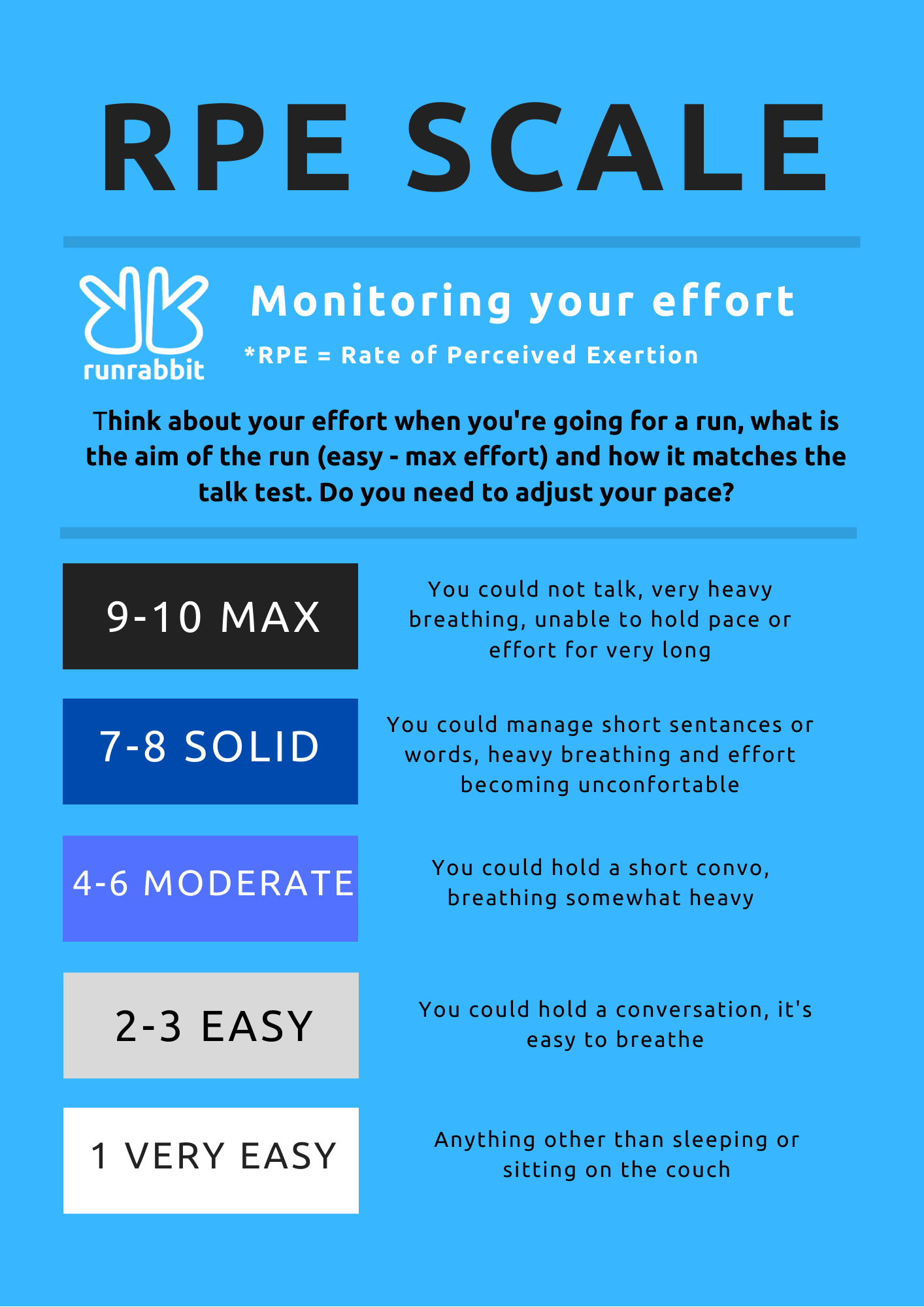
You do not have to decide whether a run was “exactly 3” or “exactly 4.” First identify the broad category: conversational and easy, noticeably demanding, or hard. The number is a compact way to record that judgment.
Use both cues while the run is unfolding
Suppose an easy run begins at a comfortable conversational effort that you rate 3 out of 10. On an incline, your pace slows but you can still speak comfortably and the effort remains near 3. The session is still easy. If instead you try to preserve your flat-ground pace, find yourself speaking only in fragments, and rate the effort 6, the hill has changed the nature of the session. Slow down or walk until conversation becomes comfortable again.
This is also why a planned walk break can serve a purpose without making the run a failure. It is one way to manage effort. You can resume running when the intended easy effort is available again; you need not “earn back” the walking time by running faster.
Sometimes the two cues will not align neatly. Your breathing might permit conversation while your legs feel unusually heavy and the run feels much harder than normal. Or you may assign a low number out of habit while speech is plainly uncomfortable. For an intended easy run, use the more cautious signal: ease off rather than arguing that one measurement gives you permission to continue at the same speed. Over time, noting both “RPE 3” and “comfortable conversation” will make your descriptions more consistent.
This method is especially helpful when conditions or your state change. A slower pace on a warm day may be the effort-equivalent of a quicker pace on a cool one. Conversely, a familiar pace that suddenly feels demanding is information worth noticing. Neither the talk test nor RPE diagnoses the cause of a change; they help you recognize that the effort is no longer what you planned.
There is one crucial boundary from the previous lesson. The talk test is an effort guide, not a safety clearance. Expected heavier breathing during a deliberately hard effort differs from unusual or severe breathlessness. If breathlessness is unexpectedly pronounced on an easy run, stop and follow the clinical-advice guidance from the previous lesson. If you are gasping or cannot get words out because of severe breathing difficulty, or have chest symptoms, fainting, confusion, or collapse, follow the emergency guidance. Do not merely slow down and call the symptom a higher RPE.
Carry the distinction forward
For an ordinary easy run, aim for comfortable full-sentence speech and a low perceived effort, allowing pace to vary with terrain, conditions, and how you feel. Short, strained speech and a clearly higher RPE indicate a more demanding effort—even if the watch shows a pace you usually call “easy.” When the cues disagree, ease off; when warning symptoms appear, stop and use the safety rules instead.
Next, you will compare your readiness profile with a marathon plan’s entry requirements and the time available. Knowing what “easy” actually feels like will help you judge what kind of preparation you can sustain, rather than basing that decision on a single pace or strong outing.