Welcome back. In our previous lesson, we established how to handle kinematic problems where acceleration is not constant, using integration as our primary tool. We saw that force, and therefore acceleration, can depend on position, leading us to the powerful a dx = v dv relationship, which is a precursor to the work-energy theorem.
Today, we will build directly on that foundation and on the vector calculus you mastered in the first module. Our focus is on the concept of work. You're familiar with work in simple scenarios, but many advanced physics problems involve forces that vary in magnitude and direction, acting along complex, curved paths. The goal of this lesson is to equip you with the method for calculating work in these general cases. You will learn to use line integrals to find the work done by any vector force field, a crucial skill for analyzing systems with path-dependent forces like friction, which are common in the challenging problems from Irodov and H.C. Verma that you aim to solve.
1. Generalizing the Definition of Work
You know from introductory physics that when a constant force acts on an object that undergoes a straight-line displacement , the work done is given by the dot product:
This simple formula breaks down if the force is not constant or if the path is not a straight line. For instance, consider a block sliding along a curved track with friction, or a charged particle moving through a non-uniform electric field.
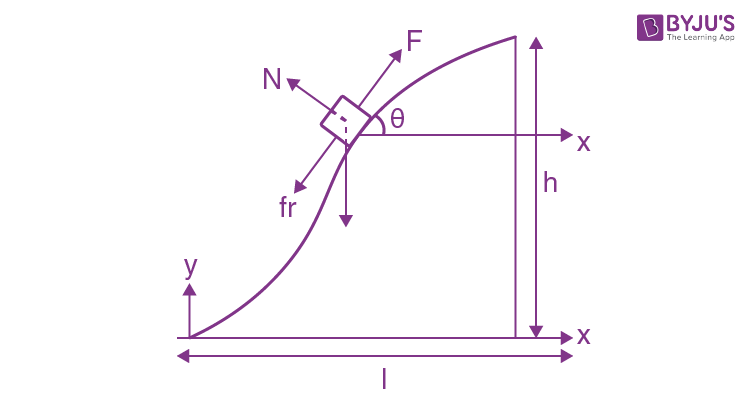
To handle these situations, we use the core strategy of calculus: we break the complex path into a series of infinitesimally small, essentially straight displacements, which we can call . Over each tiny displacement, the force vector can be considered constant. The small amount of work, , done over this segment is:
The total work done in moving the object along the entire path is the sum of all these infinitesimal contributions. This sum is precisely what a line integral represents:
This is the general definition of work done by a vector force field along a path . The integral measures the cumulative effect of the component of the force that acts along the direction of motion at every point on the path.
The following video provides an excellent conceptual bridge from the simple idea of work to this more powerful line integral formulation.
Line Integrals of Vector Fields // Big Idea, Definition & Formula
This video by Dr. Trefor Bazett introduces the line integral of a vector field by using the physical concept of work. It intuitively explains why the dot product is central to this idea.
Watch the initial motivation from the beginning. Pay close attention to the inclined plane example from this segment, which illustrates why only the tangential component of the force does work. Finally, see how this idea is assembled into the formal line integral definition from this part.
2. The Mechanics of Calculating the Line Integral
The expression is the formal definition, but to actually compute it, we need a systematic procedure. This involves converting the line integral into a standard definite integral with respect to a single variable. The key is to parameterize the path.
Here is the step-by-step method:
-
Parameterize the Path, : Describe the curve as a vector function of a single parameter, typically . For a path in 3D space, this looks like , where ranges from a starting value to an ending value .
-
Find the Differential Displacement, : Differentiate the parameterized path with respect to the parameter to get . Then, the differential displacement vector is .
-
Express the Force Field on the Path, : The force field is defined throughout space. You must evaluate it specifically along the path by substituting the parameterized components into the expression for .
-
Set Up and Solve the Integral: Substitute these components into the line integral definition. The integral transforms into a standard definite integral in the parameter :
This is now a single-variable integral that you can solve using standard calculus techniques.
The following resource provides a concise, text-based explanation of this computational process.
Line Integrals of Vector Fields
This guide from Oregon State University clearly lays out the mathematical formulation for calculating the work done by a variable force field along a curve.
Start by reading the section "Line Integral of a Vector Field" which derives the integral form. Then, study the Example section, which begins with "How much work is required", to see a complete calculation.
3. Example: Work in a Rotational Field
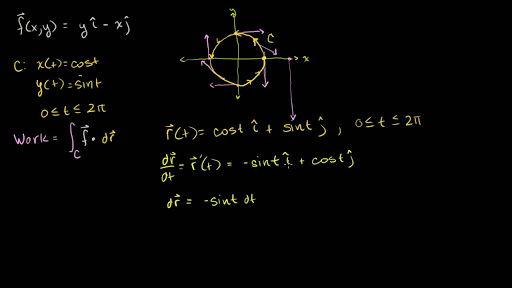
Let's work through a classic example. Consider a particle moving in a force field given by . This is a "vortex" field that tends to push objects in circles around the origin. Let's calculate the work done by this force as a particle moves counter-clockwise along the upper half of a circle of radius 1, from point (1,0) to (-1,0).
-
Parameterize the Path: The unit circle can be parameterized using as the angle. Since we only want the upper semi-circle from (1,0) to (-1,0), our parameterization is:
, for . -
Find :
.
So, . -
Express on the Path: Substitute and into the force field equation:
. -
Set Up and Solve: Now we compute the dot product and integrate.
The work integral is:
The work done is . Note that if we moved the particle around the full circle (from to ), the work would be . The work done over a closed path is non-zero. This is the defining characteristic of a non-conservative force.
4. Path Dependence: Conservative vs. Non-Conservative Fields
The result of our example leads to a crucial distinction in physics.
- Conservative Force: A force is conservative if the work it does on an object moving between two points is independent of the path taken. Equivalently, the work done by a conservative force over any closed loop is zero. Gravity and ideal spring forces are classic examples. For these forces, we can define a potential energy function, where .
- Non-Conservative Force: A force is non-conservative if the work it does depends on the path taken. The work done over a closed loop is generally non-zero. Friction and the rotational field from our example are non-conservative. You cannot define a unique potential energy for such forces.
The following video offers a fantastic visual intuition for why some fields are conservative and others are not, by examining their structure.
Calculus 3: Line Integrals (38 of 44) What are conservative/NON-Conservative Vector Fields?
This video by Michel van Biezen contrasts graphical representations of conservative and non-conservative vector fields, explaining why the line integral over a closed path is zero for one and not for the other.
Watch the entire video from start to finish. Focus on the reasoning: for the non-conservative field, the path and field vectors are consistently aligned, causing the work to always add up. For the conservative field, positive contributions to the work are cancelled by negative contributions elsewhere on the loop.
This concept of path dependence is not just a mathematical curiosity. In the problems you'll be solving, the work done by friction critically depends on the length and shape of the path an object travels. Calculating this work correctly, using a line integral, is often the key to solving the problem.
Conclusion
In this lesson, you have generalized your understanding of work to encompass the most general cases found in mechanics. You've connected the physical concept of work to the mathematical tool of a line integral, which you first studied in a more abstract context.
Here are the key takeaways:
- The work done by a variable force along a curved path is given by the line integral .
- To compute this integral, you must parameterize the path () and convert the line integral into a standard definite integral: .
- Force fields are classified based on path dependence. For conservative fields (like gravity), work is path-independent and zero over a closed loop. For non-conservative fields (like friction), work is path-dependent.
You are now equipped to analyze the energetics of motion in any force field, a skill that is fundamental to advanced dynamics.
In our next lesson, we will shift gears to another important topic in advanced mechanics: variable mass systems. We will learn how to apply Newton's second law in situations where the mass of the object is changing, such as in rocket propulsion or a falling chain. This will require setting up and solving new kinds of differential equations.