Hello! In our last lesson, we mastered the technique of finding the total hydrostatic force on a submerged surface by calculating its horizontal and vertical components and then finding their resultant and line of action. You saw that the vertical component, , was equal to the weight of the fluid column above the curved surface. Today, we will explore a profound consequence of this fact.
This lesson is dedicated to one of the most famous principles in all of physics: Archimedes' principle. We will derive this principle directly from the concepts of hydrostatic pressure that you are now familiar with. You will learn how to calculate the buoyant force on any object, whether it is fully or partially submerged, and apply this knowledge to understand why some objects float while others sink. This is a foundational topic in fluid statics and a prerequisite for solving a wide range of challenging physics problems.
1. The Origin of Buoyancy: A Net Pressure Force
Imagine any object submerged in a fluid. From our previous discussions, you know that the pressure exerted by the fluid increases with depth. This means the pressure on the bottom surface of the object is greater than the pressure on its top surface. The fluid also exerts pressure on the sides, but these horizontal forces tend to cancel each other out for a symmetric object. The imbalance in pressure between the top and bottom surfaces results in a net upward force. This net upward force is the buoyant force.
Let's think about this more formally. Consider an arbitrarily shaped object submerged in a fluid. The buoyant force is the vector sum of all the pressure forces acting on every infinitesimal area element of the object's surface.
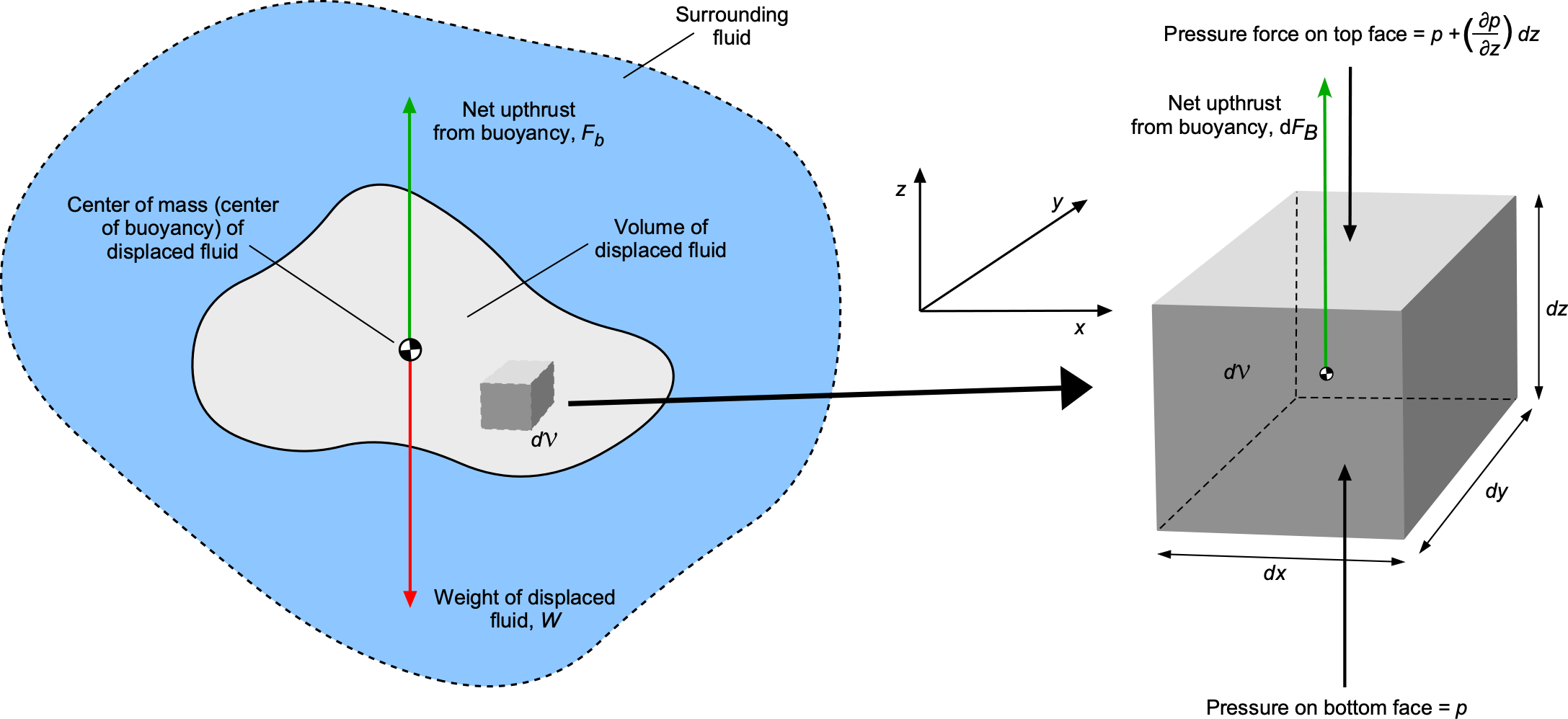
The beautiful insight, attributed to Archimedes, is that this net upward force is exactly equal to the weight of the fluid that would occupy the volume of the submerged portion of the object. Why? Because if the object weren't there, a volume of fluid identical in shape would be held in equilibrium by the exact same surrounding pressure forces. Therefore, the net pressure force (the buoyant force) must be equal and opposite to the weight of that "displaced" fluid.
Let's see a formal, calculus-based derivation of this result.
Buoyant Force and Center of Buoyancy
This document from Purdue University provides a rigorous derivation of the buoyant force, starting from the first principles of hydrostatic pressure. This approach will connect what we've learned about pressure with this new concept.
Please read the first page of the document, section 2.4. Buoyant Force and Center of Buoyancy. Focus on the derivation from Equation (2.78) to Equation (2.82). Notice how it starts with the net pressure force on a thin vertical cylinder within the object and integrates this idea over the object's entire volume to arrive at the final expression for the buoyant force, F_B.
The derivation you just read culminates in the mathematical statement of Archimedes' Principle:
where:
- is the magnitude of the buoyant force.
- is the density of the fluid.
- is the acceleration due to gravity.
- is the volume of the portion of the object that is submerged in the fluid.
The term is the mass of the fluid displaced by the object. Multiplying by gives the weight of the displaced fluid.
For a more visual and intuitive walkthrough of this derivation and principle, the following video is highly recommended.
Archimedes Principle, Buoyant Force, Basic Introduction - Buoyancy & Density - Fluid Statics
This video by The Organic Chemistry Tutor provides an excellent introduction to Archimedes' principle, including a clear, step-by-step derivation of the buoyant force formula.
Watch the first part of the video for an introduction to the concept. Then, pay close attention to the derivation of the buoyant force, which considers a simple cylindrical object and shows how the pressure difference between its top and bottom surfaces leads directly to Archimedes' principle.
2. Applications of Archimedes' Principle
Now that we have the core principle, let's apply it to the two main scenarios: fully submerged objects and floating objects.
Case 1: Fully Submerged Objects and Apparent Weight
When an object is fully submerged, . The object is subject to two main vertical forces: its own weight () acting downwards, and the buoyant force () acting upwards.
The net force on the object determines its acceleration. More practically, if you were to weigh the object while it's submerged (e.g., by hanging it from a spring scale), the scale would not read the true weight. It would read a lower value, known as the apparent weight.
The tension in the string (or the reading on the scale) would be:
This is why, as you've surely experienced, it's much easier to lift a heavy rock underwater than in the air. The buoyant force from the water is helping you.
Let's see this calculated in a concrete example.
Archimedes Principle, Buoyant Force, Basic Introduction - Buoyancy & Density - Fluid Statics
Let's return to the same video from The Organic Chemistry Tutor. It now applies the formula to a practical problem.
Watch the segment from the worked example involving an aluminum block. Observe how the buoyant force is calculated first in air (where it's negligible) and then in water (where it's significant). Note how this directly impacts the tension required to hold the block, which is its apparent weight.
Case 2: Floating Objects
An object floats when it is in static equilibrium while partially submerged. For this to happen, the net force on the object must be zero. This means the upward buoyant force must exactly balance the object's downward weight.
Let's expand this using our formulas:
Since , we can substitute this in:
Canceling from both sides gives us a powerful and elegant relationship:
This equation tells us that the fraction of an object's volume that is submerged is equal to the ratio of the object's density to the fluid's density. This immediately explains a few things:
- If , the fraction is less than 1, and the object floats.
- If , the required submerged fraction would be greater than 1, which is impossible. The buoyant force, even when fully submerged, is not enough to support the weight, so the object sinks.
- If , the fraction is 1. The object is neutrally buoyant and will remain at any level where it is placed when fully submerged.
The following video explores these concepts with some classic and more advanced examples that are staples of competitive physics exams.
How To Calculate The Fractional Volume Submerged & The Density of an Object In Two Fluids
This video, also by The Organic Chemistry Tutor, is dedicated to problems involving floating objects.
First, watch the iceberg example. This is a perfect illustration of how to use the density ratio to find the submerged fraction. Next, see how the same logic is applied in reverse in the metal block on mercury problem to find the object's density. Finally, watch the more advanced example of a block suspended between two fluids. This is a very common type of problem. The key insight is that the total weight is balanced by the sum of the buoyant forces from both the oil and the water.
3. A Conceptual Test: The Melting Ice Cube
To truly solidify your understanding, let's consider a classic conceptual problem. An ice cube is floating in a glass of water, filled to the brim. When the ice cube melts, what happens to the water level? Does it rise (and overflow), fall, or stay exactly the same?
Think about this for a moment using the principles we've discussed. The floating ice cube displaces a volume of water whose weight is equal to the ice cube's total weight. When the ice melts, it becomes water. What volume does this new water occupy?
The following reading provides a concise and elegant mathematical proof of the answer.
Buoyant Force and Center of Buoyancy
Let's revisit the Purdue University notes. The example at the end provides a clear answer to our conceptual puzzle.
Please read the short example "statics_20" which begins on page 164. The solution starting with the equations shows, using Archimedes' principle, that the volume of the melted ice is exactly equal to the volume of water the ice was displacing when it was floating.
The conclusion is that the water level remains unchanged! This is a non-trivial result that demonstrates the power of applying these principles correctly.
Conclusion
In this lesson, you've moved from the detailed mechanics of hydrostatic pressure to the elegant and powerful Archimedes' principle. This single principle allows you to solve a vast array of problems involving submerged and floating bodies.
Key Takeaways:
- The buoyant force arises from the pressure difference between the bottom and top of a submerged object.
- Archimedes' Principle states that the buoyant force is equal to the weight of the fluid displaced by the object: .
- For a fully submerged object, its apparent weight is its true weight minus the buoyant force: .
- For a floating object, the buoyant force equals the object's weight, which leads to the relationship: .
So far, we have only concerned ourselves with the magnitude of the buoyant force. However, just like the hydrostatic forces we studied before, the buoyant force also has a specific line of action. It acts through the centroid of the displaced volume, a point known as the center of buoyancy. In our next lesson, we will investigate the interplay between the center of gravity and the center of buoyancy to analyze the stability of floating bodies—a critical concept in ship design and engineering.