Hello! Welcome to the first lesson of our module on LLM Fundamentals and Prompt Engineering.
In our last lesson, you did a fantastic job fine-tuning an encoder-only model, DistilBERT, for text classification. We focused on how these models understand text to make a prediction. Now, we're going to pivot to the other side of the Transformer world: decoder-only models, like those in the GPT family.
Our goal in this lesson is to explain autoregressive text generation in decoder-only LLMs. This is the fundamental mechanism that enables models to write code, compose poetry, and power chatbots. We'll break down what "autoregressive" means and see how the model's architecture is perfectly designed for this creative process.
From Understanding to Generating
Think back to the text classification task. The encoder model processed the entire input sequence at once to produce a single prediction (positive or negative). It had a bird's-eye view of the text.
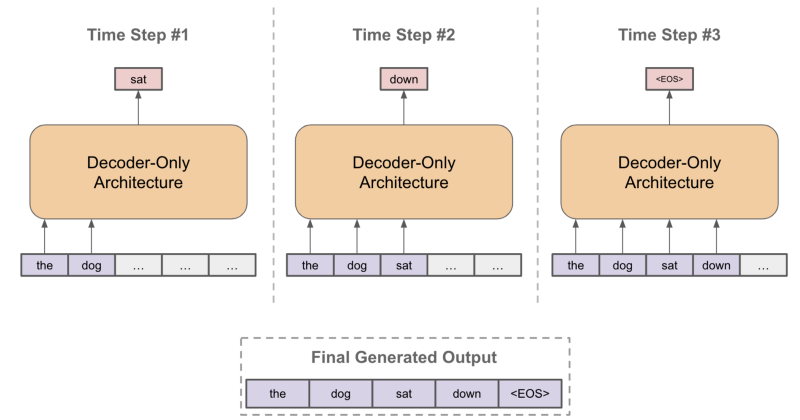
Text generation is different. It's a sequential, step-by-step process. The model writes one word (or token) at a time, and each new word it writes is influenced by all the words that came before it. This is the essence of autoregressive generation.
The term "autoregressive" can be broken down:
- Auto: Means "self". The model uses its own previous outputs as input for the next step.
- Regressive: In statistics, this refers to predicting future values based on past values.
So, an autoregressive model predicts the next token in a sequence based on the sequence it has generated so far.
This image perfectly illustrates the loop:
The Architecture of a Generator: Decoder-Only
In the last module, we saw that the original Transformer had both an encoder and a decoder. For tasks that only require generation (and not translation from one language to another), we can use a decoder-only architecture. Models like GPT, Llama, and Mistral are all decoder-only.
Here is a high-level view of this architecture:

As you can see, the core of the model is a stack of Decoder Blocks. The critical innovation inside each block is Masked Self-Attention. This is what makes autoregressive generation possible.
The Secret Sauce: Masked Self-Attention
In the encoder model you used, the self-attention mechanism allowed every token to look at every other token in the sequence, both before and after it (bidirectional attention). This is great for understanding the full context.
However, for generation, this would be a problem.
- During Training: If the model could see the "future" tokens in the training data, it would simply copy the next word instead of learning to predict it.
- During Inference: When generating new text, there are no future tokens to look at!
Masked Self-Attention (also called Causal Self-Attention) solves this. It modifies the attention mechanism to ensure that when predicting the token at position i, the model can only attend to tokens at positions 0 to i. It "masks out" all future tokens.
The following article from Jay Alammar provides an excellent visual introduction to the GPT-2 architecture and its autoregressive nature.
The Illustrated GPT-2 (Visualizing Transformer Language Models)
Let's start with a high-level overview. This famous blog post, 'The Illustrated GPT-2', masterfully explains how decoder-only models work. We'll focus on the sections that introduce the architecture and the step-by-step generation process.
Please read 'Part #1: GPT2 And Language Modeling'. Pay close attention to the section 'The Decoder-Only Block' and the visual breakdown of the iterative generation process under 'Crash Course in Brain Surgery: Looking Inside GPT-2'. Notice how the model produces one token at a time and adds it to the input for the next step.
A Detailed Walkthrough of the Generation Loop
Now that you have a high-level picture, let's dive into the details. The next video from StatQuest provides a clear, step-by-step walkthrough of the entire process, from input prompt to final generated text. It's a fantastic resource for cementing your understanding.
Decoder-Only Transformers, ChatGPTs specific Transformer, Clearly Explained!!!
This video, 'Decoder-Only Transformers, Clearly Explained!!!', walks through a complete example of generating a response. It animates the concepts of masked self-attention and the autoregressive loop.
Please watch the following three segments: Masked Self-Attention (9:59 - 22:30): Focus on how the model calculates relationships between a word and only the preceding words. This is the core of causal masking. Generating the Next Word (22:30 - 26:58): Observe how the processed input is used to predict the very first output token. The Autoregressive Loop (26:58 - 32:06): This is the most crucial part. Watch how the newly generated word ('awesome') is fed back into the model to generate the next token, and how this process repeats until an end-of-sequence token is produced. Don't worry about memorizing every calculation; concentrate on the flow of information.
Connecting Concept to Code Structure
As a software engineer, it's helpful to see how these conceptual steps are organized in code. While we won't implement it from scratch today, looking at the structure can clarify the logic. A common pattern is to wrap the core model in a class that handles the autoregressive loop.
Building a text generation model from scratch
This article, 'Building a text generation model from scratch', shows how the concepts we've discussed map to PyTorch code. We'll look at the sections explaining masking and the overall model structure.
Please read the following sections: Masking: This section provides another clear explanation of why causal masking is necessary and how it's implemented. The decoder layer: Understand how a single decoder block is constructed. Autoregressive Wrapper: This is the most important part for our lesson. See how the author creates a wrapper class specifically to handle the process of feeding the model's output back as its next input. This directly mirrors the generation loop we saw in the StatQuest video.
Test your understanding!
Imagine a decoder-only LLM is given the prompt "The sky is". It processes this input and predicts the next token is "blue".
Question: What is the exact input the model will use in the very next step to predict the token that comes after "blue"? And what architectural feature ensures it learned to predict "blue" without just copying it from a training example like "The sky is blue"?
Show answer
The input for the next step will be the sequence "The sky is blue". The model appends its own output to the previous input to form the new input.
The architectural feature that prevents it from cheating is Masked Self-Attention (or Causal Masking). This ensures that when training on the sentence "The sky is blue", the model can only use "The sky is" to predict "blue", and is "masked" from seeing the correct answer in the input.
Conclusion
Great work! You've just unpacked the core engine of modern large language models. This step-by-step generative process is fundamental to everything we'll do from now on.
Key Takeaways:
- Autoregressive Generation is a sequential process where a model predicts one token at a time, using its own previous outputs as the input for the next step.
- Decoder-Only Architecture (like GPT) is specialized for this task.
- Masked Self-Attention is the key mechanism that allows these models to work. It prevents the model from "peeking" at future tokens, forcing it to learn how to predict what comes next based only on the past.
- The Generation Loop continues until the model produces a special end-of-sequence (
<EOS>) token or hits a predefined length limit.
Next Up:
In the generation loop, the model produces a probability distribution over its entire vocabulary for the next token. So far, we've assumed we just pick the most likely one. But is that always the best strategy? In the next lesson, we will explore different sampling strategies like greedy search, top-k, and nucleus sampling, which give us powerful ways to control the creativity and coherence of the generated text.