Hello and welcome to the final lesson in our module on optimizing and scaling LLM applications.
In our last session, we built a robust, reactive system for handling API errors. By implementing retries with exponential backoff, you learned how to make your application resilient to transient failures like the RateLimitError. That was about gracefully recovering when things go wrong.
Today, we shift from a reactive to a proactive stance. Your goal is to apply techniques for managing API rate limits and quotas in a production environment. Instead of just handling rate limit errors, we'll focus on the engineering patterns that help you avoid hitting them in the first place. For a backend engineer, these concepts are fundamental to building stable, scalable, and cost-effective systems. We will cover client-side rate limiting, quota monitoring, cost management, and other production-grade strategies.
The Big Picture: Where Rate Limiting Fits
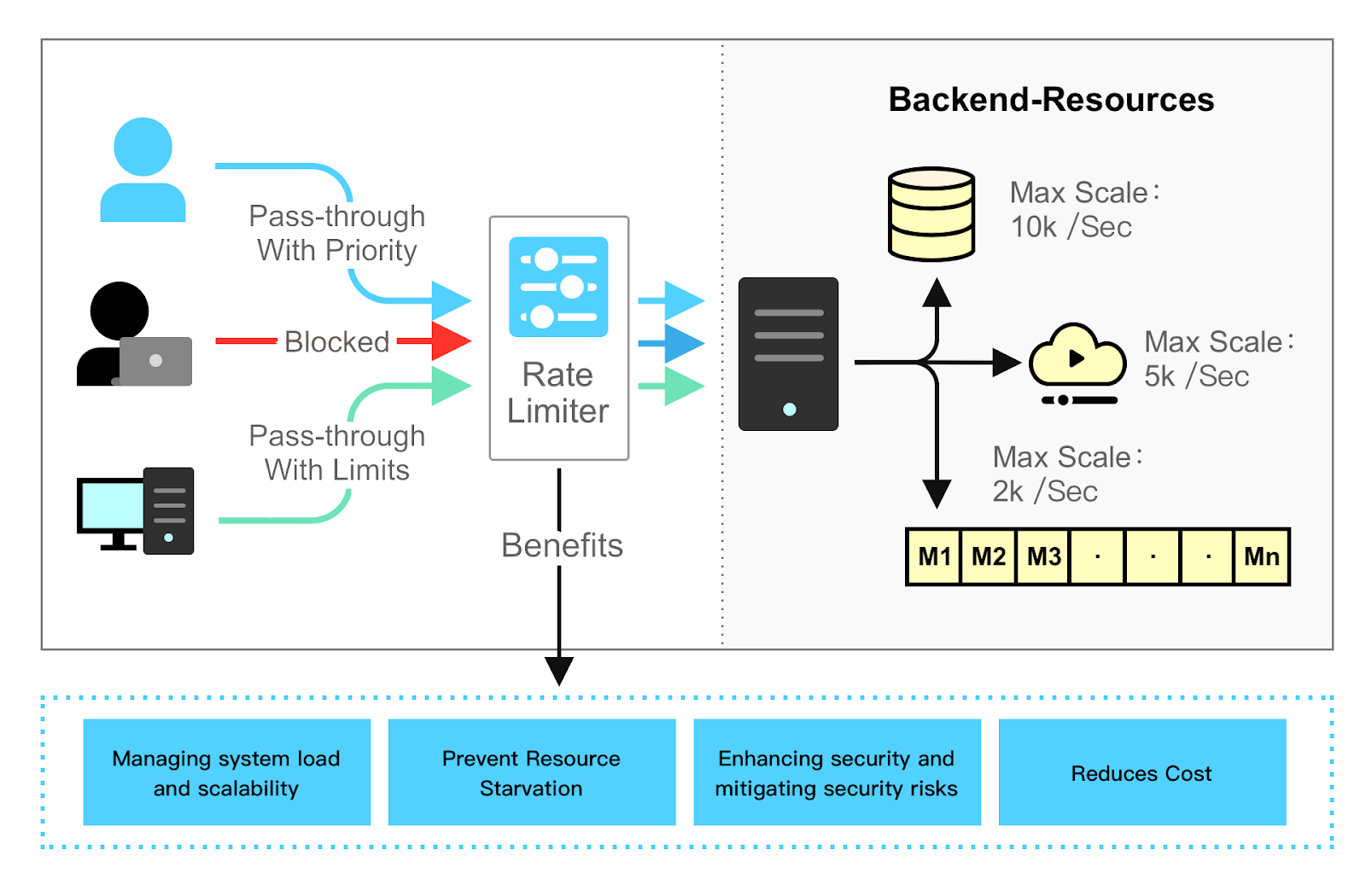
Before diving into code, let's visualize where these controls fit within a system. A rate limiter acts as a gatekeeper, protecting your backend services—and your budget—from being overwhelmed.
1. Understanding the Landscape: Rate Limits, Quotas, and Tokens
The first step in managing API usage is to understand the terminology and the unique challenges LLMs present.
LLM Rate Limiting & Quota Management / Rate Limiting and Quotas for LLM APIs
Let's start by clarifying the key concepts. Please read the following sections from two excellent articles. The first distinguishes between rate limits and quotas, while the second explains why traditional rate limiting is insufficient for LLMs.
First, from the 'reintech.io' article, read the sections 'Understanding Rate Limits vs. Quotas' and 'Common Rate Limiting Patterns in LLM APIs'. This will define the short-term and long-term constraints you'll be working with.
Rate Limiting and Quotas for LLM APIs
Next, from the 'hivenet.com' article, read 'Why plain request limits fail for LLMs' and 'Token‑aware patterns that work'. This will solidify why token-based limits are essential and introduce different ways to measure usage.
To summarize the key points:
- Rate Limits are short-term throttles, like requests per minute (RPM) or tokens per minute (TPM). They prevent service abuse and ensure stability.
- Quotas are long-term allowances, typically a monthly cap on tokens or cost. They are crucial for budget control.
- Simple request-based limiting (
requests/minute) is inadequate for LLMs because the computational work (and cost) of each request can vary dramatically. A request with a 10,000-token prompt is vastly different from one with a 100-token prompt. - Token-aware limiting (e.g., TPM) is the standard for LLMs as it more accurately reflects the actual resource consumption.
2. Client-Side Rate Limiting: The First Line of Defense
The most direct way to avoid hitting a provider's rate limit is to limit yourself before you even make the request. This is done in your application's code.
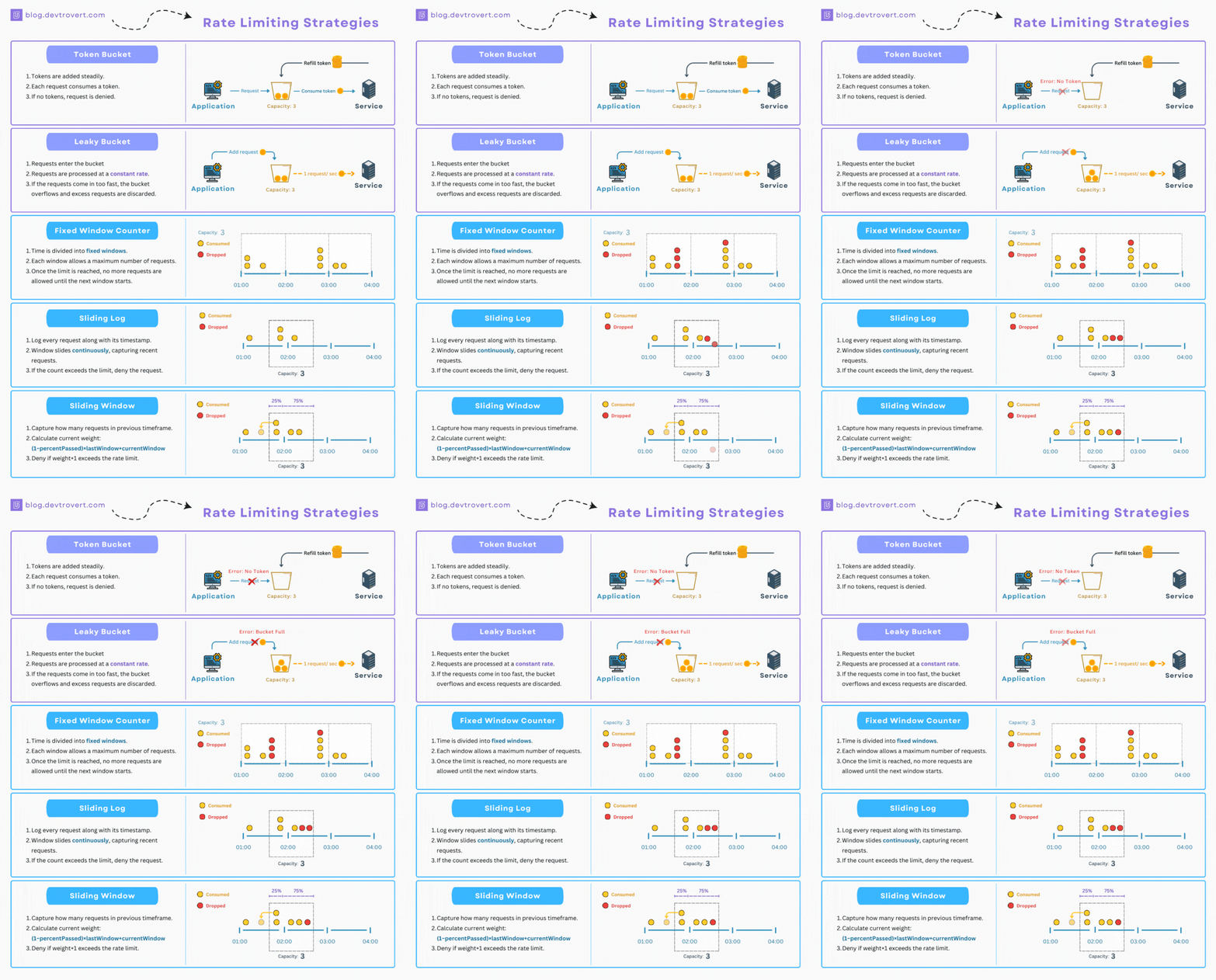
There are several algorithms for this, but the Token Bucket algorithm is an industry standard and is particularly well-suited for managing token-based limits.
Now, let's see how to implement this in Python.
LLM Rate Limiting & Quota Management: Production Best ...
The 'reintech.io' article provides a production-ready Python implementation of the Token Bucket algorithm. It also shows how to manage multiple limits simultaneously (e.g., TPM and RPM), which is a common real-world requirement.
Please read the section 'Implementing Client-Side Rate Limiting'. Study both the TokenBucket and MultiRateLimiter classes. Pay close attention to how the consume and wait_for_tokens methods work.
The core idea of the TokenBucket implementation is that it calculates how many new tokens should have been added to the bucket since the last check, adds them, and then determines if the current request can proceed. This is a very efficient way to avoid hitting the API provider's hard limits.
The MultiRateLimiter class is a practical extension, creating a wrapper that ensures a request is only sent if it satisfies all configured limits (e.g., it doesn't exceed 3,500 RPM and 90,000 TPM).
3. Managing Long-Term Usage and Costs
While a token bucket handles short-term bursts, you also need to manage your long-term consumption to stay within your monthly budget. This involves monitoring, alerting, and sometimes managing quotas based on cost rather than tokens.
Quota Monitoring and Alerting
A good system warns you before you exhaust your quota. This can be implemented with a monitoring class that tracks usage and triggers alerts (e.g., logs a warning, sends a Slack message, or pages an on-call engineer) when you approach a threshold.
Cost-Based Quota Management
For business-critical applications, managing a dollar budget is often more important than a token budget. This is especially true when using multiple models with different price points. A CostBasedQuotaManager abstracts this away, allowing you to check if a potential call fits within your remaining budget.
Per-User Quotas
If you're building a multi-tenant application, you can't let one power user consume the entire system's quota. You need to enforce per-user or per-API-key limits.
LLM Rate Limiting & Quota Management: Production Best ...
The 'reintech.io' article provides excellent, self-contained Python classes for all three of these patterns. As a backend engineer, you'll recognize these as common designs for building manageable services.
Read the following three sections and study their code examples: 'Quota Monitoring and Alerting' (QuotaMonitor class). 'Cost-Based Quota Management' (CostBasedQuotaManager class). 'Handling User-Specific Quotas' (UserQuotaManager class). Focus on the public methods of each class (e.g., record_usage, can_afford, check_and_consume) to understand how they would be integrated into an application.
These patterns move beyond simple API interaction into the realm of robust service architecture, which is a key part of the AI Engineer role.
Test your understanding!
You are building a multi-tenant application that offers 'Free' and 'Pro' tiers. You use the UserQuotaManager and CostBasedQuotaManager from the reading. A 'Pro' user, who has a higher hourly token limit, makes a request using a very expensive model (e.g., GPT-4).
Which manager would be responsible for rejecting the call if:
- The user has made too many requests in the last hour, even though the overall monthly budget for the application is fine?
- The user's hourly limit is fine, but this specific expensive call would push the entire application over its monthly dollar budget?
Show answer
- The
UserQuotaManagerwould reject the call. Its job is to enforce per-user limits over a specific time window (e.g., tokens per hour) to ensure fairness among tenants. - The
CostBasedQuotaManagerwould reject the call. Its responsibility is to track the global, application-wide spending against a total budget, regardless of which user is making the call.
In a real system, you would likely check both: first, can the user afford it within their tier (UserQuotaManager), and second, can the application afford it globally (CostBasedQuotaManager)?
4. Advanced Architectural Patterns
To round out your knowledge, let's briefly touch on a few other advanced patterns that contribute to a highly available and scalable system.
- Request Queuing & Prioritization: When your incoming request volume exceeds your rate limits, you don't have to drop them. You can place them in a queue. A priority queue allows you to process critical, user-facing requests before less urgent background tasks.
- Multi-Provider Fallback: Relying on a single LLM provider is a single point of failure. If OpenAI has an outage, your service goes down. A robust strategy involves integrating multiple providers (e.g., Anthropic, Cohere, Google) and automatically falling back to a secondary provider if the primary one fails or is rate-limited.
- Infrastructure-Level Limiting: In addition to client-side logic, it's a best practice to enforce rate limits at the infrastructure level using an API gateway (like Kong, Traefik, or NGINX). This provides a defense-in-depth layer and can protect your service from misbehaving clients or DDoS attacks. Your experience with Docker is relevant here, as these gateways are typically deployed as containers.
LLM Rate Limiting & Quota Management: Production Best ...
We won't dive deep into the implementation of these, but it's important to be aware of them as architectural solutions. The following sections provide conceptual overviews and code sketches.
Skim through the sections: 'Implementing Request Queuing and Prioritization' 'Multi-Provider Fallback Strategy' 'Rate Limiting at the Infrastructure Level' The goal is to understand what these patterns are and when you might use them, not to memorize the code.
Conclusion
Congratulations on completing this module! You've gone from making simple API calls to designing a robust client application that can handle real-world production challenges.
Key Takeaways:
- Rate limits (short-term) and quotas (long-term) are distinct but related controls for managing API usage.
- For LLMs, token-aware limiting is essential because request cost is variable.
- The Token Bucket algorithm is a standard pattern for implementing client-side rate limiting to proactively avoid hitting provider limits.
- In production, you need to manage more than just tokens; robust systems include quota monitoring, cost-based management, and per-user limits.
- Advanced patterns like request queuing, multi-provider fallbacks, and infrastructure-level limiting provide further layers of reliability and scalability.
What's Next?
So far, our focus has been on building an application that consumes AI models via APIs. We've mastered the engineering practices to do this reliably and efficiently.
In the next module, Deploying AI Models as Services, we will flip the script. You will learn how to take a model and wrap it in your own API, effectively becoming the provider. We'll start by learning how to build a REST API for a trained AI model using FastAPI. This is a perfect next step for a backend engineer, moving you from being a consumer of AI services to a creator of them.