Hello! Welcome to the first lesson in our course designed to sharpen your skills for top-tier consulting interviews.
Given your goal of preparing for final-round interviews, this first module is designed to move beyond standard frameworks and address the core challenge of executive-level problem-solving: ambiguity. Today's lesson focuses on the critical opening moments of a case. We'll work on the skill of taking a complex, often deliberately vague, prompt and distilling it into a precise, solvable problem. Your ability to deconstruct the case objective and its constraints right at the start is the foundation upon which your entire analysis, and ultimately your recommendation, will be built.
By the end of this lesson, you will be able to confidently distill the core objective and key constraints from an ambiguous, multi-layered case prompt, setting you up for success before the analysis even begins.
1. The Critical First Five Minutes
In a case interview, a brilliant analysis of the wrong question is an immediate and definitive failure. The interviewer presents a business situation, and your first task is not to solve it, but to understand it with absolute clarity. Many strong candidates falter here, rushing to apply a familiar framework without ensuring they've correctly identified the client's central problem and success metrics.
To understand the severity of this common misstep, let's begin with a short reading from the My Consulting Coach guide.
2024 Comprehensive Case Interview Guide
This section, "Identify the problem," explains why fully understanding the prompt is the most critical and most frequently failed step. It lays the groundwork for why the techniques we'll discuss today are so essential.
Please read the introduction to the section "Identify the problem". Pay close attention to the author's emphasis on how a simple misunderstanding at the start can derail the entire interview.
This reading underscores a crucial point: the clarification phase is not a preliminary chore; it is your first strategic action in the case. It demonstrates intellectual rigor and a methodical approach—hallmarks of a top consultant.
2. The Art of the Clarifying Question
Your objective in the clarification phase is to transform an ambiguous prompt into a well-defined problem. This involves probing several key areas. Think of it as defining the boundaries of the problem space.
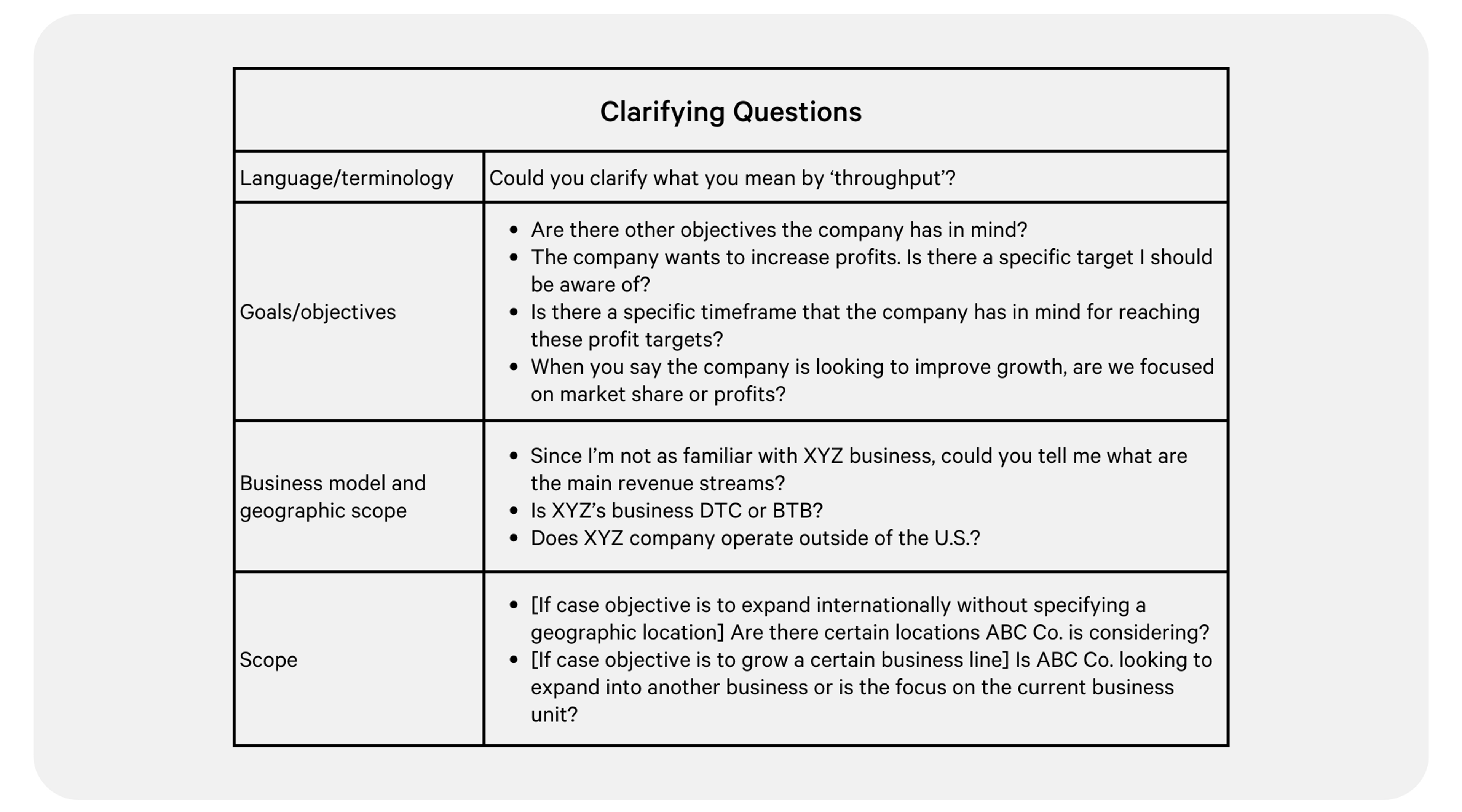
As the table shows, your questions should be targeted. While you are familiar with basic business concepts, final-round cases often introduce nuances. The goal is to confirm:
- The Core Objective: What is the single most important question the client needs answered? Is it about profitability, market share, growth, or something else? Is there a specific target or timeframe?
- Key Constraints & Scope: What is off-limits? Are we focused on a specific geography (e.g., U.S. only) or product line? Are there any known capital or resource constraints?
- Definitions: Are there any terms in the prompt that could be misinterpreted? "Improving performance" can mean many things—it's your job to clarify if it means revenue growth, margin improvement, or operational efficiency.
Let's see how this plays out in practice. The following video from CraftingCases shows a candidate tackling a profitability case. Pay close attention to how her initial questions immediately narrow the scope of the problem.
Profitability Case Study Interview Example - Solved by Ex-McKinsey Consultant
Watch this clip where the interviewee is presented with the case and begins asking clarifying questions. Notice how each question is designed to test a hypothesis about the problem's nature.
Watch from the start of the case prompt until the end of the initial clarification phase, specifically noting the questions about competitor performance and business scope.
Her questions—"Did our competitors' profitability decrease as well?" and "Are we luxury or mass market... Is this global?"—are masterful. In seconds, she establishes that this is not an industry-wide issue and defines the client's business and geographic scope. She isn't asking for data; she's defining the problem.
3. A Mental Framework for Deconstruction: SCQA
While asking questions is the external action, you need an internal mental model to structure your own thinking as you absorb the prompt. The SCQA framework (Situation, Complication, Question, Answer) is a powerful tool used by consultants to bring clarity to complex narratives.
- Situation: The established context that everyone agrees on. It’s a stable, factual starting point.
- Complication: The change, disruption, or challenge that destabilizes the situation and creates the problem.
- Question: The core question that arises from the tension between the Situation and Complication. This becomes your case objective.
- Answer: Your initial hypothesis, which will guide the structure of your analysis (a topic for our next lesson).
Let’s use the prompt from the video you just watched as an example:
- Situation: We are a U.S. auto manufacturer with 5% profitability five years ago.
- Complication: Our profitability has fallen to 2.5%, while our competitors' average profitability has increased to over 3.5%.
- Question: How can we identify the root cause of our profitability decline and develop a plan to restore it within two years?
Thinking in this structured way helps you rapidly identify the core tension of the case. The following reading provides more detail on applying SCQA to strategic problems.
This article eloquently explains the SCQA framework and its application in high-stakes problem diagnosis. It will provide you with a robust internal monologue for deconstructing prompts.
Please read the sections Deconstructing SCQA and the two examples under "SCQA in Action". Focus on how the framework systematically moves from a general context to a precise, actionable question.
4. Demonstrating Understanding: The Synthesis and Playback
After absorbing the prompt and asking clarifying questions, you must synthesize your understanding and "play it back" to the interviewer. This is not a simple repetition. It is a structured restatement that confirms you have grasped the objective, the key metrics, the constraints, and the scope of the expected answer.
Let's watch another example. This case, from Management Consulted, involves a more ambiguous strategic question than the last one.
Case Structure: Walkthrough Video
This video is a prime example of handling a strategic, non-standard prompt. The candidate, Lisa, excels at clarification and synthesis.
First, watch the prompt and Lisa's masterful recap and clarification, from prompt to question. Note how she rephrases the problem, connecting "lagging performance" to both top-line and bottom-line issues. Her question about "targets" is crucial for defining success. Next, skip ahead to the interviewer's feedback on this specific part of her performance. Watch from the recap feedback. The interviewer explicitly praises how her clarifying questions informed the structure she would later build.
This playback step serves two purposes:
- It gives the interviewer a final chance to correct any misunderstanding.
- It demonstrates your ability to synthesize disparate facts into a coherent problem statement—a core consulting skill.
5. Advanced Application: Defining the Engagement
For a final-round candidate, simply identifying the problem isn't enough. You must also clarify the scope of the engagement—that is, what does the interviewer expect from you by the end of the 30-minute case? Are you delivering a root-cause diagnosis, a list of strategic options, or a quantified recommendation with next steps?
Let’s return to the CraftingCases video for a crucial piece of advanced feedback.
Profitability Case Study Interview Example - Solved by Ex-McKinsey Consultant
In this final clip, the interviewer gives feedback on how a good candidate could elevate their opening to a great one.
Please watch the feedback section from this point. The interviewer explains that a top-tier candidate would not only plan to find the root cause but would also lay out a roadmap for developing and evaluating solutions.
This is a high-level move. By framing your approach upfront to include not just diagnosis but also solution generation and evaluation, you are transitioning from a student answering a question to a consultant managing an engagement. You can incorporate this into your synthesis: "So, to confirm, my task is to first diagnose the root cause of the profitability decline, then propose a set of solutions, and finally, evaluate their potential impact to provide a recommendation. Is that correct?"
Conclusion
Mastering the opening of a case is about control and precision. By resisting the urge to jump to solutions, you create the space to define the problem on your own terms. This methodical approach is what separates good candidates from great ones.
Key Takeaways:
- The first few minutes are strategic: Use them to demonstrate rigor, not speed.
- Ask targeted, insightful questions: Your goal is to narrow the problem space by clarifying the core objective, scope, and key definitions.
- Use SCQA as a mental model: Internally deconstruct the prompt into Situation, Complication, and a core Question.
- Synthesize and play back: Confirm your understanding with the interviewer, including the scope of the expected answer.
- Define the engagement: Frame your approach to show you're thinking not just about the problem, but about the entire problem-solving process from diagnosis to recommendation.
In our next lesson, we will build directly on this foundation. Once you have a crystal-clear objective, the next step is to design a bespoke, hypothesis-driven framework to structure your analysis. We will explore how to move beyond standard templates to create a MECE structure tailored to the unique complexities of any non-traditional business problem.