Hello! In our last lesson, we focused on the crucial first step of any case: deconstructing an ambiguous prompt to define a precise core objective and its constraints. You learned how to use clarifying questions and mental models like SCQA to establish a clear "key question" for the engagement.
Today, we'll build directly on that foundation. Once you have the right question, the next step is to design a logical, robust structure to guide your search for the answer. This lesson moves beyond the standard frameworks you've likely encountered in your MBA program. We will concentrate on formulating a bespoke, hypothesis-driven, and MECE (Mutually Exclusive, Collectively Exhaustive) framework tailored to the unique contours of any business problem, especially non-traditional ones often seen in final-round interviews. Mastering this skill is a hallmark of a top-tier consulting candidate, demonstrating structured, creative thinking under pressure.
1. Beyond Templates: The Case for Custom Frameworks
Your MBA studies have equipped you with a toolbox of established business frameworks—the 3 Cs, Porter's Five Forces, the 4 Ps, and standard profitability breakdowns. While these are foundational, relying on them as plug-and-play templates in a case interview is a common pitfall. Interviewers are not testing your ability to recall a framework; they are assessing your ability to think. Presenting a generic framework for a nuanced problem can suggest you're trying to fit a square peg into a round hole.
In real consulting engagements, problems are rarely neat and tidy. The most effective consultants create custom issue trees for each unique client situation. Your case interview is a simulation of this process. The goal is to demonstrate that you can build a logical structure from first principles, tailored specifically to the problem at hand.
To understand why this is a critical distinction for advanced candidates, let's start with a reading from the 'I Got An Offer' blog.
Common Case Interview Frameworks (and how to create ...
This article makes a strong case for moving beyond memorized templates. It explains the limitations of pre-existing frameworks and outlines why custom-built structures are the gold standard in consulting interviews.
First, read the section "Why create your own framework?" Then, read the critique under the heading "Why you shouldn’t use pre-existing case interview templates". Pay attention to the arguments against methods like Case in Point and Victor Cheng's LOMS.
The key takeaway is that while standard frameworks provide useful building blocks, your final structure should be a unique construction, assembled to address the specific "key question" you identified in the opening of the case.
2. MECE: From a Rule to a Mindset
The guiding principle for any good structure is that it must be MECE: Mutually Exclusive (no overlaps) and Collectively Exhaustive (no gaps). You are certainly familiar with the term, but for advanced casing, you need to treat MECE not as a simple rule applied to Profit = Revenue - Costs, but as a flexible, creative mindset.
A problem can be broken down in many MECE ways. The art is in choosing the decomposition that is most insightful for the problem at hand.

For non-traditional problems—which are common in final rounds—you often can't rely on a simple equation. Cases like "How can a city increase tourism?" or "How can a university improve its graduate employment rate?" require conceptual, not just algebraic, frameworks. You have to break the problem down into its logical, constituent parts.
This video from CraftingCases provides an excellent overview of creating these conceptual frameworks.
Conceptual Frameworks: The 3rd Way To Be MECE In Case Interviews
This video explains the difference between algebraic structures and conceptual frameworks, which are essential for tackling qualitative or strategic problems.
First, watch the introduction explaining what conceptual frameworks are and how they differ from formulas. Then, watch the next segment, which demonstrates how to build custom conceptual frameworks for non-traditional cases, such as improving law firm staff quality or a business school education.
The video shows how you can deconstruct a complex system (like "staff quality") into its core components (smarter people, more experienced people, better training, etc.) in a MECE way. This is the type of first-principles thinking that interviewers are looking for.
3. Structuring with Purpose: Hypothesis-Driven Issue Trees
Now that we've established the need for bespoke, conceptually MECE frameworks, let's connect this to a hypothesis-driven approach. A weak framework simply lists areas to explore ("Customers," "Competitors," "Company"). A strong framework is built around a set of initial hypotheses that you intend to test.
The most effective tool for this is the issue tree (also called a decision tree). You start with your main hypothesis, which directly addresses the key question, and then break it down into smaller, MECE sub-hypotheses that you need to prove or disprove. Each branch of your tree becomes a core component of your analytical framework.
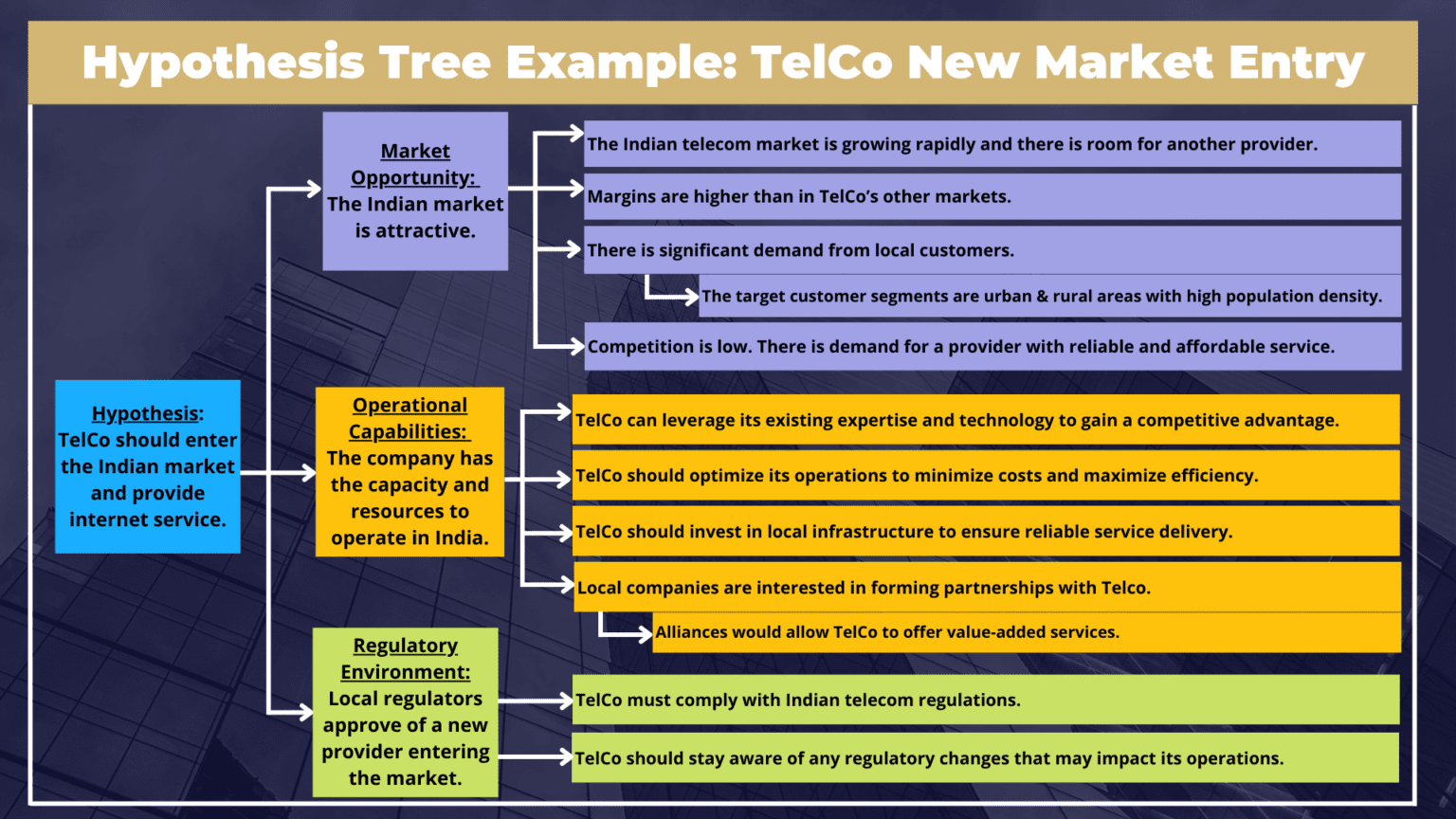
The following resource from Firmsconsulting provides a detailed walkthrough of how to build these hypothesis-driven issue trees.
Using Decision Tree Consulting to Build MECE Hypotheses
This article details the methodology for using a decision tree to methodically generate MECE hypotheses, linking your structure directly to the problem you need to solve.
First, read the section An Effective Technique. This explains the overall 6-step process. Then, focus on the detailed example provided. Read from the start of the example about the French restaurant through to the end of the article. This will show you how to apply the technique, from clarifying questions to structuring the tree and forming specific hypotheses for each branch.
The critical insight here is that by building your framework off the branches of an issue tree, you ensure by design that it is both MECE and directly tied to a testable hypothesis. You're not just exploring; you're systematically investigating.
4. Teardown: From a Generic Framework to an A-Grade Structure
Let's bring these concepts together. A great framework is not just created; it's refined. It has layers of specificity and insight that go beyond a simple list of buckets.
The following video is a masterclass in this refinement process. It takes a generic, C-minus market entry framework and transforms it into an A-grade structure by applying three specific shifts. For an advanced candidate like yourself, this is an incredibly valuable process to internalize.
Framework Teardown: How To Improve Your Case Interview Frameworks
This video from CraftingCases deconstructs and rebuilds a case framework, showing the concrete steps to elevate it from generic to insightful. It's one of the most practical guides available for this skill.
This video is worth watching in more detail. First, watch the introduction of the case and the "C-minus" framework from the case question. This sets the baseline. Next, understand the three shifts. The first shift is about making your structure more exhaustive. Watch how the presenter adds the "Distribution channels" bucket and rephrases category names to show purpose. The second shift is about making your issues more specific. Watch from the introduction to customizing issues, where the presenter explains how to add industry-specific color and examples. The third and most important shift is adding hypotheses. Watch from the introduction to adding hypotheses to understand how this provides the "why" behind your questions. Finally, to see the end result, watch the presenter deliver the full, polished, A-grade framework, from presenting the full framework. Notice how the hypotheses are woven into the structure.
The three shifts presented in this video are a powerful toolkit for you to practice:
- Expand Categories: Are there any missing players or structural elements? Go beyond the standard 3 Cs.
- Make Issues Specific: Add industry-specific examples and nuances. Pass the "toothbrush test" (i.e., would this issue apply to a case about toothbrushes? If so, it's too generic).
- State Your Hypotheses: For each bucket or key issue, explicitly state the underlying hypothesis you are testing. This shows the interviewer you are thinking with purpose.
Conclusion
You have now moved from defining the core question to structuring a sophisticated plan to answer it. This is the engine of a successful case interview. By abandoning templates and building bespoke, hypothesis-driven issue trees, you demonstrate the structured, creative, and purposeful thinking that defines top-tier consultants.
Key Takeaways:
- Custom over Canned: Generic frameworks are a red flag in advanced interviews. Always build a structure tailored to the specific problem.
- MECE as a Creative Tool: Use the MECE principle to break down non-traditional problems conceptually, not just algebraically. Think in terms of processes, stakeholders, or causal factors.
- Structure Follows Hypothesis: Use an issue tree to break down a main hypothesis into MECE sub-hypotheses. These sub-hypotheses form the buckets of your framework.
- Refine for Insight: Elevate a good structure to a great one by making it more exhaustive (adding relevant categories), specific (injecting industry nuance), and purposeful (explicitly stating the hypotheses for each area of inquiry).
In our next lesson, we will address a crucial dynamic of live case interviews. You've built your perfect framework, but the interviewer gives you a piece of data that contradicts your initial hypothesis. We will focus on how to adapt your analytical framework mid-case without losing your structure or composure.