Welcome to the third module of your course!
In our last lesson, we concluded our exploration of customer psychology by focusing on how to build trust with your target audience in East Africa. We identified specific relational, transactional, and professional signals that reassure customers and make them feel confident in purchasing from you.
Now that we understand your customer, it's time to define your brand's core identity. This is the foundation upon which you'll build your visual style, your voice, and your marketing strategy. This lesson addresses the learning outcome: Develop a brand mission and vision statement aligned with business goals.
These two statements are the North Star for your brand. They answer the fundamental questions of "Where are we going?" (your vision) and "How will we get there?" (your mission). Getting these right ensures that every decision you make—from the colors you choose to the content you post—is purposeful and aligned with your ultimate goal for your woodworking studio.
What's the Difference? Vision vs. Mission
The terms "vision" and "mission" are often used interchangeably, but for strategic purposes, it's vital to distinguish them.
- A Vision Statement is about the future. It paints a picture of the world you want to create and your ultimate long-term goal. It answers the question: Where are we going?
- A Mission Statement is about the present. It describes what your company does, who it serves, and how it does it, in service of that vision. It answers the question: What do we do to get there?
To start, let's watch a short video that clearly explains this distinction and provides a simple checklist for a good vision statement.
How to Write a Vision Statement
This video from OnStrategy, titled 'How to Write a Vision Statement,' offers a clear and practical breakdown of what a vision statement is and how it differs from a mission. It also provides a helpful checklist of characteristics.
Please watch the following two segments: 00:04 - 00:47: Pay attention to the distinction between vision ('where') and mission. 01:23 - 02:29: Focus on the checklist for an effective vision statement (long-term, future-tense, audacious, etc.).
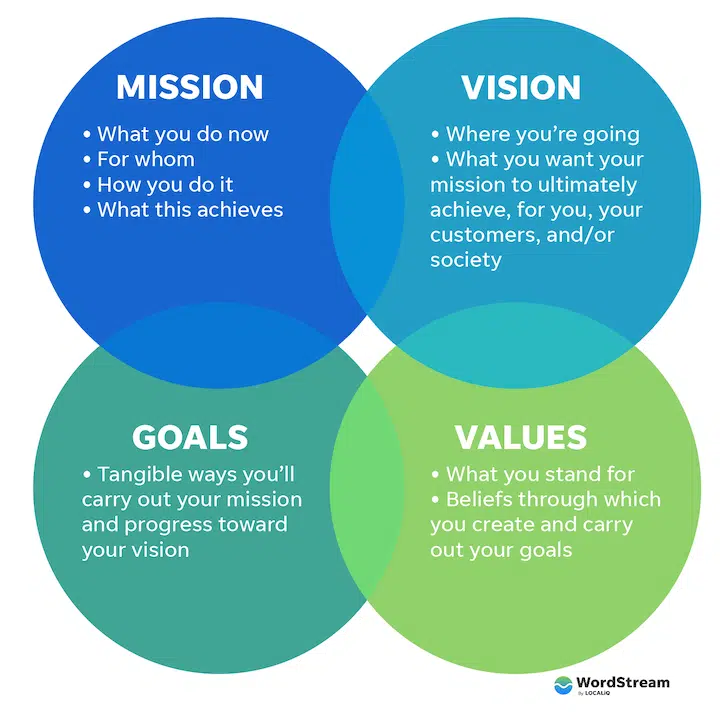
This diagram is another helpful way to visualize the relationship between these concepts. Your Vision is the ultimate destination, your Mission is the vehicle, your Goals are the roadmap, and your Values are the code of conduct for the journey.
Crafting a Powerful Vision Statement
Your vision should be more than just a business objective; it should be inspiring. It's the "why" that will motivate you and eventually, your team and your customers.
A great way to think about this is through the lens of a "Just Cause," a concept developed by author Simon Sinek. A Just Cause is a vision of a future state that is so appealing that people are willing to make sacrifices to help build it.
3 Things that Make a MEANINGFUL Vision | Simon Sinek
In this clip, '3 Things that Make a MEANINGFUL Vision,' Simon Sinek explains his criteria for a powerful vision, which he calls a 'Just Cause.' This will help you elevate your vision from a simple goal to an inspiring purpose.
Watch the full clip (it's short!). Focus on his three tests for a meaningful vision: Resilient: Can it withstand changes in technology or culture? Inclusive: Does it invite everyone to contribute? Service-Oriented: Is its primary benefit for others (your customers, community, etc.)?
Applying this to your brand:
- Resilient: Your vision shouldn't be "to be the best CNC furniture maker." Technology changes. A more resilient vision might be "to be the benchmark for modern African design" or "to fill East African homes with beautiful, locally-made, enduring objects."
- Inclusive: It should inspire a future designer, a salesperson, a delivery driver, and a customer equally.
- Service-Oriented: The ultimate beneficiary should be your customer and your community, not just your profit margin.
Let's look at a concrete example from a relevant industry.
A Planning Guide for Small and Medium Sized ...
This 'Planning Guide for Small and Medium Sized Wood Products Companies' provides a perfect example of a vision statement in your sector. It shows how a company can articulate its long-term ambition.
Read the section titled 'Vision (Where are we going?)'. Pay close attention to the definition of a vision statement and the example provided for a wood component manufacturer.
Developing a Clear Mission Statement
If the vision is your "where," the mission is your "how." It's grounded in the present day and defines your core purpose in a practical way. Your engineering background will be very useful here, as a great mission statement is structured and precise.
A highly effective way to structure your mission is to answer three questions:
- Who do we serve?
- What do we provide?
- How do we provide it?
The same planning guide for wood companies has an excellent section on this.
A Planning Guide for Small and Medium Sized ...
Let's return to the 'Planning Guide.' This next section breaks down the mission statement into the 'Who, What, How' framework, which is a fantastic, practical tool for writing your own.
Read the section titled 'Mission (We will be...).' Focus on how the East Brady Woodworks example is broken down into 'who,' 'what,' and 'how.'
Now, let's look at a real-world example of an African luxury brand that has a powerful mission.
The Queen Of African Luxury: Swaady Martin-Leke ...
This Forbes article about Swaady Martin-Leke, founder of the luxury brand YSWARA, provides a brilliant example of a mission that goes beyond the product itself. YSWARA is a great case study for your own premium African brand.
Read the two highlighted sections. First, under the question about what YSWARA does, find their mission statement. Then, read the section on the 'initial idea' to understand their 'Luxe Ubuntu' concept. Notice how their mission combines economic and social goals.
YSWARA’s mission is a perfect example.
- Who: The world (customers, artisans, farmers).
- What: Exceptional products that promote and preserve Africa’s culture.
- How: By using natural resources, working with African artisans, and combining traditional techniques with contemporary designs.
Your Turn: Draft Your Mission and Vision
Now it's time to apply these concepts to your woodworking brand. Use the frameworks we've discussed to write the first draft of your vision and mission statements. Don't worry about getting them perfect; the goal is to get your core ideas down on paper.
This image shows a "Brand Strategic Canvas" where these statements often live. It's a good reminder of their foundational role.

Activity: Draft Your Brand's Mission & Vision
Take 10-15 minutes to write down your initial thoughts. Use the prompts below to guide you.
To draft your Vision Statement (The Future / The "Why"):
- Think 10 years ahead. What is the ultimate impact you want your brand to have had on design and craftsmanship in East Africa?
- What does the world look like if you succeed? (e.g., "A world where...")
- What is the "Just Cause" behind your business? Is it resilient, inclusive, and service-oriented?
Example Vision Starter: "To be the leading voice in contemporary East African furniture design, crafting heirloom pieces that blend modern innovation with timeless local artistry."
To draft your Mission Statement (The Present / The "How"):
- Who are you serving? (Be specific: e.g., discerning homeowners and interior designers in Tanzania and Kenya).
- What do you provide them? (e.g., precision-crafted, customisable furniture).
- How do you do it? What makes your process unique? (e.g., by using CNC technology, sustainable local hardwoods, and a collaborative design process).
Example Mission Statement: "Our mission is to create exquisite modern furniture for style-conscious clients in East Africa. We achieve this by combining advanced CNC manufacturing with the rich heritage of local materials and craftsmanship, delivering unparalleled quality and service from design to installation."
Conclusion
In this lesson, we've laid the cornerstone of your brand strategy. You've learned the critical difference between a vision and a mission and have begun to articulate your own.
Key Takeaways:
- Vision is your "Where": A long-term, inspiring picture of the future you aim to create. It should be audacious, resilient, and service-oriented.
- Mission is your "How": A present-day, practical statement defining who you serve, what you do, and how you do it, in service of your vision.
- The "Who, What, How" framework is a structured and effective tool for building a clear mission statement.
- These statements are not just for a business plan; they will guide every creative and strategic decision you make for your brand.
Next Up:
With your vision and mission defined, we need to determine the principles that will guide your brand's behavior. In the next lesson, we will identify and articulate your brand values. These values will ensure that the way you operate your business is in perfect harmony with the mission you've just defined and the vision you aspire to achieve.