Hello! Welcome back to your course on building your brand.
In our last lesson, we set the strategic direction for your woodworking studio by drafting your brand's mission and vision statements. You defined where you are going (your vision) and what you do to get there (your mission).
Now, we'll build on that foundation by defining your brand's character. This lesson focuses on the learning outcome: Identify and articulate brand values that resonate with target customers.
Brand values are the non-negotiable principles that guide every action, decision, and communication your brand makes. They are the 'code of conduct' for how you will achieve your mission and realize your vision. For a premium brand like yours, values are not just internal guidelines; they are the very soul of the story you tell your customers, creating the desire and trust that justify a premium price.
What Are Brand Values and Why Do They Matter?
At their core, brand values are the beliefs you stand for. They ensure consistency and build a genuine connection with your audience. To start, let's get a clear definition.
How To Define Your Core Brand Values (Steps + Examples)
This video, 'How To Define Your Core Brand Values' by Brand Master Academy, provides an excellent overview of what brand values are and why they are crucial for building trust.
Please watch from 01:01 to 03:12. Focus on the explanation of values as the 'guiding principles that guide our decisions and actions' and how they help a brand show up as if it 'stands for something.'
As the video explains, values are not just keywords to put on a website. They are actionable principles that shape your brand's reputation. For your premium woodworking studio, strong values answer the customer's implicit question: "Why should I trust you and invest in your work?"
This is especially true in the luxury market, where the story and the feeling behind a product are often more important than its functional benefits.
How Luxury Brands Get You to Buy Into Their Hype
To understand the psychology of premium pricing, let's watch a clip from 'How Luxury Brands Get You to Buy Into Their Hype'. It powerfully illustrates how storytelling, rooted in values, creates perceived worth.
Watch the first minute of the video (00:00 - 01:04). Notice how the perceived value of the sunglasses changes dramatically once a story of craftsmanship, heritage, and exclusivity is introduced. These are all expressions of brand values.
This is the power you are aiming to harness. Your values around craftsmanship, design, and materials will form the story that elevates your furniture from a simple product to a desirable piece of art.
Values for a Premium African Brand
To resonate with your target customers in Tanzania and Kenya, your values must reflect not only universal premium cues but also local cultural context. This involves a blend of what makes something feel luxurious globally and what makes it feel meaningful locally.
Universal Premium Values
Globally, premium and luxury brands often build their stories around a few key value concepts. As you watch this next segment, think about how these apply to woodworking.
How Luxury Brands Get You to Buy Into Their Hype
Returning to the 'Design Theory' video, this section explores the value of 'quality of time' in luxury, which is directly applicable to craftsmanship.
Watch from 12:09 to 19:44. Pay attention to how luxury focuses on: Painstaking Craftsmanship: The time and skill invested in creation (e.g., hand-cut gears, hundreds of hours per product). Timeless Design: Creating 'long sellers' that don't bow to trends. Durability & Legacy: Using materials that last for generations, creating family heirlooms.
Values like meticulous craftsmanship, timelessness, durability, and authenticity are central to the promise of a premium furniture brand. They assure the customer they are buying a piece that will last a lifetime.
The 'Afro Luxe' Context: Luxury Ubuntu
Now, let's layer in the specific cultural context. A growing movement in African luxury, often called 'Afro Luxe' or 'Luxury Ubuntu', redefines luxury not just by what you own, but by its connection to community, heritage, and social value.
The Development of African Luxury Brands
This research paper, 'The Development of African Luxury Brands,' contains a crucial section on 'Luxe Ubuntu.' It explains how luxury in an African context is intertwined with community and culture, providing a powerful framework for your brand.
Please read the section titled 'Afro Luxe and Luxury Ubuntu' (starts on page 41). Focus on the core idea that African luxury adds 'the community as a core element' and involves the celebration of cultural heritage. Don't worry about memorizing every detail; just absorb the main concept.
This concept is your unique advantage. By embracing it, your brand can stand for more than just beautiful furniture. It can represent values like:
- Community Empowerment: Using local materials and providing local jobs.
- Cultural Heritage: Drawing inspiration from East African design motifs, stories, or traditions.
- Sustainability: Honoring the natural resources you work with.
The paper provides a fantastic case study of a brand that does this well.
The Development of African Luxury Brands
Let's look at the case study of 'Maxhosa by Laduma' in the same document. It's a perfect example of translating cultural heritage into a successful premium brand.
Read the short section 'A luxury African brand: Maxhosa by Laduma' (page 45). Notice how the designer took inspiration from his Xhosa heritage and prioritized local production. This is a model for how you might integrate your own context.
How to Define Your Brand Values
Now let's get practical. Defining your values is a process of reflection and refinement. This image provides a great visual guide for the journey.
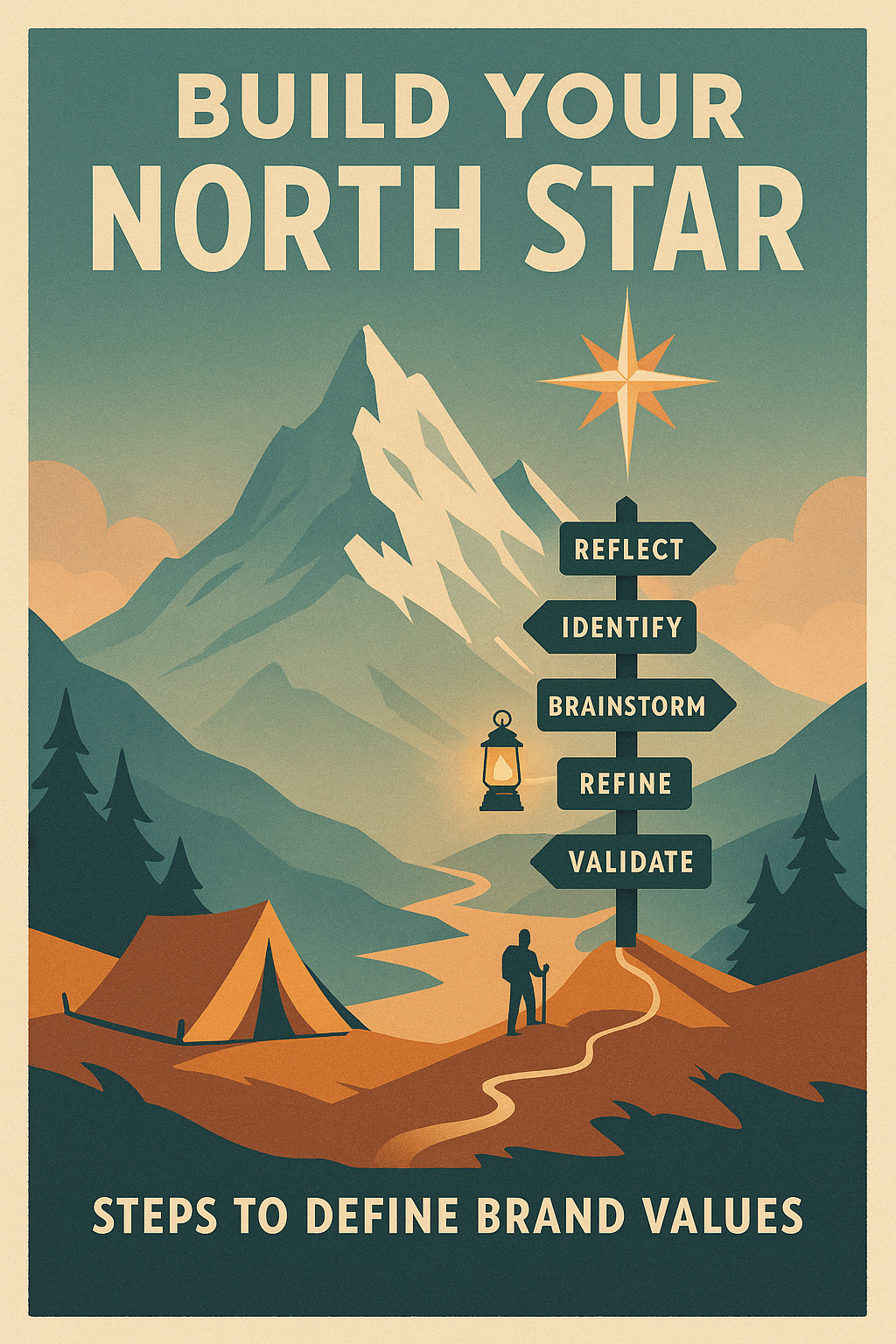
We will use a simplified four-step version of this process.
Step 1: Brainstorm
First, gather your raw ideas. Don't filter yourself. Think about:
- What you believe in: As an engineer and designer, what standards of quality, precision, or innovation are important to you?
- What you want customers to say: When a customer talks about your brand, what words do you want them to use? (e.g., "They are true artists," "The quality is unmatched," "You can trust them completely.")
- Your Brand Story: Why did you start this business? What's the passion behind it?
- The Opposite: What behaviors in business disappoint you? (e.g., dishonesty, cutting corners, poor service). The opposite of these are often strong values.
Step 2: Shortlist
Look at your brainstormed list. Group similar ideas and identify the most powerful themes. Aim to narrow it down to 3-5 core values. These should be the most authentic to you and the most relevant to your premium East African customer.
Step 3: Articulate
This is the most important step. A single word like "Quality" is generic. You must expand it into a unique, actionable statement that is memorable and specific to you.
The Beginners Guide To Brand Values (+ Examples)
This article, 'The Beginners Guide To Brand Values,' offers practical advice on writing your values and provides great examples.
First, skim the lists under the section 'What brand values are right for your business?' for inspiration (e.g., craftsmanship, precision, expertise). Next, read the section 'How do you write brand values?' focusing on making them clear, sincere, and distinct. Finally, look at the 'Examples of brand values' to see how companies like Adidas or Coca-Cola articulate their principles.
For example, instead of just "Craftsmanship," you might write: "We honor wood and wielder alike, blending timeless artisanal techniques with modern precision to create furniture with soul."
Step 4: Validate
Look at your 3-5 articulated value statements. Ask yourself:
- Are these authentic to me and my mission?
- Will they resonate with a customer seeking premium, locally-made furniture in Tanzania or Kenya?
- Can I use these to make real business decisions? (e.g., about material sourcing, design choices, customer service).
Test your understanding!
Imagine a competing furniture maker in Nairobi lists "Integrity" as a value. How could they articulate this value to make it unique and actionable, rather than just a generic keyword?
Show answer
A generic statement is just "Integrity." A more powerful, articulated value could be: "We build lasting relationships by being transparent in our pricing, honest about our process, and accountable for every piece that leaves our workshop." This is specific, sets clear expectations, and builds trust.
Activity: Define Your Woodworking Brand's Values
Now it's your turn. Set aside 15 minutes to work through this process. Use a notebook or a document to capture your thoughts.
1. Brainstorm: Write down at least 10-15 words or phrases that come to mind based on the prompts in Step 1. Mix in premium concepts (e.g., heritage, precision) and 'Afro Luxe' ideas (e.g., community, local materials).
2. Shortlist: Circle the 3-5 most important themes from your list.
3. Articulate: For each shortlisted theme, write a full sentence or two that makes it unique to your brand.
Here is an example to get you started:
- Theme/Keyword: Design
- Articulated Value: We find inspiration in the contours of the East African landscape, creating minimalist forms that are both globally contemporary and deeply rooted in place.
Use this as a model to develop your own set of core values. This exercise is the heart of this lesson.
Conclusion
In this lesson, you have moved from the 'what' of your brand to the 'how.' You have explored the essential role of brand values in creating desire, especially in the premium and luxury space.
Key Takeaways:
- Values are Guiding Principles: They are the actionable beliefs that shape your brand's behavior and build trust.
- Premium Values Tell a Story: For a luxury brand, values like craftsmanship, heritage, and authenticity are the foundation of the story that creates perceived worth.
- 'Luxury Ubuntu' Offers a Unique Angle: Integrating values of community, cultural heritage, and social good can create deep resonance with your East African audience.
- Articulation is Key: Moving beyond single keywords to unique, memorable sentences is what makes values ownable and powerful.
Next Up:
With your brand's guiding principles defined, we can now give it a face and a voice. In our next lesson, we will use these values to create a brand personality using an archetypal framework. Your values will help us determine if your brand is a "Creator," a "Sage," a "Ruler," or another archetype, which will, in turn, guide your brand's voice and visual style.