Hello! Welcome to your third lesson.
In our last session, we established the fundamental force law of electrostatics, Coulomb's Law, which allows us to calculate the force between charges. We ended by noting that instead of thinking of forces acting at a distance, it's often more useful to think of a charge creating an electric field that permeates the space around it.
Today, we will build directly on that idea to explore one of the most central concepts in all of electronics: electric potential difference, more commonly known as voltage. This lesson is designed to help you define electric potential difference (voltage) and its relationship to the electric field.
We will start with an intuitive, analogy-driven approach to understand what voltage is, then formalize the definition with physics principles, and finally derive the crucial mathematical link between voltage and the electric field. Understanding this relationship is key to moving from static charges to the dynamic world of circuits.
1. What is Voltage? An Intuitive Approach
In the last lesson, we saw that an electric charge experiences a force in an electric field. If we want to move that charge against the direction of the force, we have to do work. This work isn't lost; it's stored as electric potential energy.
This is perfectly analogous to gravity.
- Lifting a ball against the gravitational field gives it gravitational potential energy.
- Moving a positive charge against an electric field (i.e., towards another positive charge) gives it electric potential energy.
The higher you lift the ball, the more potential energy it has. The "height" itself isn't energy, but it represents the potential for energy. Voltage is the electrical equivalent of height. It's a measure of the electric potential energy per unit of charge.
To build a solid intuition for this, let's watch a video that uses some excellent analogies.
An intuitive approach for understanding electricity
The video 'An intuitive approach for understanding electricity' by AlphaPhoenix uses a fantastic analogy of a 'hill' to explain voltage. It also clarifies the distinction between energy and voltage.
Please watch the segment from 11:04 to 13:17. Pay close attention to the comparison between gravitational potential energy (MGH) and electrical potential energy. Notice how voltage is analogous to height, not to energy itself.
As the video explains, a volt is not a unit of energy (like a Joule). It's a unit of energy per charge (Joules per Coulomb).
This distinction is crucial.
2. Formal Definition: Potential and Potential Difference
Let's make our definitions more precise. The textbook University Physics provides clear, formal definitions.
7.3: Electric Potential and Potential Difference
This reading from 'Electric Potential and Potential Difference' formalizes the concepts we've just discussed.
Please read the first part of this page, down to the end of Example 1 ('Calculating Energy'). Focus on the definitions of Electric Potential (V) and Electric Potential Difference (ΔV), and the relationship between potential difference and electrical potential energy.
From the reading, we can summarize the key relationships:
- Electric Potential (V): The potential energy () per unit charge ().
- Electric Potential Difference (): The change in potential energy () when a charge moves between two points, divided by the charge. This is what we call voltage.
The example of the car battery versus the motorcycle battery is excellent. Both can be 12V batteries, meaning they provide 12 Joules of energy to every Coulomb of charge that moves between their terminals. However, the car battery can move a much larger total amount of charge, so it stores far more total energy ().
An important note on reference points: Voltage is always a difference between two points. When we say a point is "at 5 volts," we implicitly mean it is 5 volts higher in potential than a reference point, which we define as 0 volts (often called "ground"). This is just like saying a mountain peak is 8,000 meters high, which means 8,000 meters above sea level (our 0-meter reference).
3. The Relationship Between Electric Field and Voltage
Now for the core of today's lesson: connecting voltage () back to the electric field ().
Intuitively, the electric field points "downhill"—from a region of high potential to a region of low potential. A steep hill corresponds to a strong gravitational field; likewise, a region where the voltage changes rapidly corresponds to a strong electric field.
Let's formalize this.
From Field to Voltage
We know that the change in potential energy () is the negative of the work done by the field (). And work is the integral of force () over a path ().
Since and , we can divide by to get the fundamental relationship:
This equation tells us that the potential difference between two points is the negative of the line integral of the electric field along any path connecting them.

From Voltage to Field
We can also express the relationship in reverse. In one dimension, the relationship simplifies to:
The electric field is the negative gradient of the potential. The minus sign tells us that the field points in the direction of decreasing potential. The derivative tells us that the magnitude of the field is equal to how steeply the potential changes with distance.
This gives us a new unit for the electric field. We first defined it as force per charge (Newtons/Coulomb). Now we can see it is also potential per distance: Volts per meter (V/m). These units are equivalent:
Let's watch a video that derives and explains this relationship very clearly.
Relation between electric field & potential | Electrostatic potential & capacitance | Khan Academy
This Khan Academy video, 'Relation between electric field & potential', provides a step-by-step derivation that connects the two concepts and the two different units for the electric field.
Watch the segment from the beginning to 08:58. The host, Sal Khan, does an excellent job of starting with the definition of the electric field in N/C and showing how it naturally leads to the concept of potential drop in V/m. Pay attention to how he defines the 'negative potential gradient'.
4. A Special Case: The Uniform Electric Field
The integral relationship can be complex to solve. However, for a uniform electric field (where is constant in magnitude and direction), it simplifies beautifully. This situation is very common, for example, between two parallel charged plates, which is the basic structure of a capacitor.
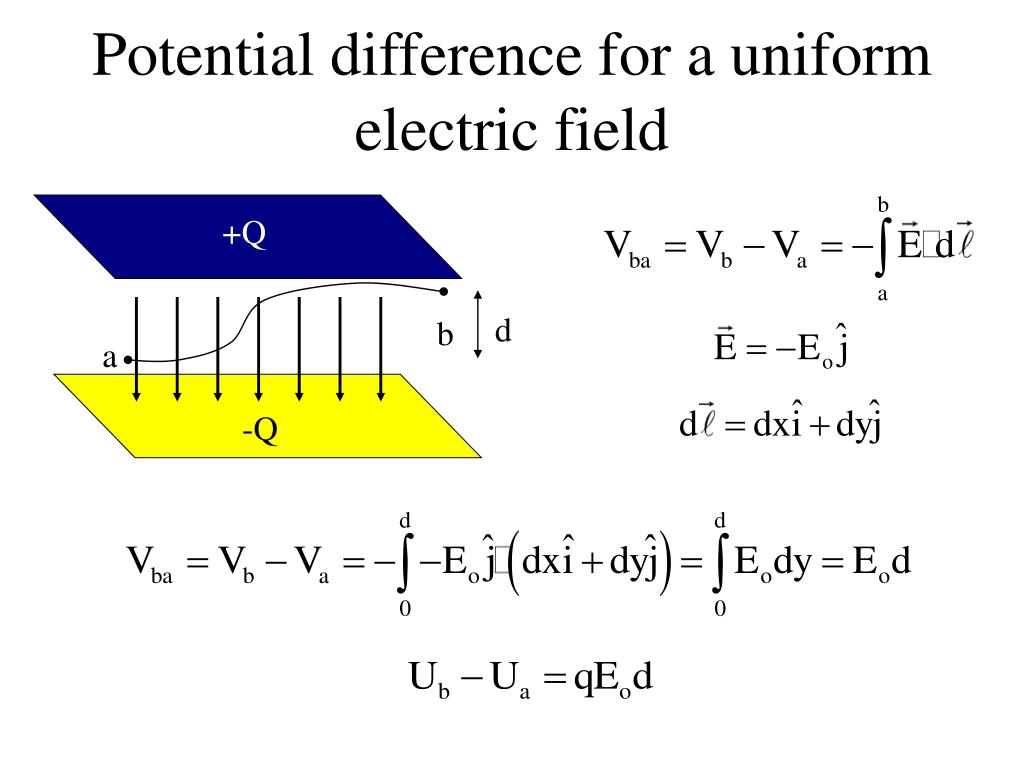
In this case, the potential difference (or ) between the plates is simply:
Or, rearranging for the electric field:
This simple equation is extremely useful.
Test your understanding!
Dry air breaks down and becomes a conductor (creating a spark) when the electric field strength reaches about V/m. Your Arduino kit has jumper wires. If you connect one to the 5V pin and another to the GND (0V) pin, what is the minimum distance you need to bring the tips together to create a spark in dry air?
Show answer
We have V and V/m. We want to find the distance .
Using the formula , we can rearrange for :
This is 1.67 micrometers (). This is an incredibly small distance, about 1/50th the width of a human hair. This explains why you don't see sparks flying between your low-voltage components unless they are physically touching!
Conclusion
Today we tackled the essential concept of voltage, bridging the gap between force and energy in electrostatics.
Here are the key takeaways:
- Electric Potential Difference (Voltage) is the change in electric potential energy per unit charge. Its unit is the Volt (V), where .
- Voltage is analogous to height in a gravitational field; it represents the "electrical pressure" that can cause charge to move.
- Voltage is always a difference measured between two points.
- The electric field () and potential difference () are intimately related. The field points from high potential to low potential.
- The mathematical relationship can be expressed in two ways:
- Integral form:
- Differential form (1D):
- In a uniform electric field, the relationship simplifies to .
We now have two crucial pieces of the puzzle: we know what charge is, and we know what voltage (the "push" on the charge) is. In our next lesson, we will see what happens when that push causes charges to start moving in a continuous flow. This flow is called electric current, and understanding it is the first step into the world of electric circuits.