In our previous lesson, we explored how the determinant and trace provide scalar summaries of a matrix's geometric effects, specifically its impact on volume and infinitesimal volume. This continues our theme of interpreting matrices not just as arrays of numbers, but as geometric transformations.
Today, we will introduce another powerful way to summarize a matrix with a single number: the matrix norm. While determinants measure volume change, norms measure a matrix's "magnitude" or "size." We will define two key norms—the Frobenius and the operator norm—and discover their deep connection to a concept you'll soon master: singular values. Most importantly, we'll apply these norms to analyze one of the most persistent challenges in training deep neural networks: the stability of gradients and activations.
Measuring the "Size" of a Transformation
How can we quantify the size of a linear transformation? A simple approach is to treat the matrix as a large vector and compute its standard Euclidean length. This gives us the Frobenius norm.
A more profound approach, however, is to define the "size" of a transformation by its effect on vectors. This leads to the concept of an induced matrix norm, which measures the maximum "stretching factor" the matrix applies to any vector.
The following videos introduce these two fundamental concepts.
Advanced Linear Algebra 23: Frobenius and Operator Norm for Matrices
This video from Math at Andrews University introduces both the Frobenius norm and the more geometrically motivated operator norm.
Please watch these two segments: Frobenius Norm: This part defines the Frobenius norm as the square root of the sum of the squares of all matrix elements. Note the lecturer's comment that this norm doesn't fully "respect the matrix" as a linear transformation. Operator Norm: This section introduces the operator norm, which is defined by the transformation's action on vectors. Pay close attention to the definition as the maximum ratio of the output vector's norm to the input vector's norm.
The key distinction is that the Frobenius norm is about the matrix entries themselves, while the operator norm is about the matrix's behavior as a transformation. The operator norm is defined as:
The specific operator norm depends on the choice of vector norm used for and . When the Euclidean () norm is used for both, the resulting operator norm is called the spectral norm, often denoted .
The following short video provides a more formal look at the definition of induced norms and an important simplification.
This video from the "Advanced LAFF" series formalizes the definition of induced norms.
Watch from the beginning to the derivation. The key insight here is the argument showing that we can simplify the definition from taking the supremum over all non-zero vectors to taking the maximum over all unit vectors: \|A\|_2 = \max_{\|x\|_2=1} \|Ax\|_2 The lecturer's brief mention of compact sets and continuous functions as the reason sup becomes max is the formal justification for why such a maximum-stretching vector is guaranteed to exist.
Geometrically, this means we are searching the unit sphere for the vector that gets stretched the most by the transformation . The length of the resulting vector, , is the spectral norm of .
A Deeper Connection: Norms and Singular Values
This geometric picture of "maximum stretch" has a beautiful connection to the Singular Value Decomposition (SVD), which we will explore in detail in the next module. For now, let's build the intuition.
Any linear transformation can be decomposed into a sequence of three fundamental operations: a rotation (), a scaling along orthogonal axes (), and another rotation ().
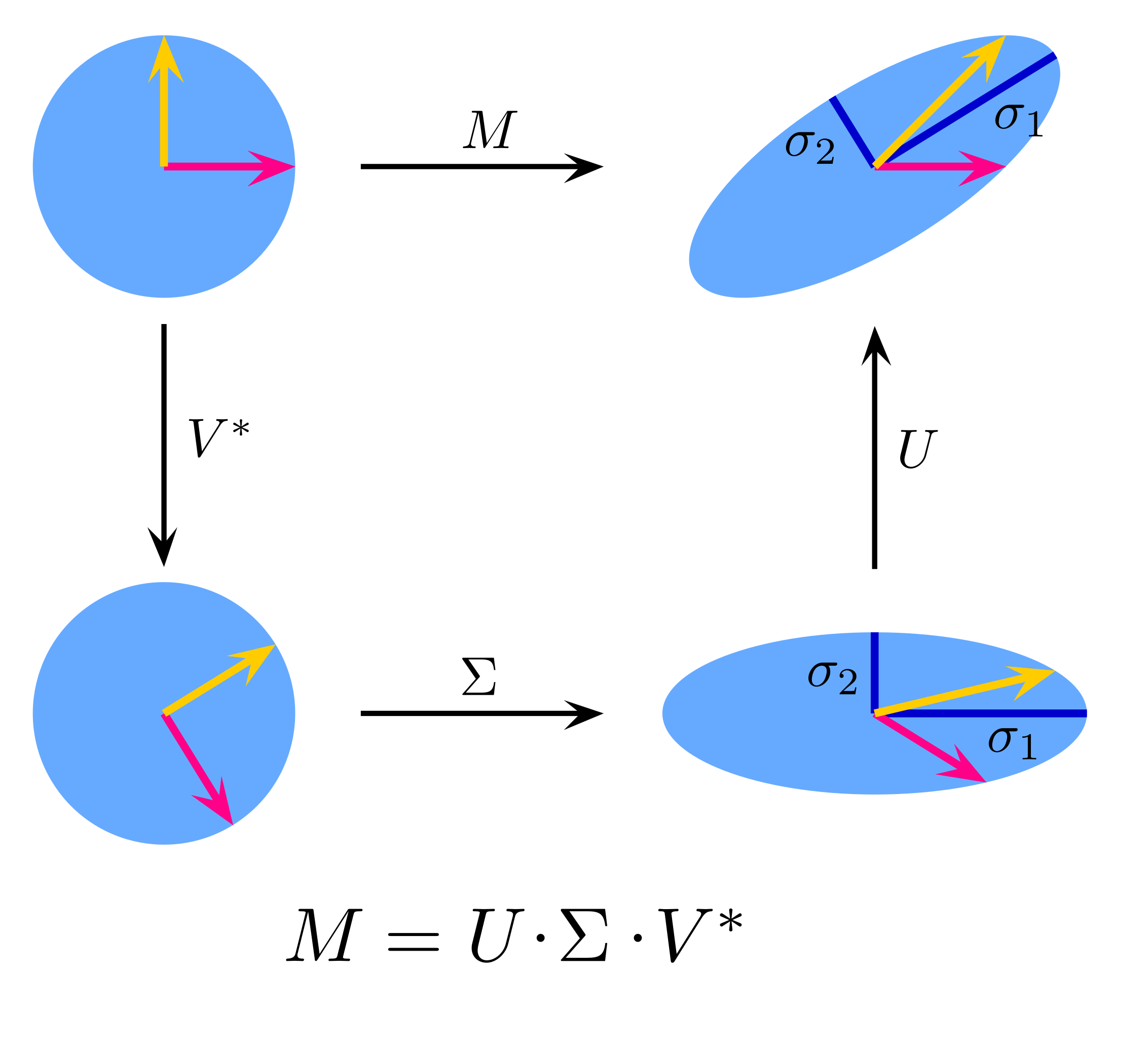
The scaling factors, , are the singular values of the matrix. Since rotations don't change the length of vectors, all the "stretching" is done by the matrix. The maximum possible stretch is therefore simply the largest singular value, . This gives us a profound result:
The spectral norm of a matrix is its largest singular value: .
The SVD also provides a new perspective on the Frobenius norm. It can be shown that the Frobenius norm is the square root of the sum of the squares of all singular values: .
The following video segment elegantly derives these two connections.
Advanced Linear Algebra 23: Frobenius and Operator Norm for Matrices
This segment connects the SVD to both the Frobenius and operator norms.
Watch the portion from SVD and Norms. Focus on two key outcomes: The derivation showing that \|A\|_F^2 = \text{tr}(A^*A) = \sum \sigma_i^2. This leverages the cyclic property of the trace, which you've seen before. The geometric argument explaining why the operator (spectral) norm is simply the largest singular value, \sigma_{\max}. This directly visualizes the "maximum stretch" concept.
Application: Analyzing Stability in Deep Networks
These formalisms are not just theoretical. They are essential for understanding and controlling the behavior of deep neural networks. One of the primary challenges in training deep networks is the problem of exploding or vanishing gradients.
Consider a deep linear network where the output is computed by applying a series of weight matrices to an input :
How does the magnitude of the output relate to the input ? We can analyze this using the sub-multiplicative property of operator norms, which states that .
Applying this property repeatedly gives us an upper bound on the output's magnitude:
A similar relationship holds for the gradients during backpropagation. This inequality reveals a critical dynamic:
- If the spectral norms of the weight matrices are consistently greater than 1, the activations (and gradients) can grow exponentially, leading to exploding gradients.
- If the spectral norms are consistently less than 1, the activations (and gradients) can shrink exponentially, leading to vanishing gradients.
This makes controlling the spectral norm of the weight matrices a powerful tool for stabilizing training. This is exactly what Spectral Normalization (SN) does, a technique widely used in Generative Adversarial Networks (GANs).
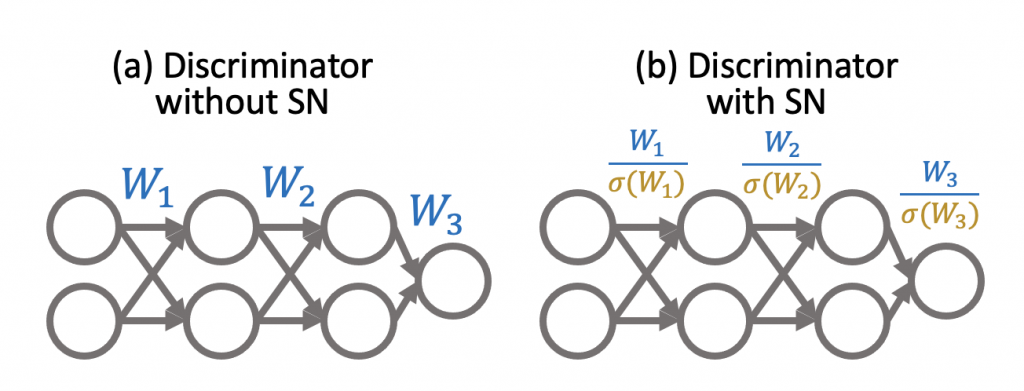
The following blog post from Carnegie Mellon University provides an excellent, concise explanation of why SN is so effective.
This article explains the theoretical underpinnings of Spectral Normalization (SN), a key technique for stabilizing GAN training.
Please read the following sections: Start with the introduction to understand the problem context. Read the section "Exploding and vanishing gradients cause training instability" to see the empirical effect. Focus on the section "How spectral normalization mitigates exploding gradients". This part provides a formal bound on the gradient norm that directly uses the ideas we've discussed. By ensuring each weight matrix has a spectral norm of 1, SN prevents the product of norms from exploding. Finally, read "How spectral normalization mitigates vanishing gradients". This section makes a fascinating connection to classic initialization schemes, arguing that SN helps prevent gradients from vanishing throughout training, not just at the start.
By constraining the largest singular value of each weight matrix to be 1, Spectral Normalization effectively ensures that each layer is 1-Lipschitz, meaning it doesn't amplify distances. This prevents the runaway amplification that leads to exploding gradients and helps maintain a healthy signal magnitude throughout the network.
Conclusion
In this lesson, we have moved from viewing matrices as simple arrays of numbers to understanding their "magnitude" as geometric transformations.
Key Takeaways:
- Matrix norms quantify the "size" of a matrix. The Frobenius norm treats the matrix as a vector, while operator norms measure its effect as a transformation.
- The spectral norm () is the operator norm induced by the vector norm. It has a clear geometric meaning: the maximum factor by which the matrix can stretch a vector.
- The spectral norm is equal to the matrix's largest singular value (), providing a powerful link between norms and matrix decompositions.
- The sub-multiplicative property () is a crucial tool for analyzing signal propagation in deep networks.
- By controlling the spectral norms of weight matrices, techniques like Spectral Normalization can prevent exploding and vanishing gradients, leading to more stable training.
We've now seen a compelling preview of the power of singular values. In our next module, we will begin a formal study of Matrix Decompositions, starting with the Singular Value Decomposition (SVD). We will derive it from first principles and unlock its further applications, from model analysis to compression techniques like LoRA.