Welcome to the fourth and final lesson of our first module. In our previous lesson, we mapped out the terrain of psychological flexibility, identifying the six core processes—Acceptance, Defusion, Present Moment, Self-as-Context, Values, and Committed Action—that ACT cultivates. You learned how these processes work together in a dynamic system, much like the interconnected components of the machine learning systems you design.
Today, we will examine the other side of this model: psychological inflexibility. If psychological flexibility is the state of being open, present, and engaged, inflexibility is the state of being closed, distracted, and stuck. Our goal is to learn how to recognize the key patterns of inflexibility in our daily lives. By the end of this lesson, you will be able to recognize examples of experiential avoidance, cognitive fusion, and unclear values as they appear in everyday scenarios. Think of this as learning to identify the specific failure modes or bug patterns in human behavior that keep us from living the life we want.
The "Inflexahex": A Model of Being Stuck
Just as there are six interconnected processes that promote flexibility, there are six corresponding processes that create inflexibility. These are the default, often automatic, ways our minds react to difficulty, creating patterns that keep us stuck. This "problem model" in ACT is sometimes visualized as the "Inflexahex."
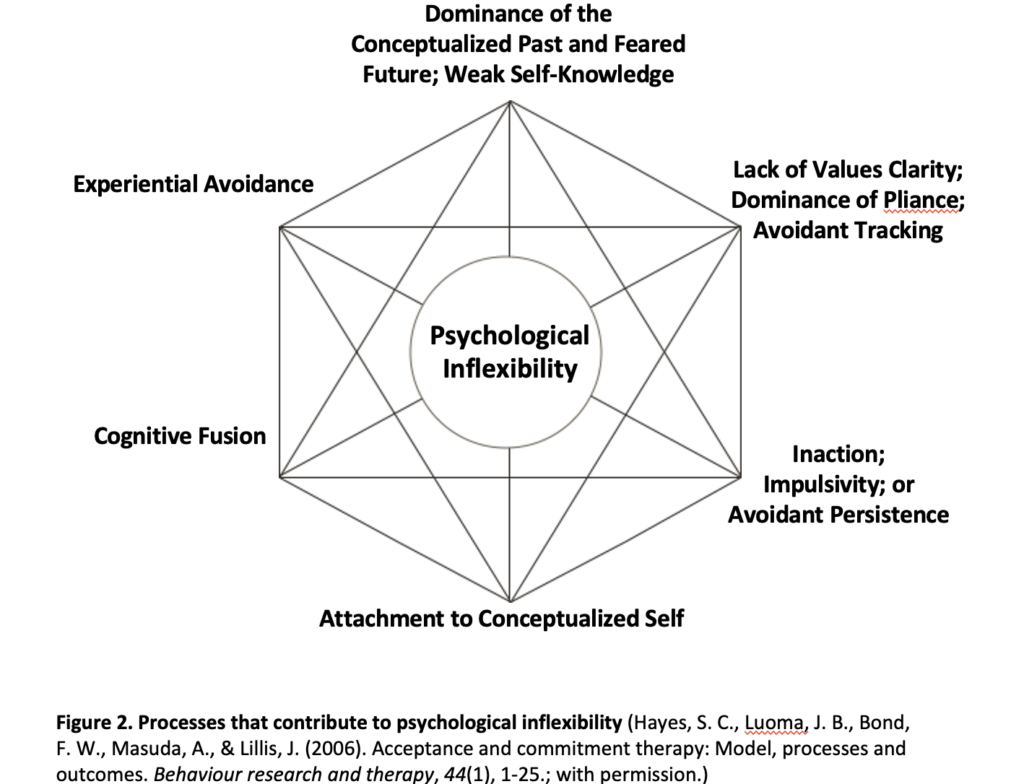
As you can see, each point on this hexagon is the direct opposite of a process from the Hexaflex model we studied:
- Experiential Avoidance is the opposite of Acceptance.
- Cognitive Fusion is the opposite of Defusion.
- Dominance of the Past/Future is the opposite of Present Moment Awareness.
- Attachment to a Conceptualized Self is the opposite of Self-as-Context.
- Lack of Values Clarity is the opposite of Values.
- Inaction/Impulsivity is the opposite of Committed Action.
Let's get a clear definition of each of these "stuck" patterns.
6 Core Processes of Psychological Inflexibility - Mindfulness Muse
This article from Mindfulness Muse provides a concise overview of the six processes of psychological inflexibility. It will give you a solid definition for each component of the "stuck" loop.
Please read the article from the beginning, starting with the introduction under the main heading, and continue through the descriptions of all six processes, ending with the section on Unworkable Action. As you read, notice how each process is framed as a way we get "stuck."
While the article covers all six, our focus today is on recognizing the three patterns that often form the core of the problem: experiential avoidance, cognitive fusion, and unclear values. Let's look at each one more closely.
1. Experiential Avoidance: The Struggle Switch
Experiential avoidance is the attempt to avoid, suppress, or get rid of unwanted private experiences: thoughts, feelings, memories, or physical sensations. We are wired to move away from danger in the external world. Experiential avoidance is what happens when we misapply that same logic to our internal world.
The following short, animated video provides a brilliant explanation of this trap.
Headstuck! What is Experiential Avoidance?
This video, "Headstuck! What is Experiential Avoidance?", clearly illustrates why the seemingly logical strategy of avoiding discomfort so often backfires.
Please watch the video from the beginning until the end. Pay close attention to the central paradox it describes: in our effort to avoid the short-term discomfort required to pursue what we value, we end up constructing lives built around avoidance itself.
As the video explains, the core problem with experiential avoidance is twofold: it doesn't work in the long run (what we resist, persists), and it often requires us to abandon what truly matters to us.

Here are some common, everyday examples of experiential avoidance:
- Procrastination: Putting off a difficult work task because the feeling of being overwhelmed or the fear of not doing it perfectly is uncomfortable. The avoidance gives temporary relief but increases stress in the long run.
- Social Avoidance: Turning down an invitation to a social event because you feel anxious. You avoid the anxiety, but you also miss out on potential connection, which might be a core value.
- Numbing and Distraction: After a stressful day, immediately turning on the TV, scrolling through social media, or having a drink to avoid "thinking about it." This prevents you from processing your experience or taking constructive action.
2. Cognitive Fusion: Getting Hooked by Thoughts
Cognitive Fusion is the process of getting entangled with our thoughts. When we are "fused" with a thought, we treat it as a literal truth or a command we must follow, rather than what it actually is: a transient internal event, a string of words and images generated by our minds.
In your work with machine learning, you deal with language models that generate text. You know not to treat every output as a perfect, factual representation of reality. You evaluate it, use what's helpful, and discard what isn't. Cognitive fusion is the equivalent of taking every single thought your brain produces as an absolute truth or a direct order.
Let's look at a few examples:
- Fusion with Self-Judgments: You have the thought, "I'm not good at this." In a state of fusion, you treat this as a definitive statement of fact, which might lead you to give up. The unfused perspective is to notice, "I'm having the thought that I'm not good at this."
- Fusion with Worries: Your mind generates a "what if" story: "What if I mess up the presentation and everyone thinks I'm incompetent?" Fusion means you get so absorbed in this story that you feel the panic as if it's already happening, making it hard to prepare effectively.
- Fusion with Rules: Your mind presents a rule, like "I must not show any weakness." Fusion means you follow this rule rigidly, even in situations where being vulnerable could build stronger connections.
The following short video presents a simple, practical model for understanding how fusion and avoidance team up to pull us away from a life we value.
The Choice Point: A Map for a Meaningful Life
Dr. Russ Harris's video on "The Choice Point" offers a simple map to visualize how we get 'hooked' by difficult thoughts and feelings, leading to 'away moves' that take us away from who we want to be.
Watch from the start up to the description of being 'hooked'. This section succinctly describes how difficult thoughts and feelings arise and pull us into unhelpful actions.
The "away moves" Dr. Harris describes are the behavioral result of cognitive fusion and experiential avoidance working together. You get "hooked" by a thought (fusion) and then act to get away from the uncomfortable feeling it brings (avoidance).
3. Unclear Values & Unworkable Action
The third key pattern of inflexibility is a combination of having unclear values and engaging in unworkable action. When you don't have a clear sense of what matters to you—what kind of person you want to be and what you want to stand for—your actions can become aimless, impulsive, or dictated solely by the pursuit of pleasure and the avoidance of pain.
This is analogous to an optimization problem without a well-defined objective function. If the system doesn't know what it's optimizing for, its actions become erratic and don't lead to a coherent or desirable outcome.
Unworkable action is any behavior that, while perhaps providing short-term relief, moves you away from your values in the long run.
Consider these scenarios:
- A person values health but continues to smoke. The short-term action (smoking) is driven by fusion with the thought "I need this to relax" and avoidance of withdrawal symptoms, but it's unworkable in the context of their long-term value.
- Someone values their romantic partnership but, when conflict arises, they shut down and give their partner the silent treatment. This action avoids the discomfort of a difficult conversation but corrodes the relationship they value.
- An employee values contribution and growth but spends their days doing the bare minimum to avoid challenging tasks and the possibility of failure.
Recognizing the Patterns in Your Life
The first step to changing these patterns is simply noticing them. Becoming an objective observer of your own behavior—a data scientist for your own mind—is a powerful skill. The following reading offers a systematic way to "dissect a problem" by looking for these very patterns.
[PDF] PSYCHOLOGICAL FLEXIBILITY - ACT Mindfully
This excerpt from a workshop handout by Dr. Russ Harris provides powerful, practical tools for identifying psychological rigidity. We'll look at two sections.
First, please find the page titled "DISSECTING THE PROBLEM". Read over the four boxes: Entanglement with Thoughts (Fusion), Struggle with Feelings (Avoidance), Life-draining Actions (Unworkable Action), and Avoiding Challenging Situations (Avoidance). This is a template for identifying these patterns in any given problem. Next, find the exercise titled "Join the D.O.T.S.". This provides a rich inventory of common avoidance and control strategies, categorized as Distraction, Opting out, Thinking, and Substances/other Strategies. Read through the examples. You don't need to do the exercise now, but reviewing the list will sharpen your ability to spot these behaviors.
As a brief reflective exercise, think of a minor, recent situation where you felt stuck or acted in a way you weren't proud of (e.g., procrastinating on a small task). Using the "Dissecting the Problem" framework, can you identify:
- The thoughts you were entangled with? (Fusion)
- The feelings you were struggling with? (Experiential Avoidance)
- The unhelpful actions you took? (Unworkable Action)
This is the core skill: analyzing a situation and identifying the specific processes of inflexibility at play.
Conclusion
In this lesson, we've defined psychological inflexibility and learned to spot its main components in daily life. We've flipped the Hexaflex model to understand what it means to be stuck.
Here are the key takeaways:
- Psychological Inflexibility is the state of being entangled in our thoughts, struggling with our feelings, and acting in ways that move us away from our values.
- The three core patterns of this "stuck" state are Experiential Avoidance (the struggle against feelings), Cognitive Fusion (being hooked by thoughts), and Unclear Values/Unworkable Action (losing direction and acting against our own interests).
- Recognizing these patterns in our own behavior is the crucial first step toward change. It's about moving from being automatically driven by these patterns to consciously observing them.
This concludes our foundational module. You now have a complete map of both the problem (psychological inflexibility) and the solution (psychological flexibility) as conceptualized by ACT.
In our next lesson, we will begin Module 2, "Opening Up," where we move from theory and recognition to hands-on practice. We will start by learning the specific skills of Acceptance and Defusion, the direct antidotes to experiential avoidance and cognitive fusion.