The Lateran’s place in Catholic life becomes easier to understand once two meanings of seat are kept apart. A bishop has a cathedral, the church associated with his teaching and pastoral office, and may also have a residence, where he lives. For centuries these stood together at the Lateran. This lesson begins the course’s look at the Lateran across the centuries by asking what changed when the papal residence moved—and what did not.
The central answer is that the Pope’s home changed, but his cathedral as Bishop of Rome remained the Lateran. St. Peter’s Basilica gained prominence alongside the Vatican residence without becoming Rome’s cathedral.
The chair is not the living quarters
The word cathedral comes from cathedra, the bishop’s chair. At the Lateran, that chair expresses the Pope’s office as Bishop of Rome. It is not a claim that he must live in the church, or even next door to it. Cardinal Tagle draws this distinction while comparing the Lateran with Rome’s other major basilicas:
THE BASILICA OF SAINT JOHN LATERAN | Faith Exposed with Cardinal Tagle
Watch “The Basilica of Saint John Lateran” from JesComTV for its concise explanation of why the Lateran is the Pope’s cathedral, despite the prominence of other papal basilicas.
Watch the cathedral distinction. Notice that the explanation rests on the Pope’s role as Bishop of Rome and the meaning of his cathedra—not on where he lives.
The apse makes this idea visible. The cathedra occupies a place beneath the mosaic, within the church where the community gathers for worship. It signifies an office exercised in relation to that community; it is not furniture from a papal household.
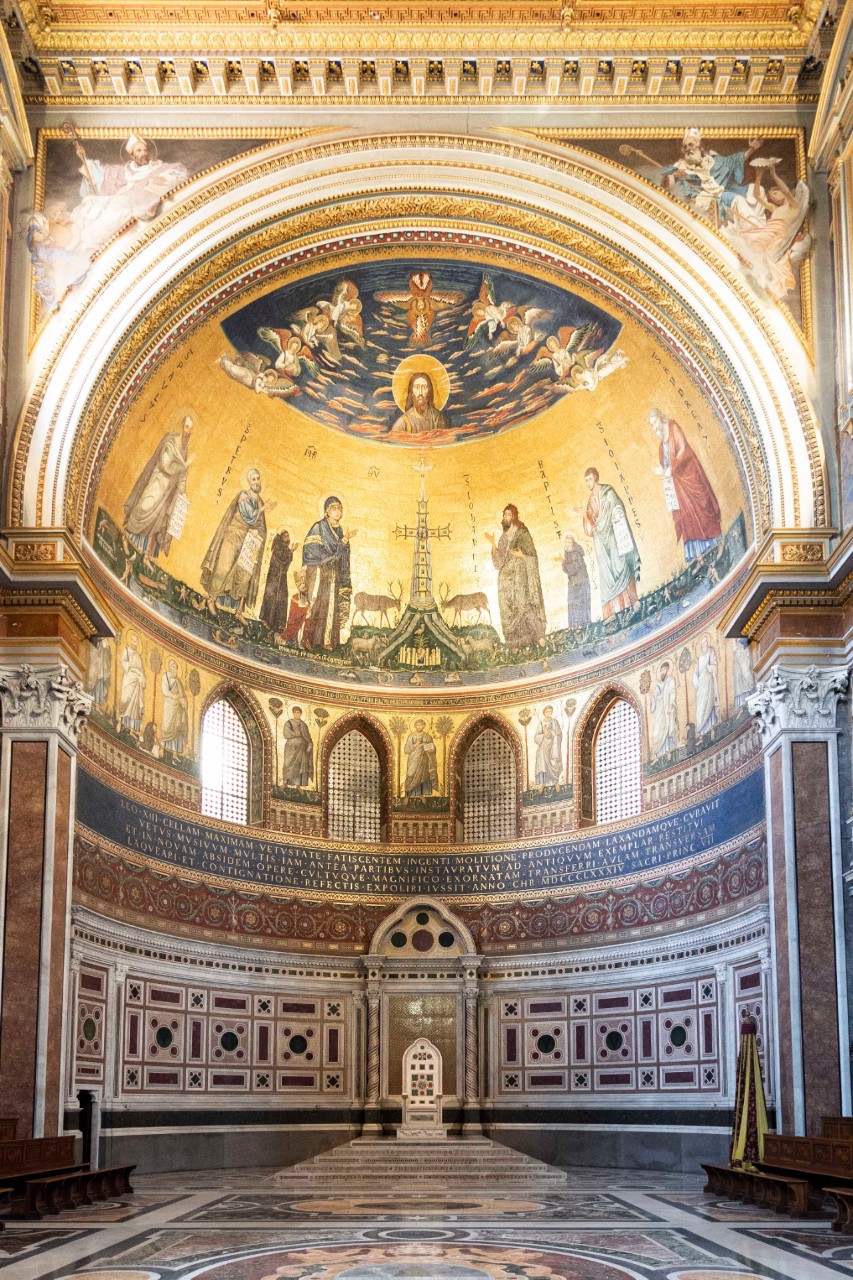
This also clarifies why calling St. Peter’s a papal basilica does not make it a cathedral. St. Peter’s is a major church associated with the traditional site of the apostle Peter’s tomb and with important papal worship. Those are substantial reasons for its significance, but they are different from being the cathedral of the Diocese of Rome. Size, fame, and frequency of papal ceremonies do not determine which church is the cathedral.
How the residence and cathedral became separated
For roughly a millennium, the distinction was easy to overlook in practice. The bishops of Rome had a residence at the Lateran Palace, and their cathedral belonged to the same complex. The Pope could live near the church that expressed his office as Rome’s bishop.
The separation emerged in the later Middle Ages. During much of the fourteenth century, the papal court was based in Avignon, outside Rome. By the time the papacy returned to Rome, fires had damaged the Lateran palace. The Lateran did not resume its former role as the principal papal residence; the Vatican became an increasingly important center of papal residence and activity. Yet the cathedral remained at the Lateran.
Read the historical account and then its explanation of what the two sites came to signify:
In his commentary for the National Catholic Register, Raymond J. de Souza explains the move away from the Lateran palace and distinguishes it from a change of cathedral. Read for that distinction, rather than treating “where the Pope lives” and “where the Pope’s cathedra is” as interchangeable questions.
In the historical passage beneath the article’s opening discussion of the dedication feast, begin with the paragraph opening “After the first centuries of persecution by state power.” Read the historical account through the paragraph about the return from Avignon and the damaged Lateran. Then find the later paragraph opening “Over time, the Lateran became associated” and read the site comparison through its explanation of the Pope’s related roles.
The decisive point is not that one building declined while another replaced it. Rather, two functions that had once been close together ceased to be close together. A papal residence belongs to the practical circumstances of governing and living. A cathedral expresses which church is the seat of a bishop’s office. Moving the first does not automatically move the second; Rome’s cathedral was not transferred to St. Peter’s.
There is a useful historical caution here. Short accounts sometimes describe the change as though the Pope moved directly from the Lateran to the Vatican and lived there without interruption thereafter. Papal residences in Rome have had a more complicated history, including use of the Quirinal Palace. None of those changes alters the point at issue: a change of residence was not a change of Rome’s cathedral.
Why the Vatican could become central without replacing the Lateran
After the return to Rome, the Vatican became increasingly prominent, and the great new St. Peter’s Basilica reinforced that prominence. It is understandable, then, to associate the Pope most immediately with St. Peter’s. But the association joins together several things that need to be distinguished: a place of residence and administration, a major basilica, and a diocesan cathedral.
One way to keep them distinct is to ask what each place tells you:
| Place | What it helps explain |
|---|---|
| Lateran Basilica | Where the Pope’s cathedra identifies his cathedral as Bishop of Rome |
| Lateran Palace | Where popes lived during the long period when residence and cathedral were adjacent |
| Vatican and St. Peter’s Basilica | A later center of papal residence and activity, alongside a major basilica associated with Peter’s tomb |
The Lateran and the Vatican can also carry different emphases. As the commentary observes, the Lateran especially brings the Pope’s identity as Bishop of Rome into view; the Vatican is often associated with his wider responsibilities for the Catholic Church. These are not two unrelated offices held by different people. The distinction explains why Vatican prominence did not erase the Lateran’s particular meaning.
It helps, finally, not to mistake the cathedra for a magical object that alone confers cathedral status. The chair is a visible sign of an enduring relationship between a bishop and his diocesan church. The reason the Lateran remained the cathedral is not simply that a chair stayed in place while someone moved house. It is that the Lateran continued to be Rome’s cathedral; the departure from its neighboring palace did not constitute a decision to make St. Peter’s the cathedral instead.
Conclusion
The medieval Lateran joined papal residence and cathedral in one complex. After the Avignon period and damage to the Lateran palace, papal residence shifted away, while the Lateran remained the cathedral of the Bishop of Rome. St. Peter’s importance—as a major papal basilica associated with Peter’s tomb—answers a different question from “Which church is the Pope’s cathedral?”
The next lesson follows the Lateran building itself through its major restorations and rebuilding. Its changing appearance will provide another opportunity to distinguish what changed over time from what endured.