Introduction
In our previous lesson, we developed a qualitative understanding of entropy change, learning to predict whether for a given process would be positive or negative based on a prioritized set of rules. We focused on factors like the change in moles of gas and phase transitions. This gave us a powerful way to make quick assessments.
Today, we will transition from qualitative prediction to quantitative calculation. Your goal is to learn how to calculate the precise numerical value of the standard entropy change for a reaction () using tabulated data. This process adds a layer of mathematical rigor to our thermodynamic analysis, a step that should resonate with your background in data analysis and engineering studies. Mastering this calculation is essential for the next step: combining enthalpy and entropy to predict the spontaneity of reactions under specific conditions.
The Foundation: Standard Molar Entropy ()
Before we can calculate a change in entropy for a reaction, we must first understand the values we'll be working with: standard molar entropies (). Unlike enthalpy () or Gibbs free energy (), for which we can only measure changes, entropy has an absolute reference point. This is established by the Third Law of Thermodynamics, which states that the entropy of a perfect, pure crystalline substance at absolute zero (0 K) is exactly zero. This gives us a defined "zero" from which all other entropy values are measured.
The Khan Academy video below offers a clear explanation of what standard molar entropy represents and the trends you can observe in tabulated data.
Absolute entropy and entropy change | Applications of thermodynamics | AP Chemistry | Khan Academy
This video defines standard molar entropy and explains how factors like the state of matter and molecular complexity influence its value.
Please watch the first two segments. The first part, from the beginning, defines standard molar entropy (S^\circ) and its reference point. The second part, from the trends section, connects the numerical values of S^\circ to physical properties we discussed in the last lesson, such as phase and molecular complexity.
To see these values in practice, here is a table of standard molar entropies for various substances.
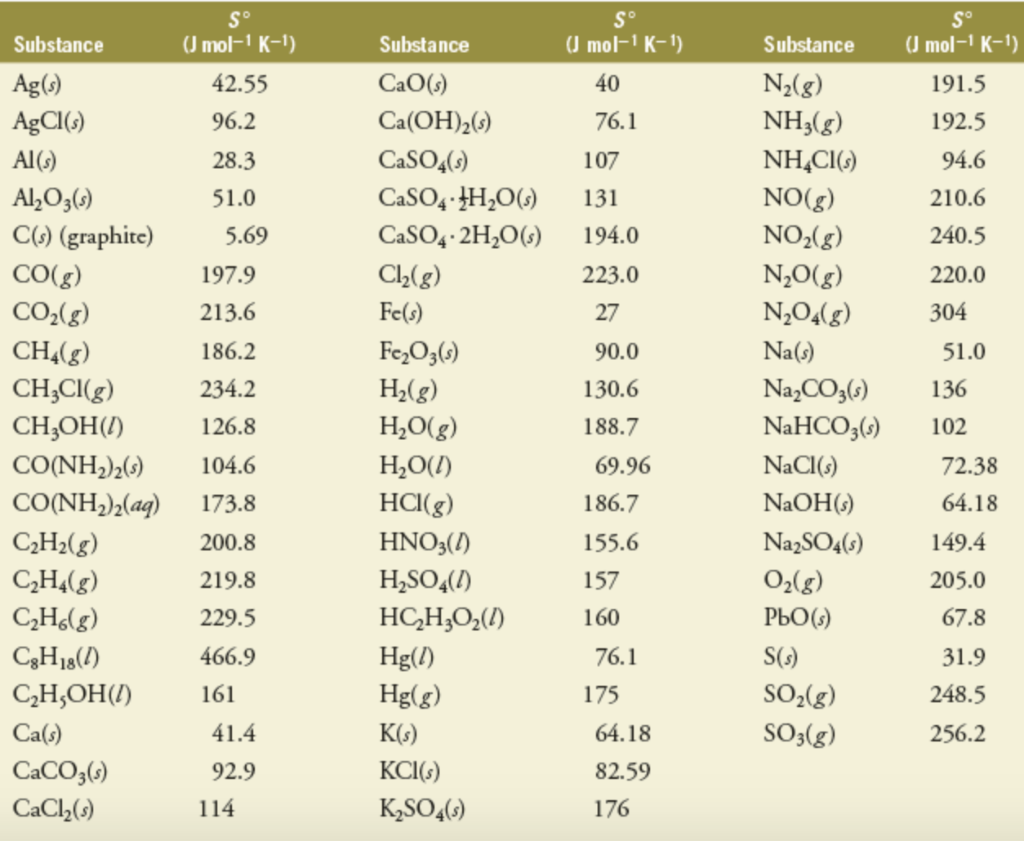
Notice a few key points that reinforce the video's explanation:
- All values are positive: Since they are measured relative to a true zero at 0 K, any substance at a higher temperature will have some amount of thermal energy and thus some degree of disorder.
- State of matter is crucial: Compare for liquid water, H₂O(l), at 69.96 J/mol·K with gaseous water, H₂O(g), at 188.7 J/mol·K. The gas phase has significantly more entropy, as expected.
- Elements are not zero: Unlike standard enthalpies of formation (), the standard molar entropies of elements in their standard state (like O₂(g) or Fe(s)) are not zero. They too possess entropy at 298 K.
Calculating the Entropy Change of a Reaction
With an understanding of standard molar entropies, we can now calculate the standard entropy change for an entire chemical reaction, . The method is a straightforward application of a "products minus reactants" rule, which is a common calculation pattern in thermodynamics.
The formula is:
Where:
- means "sum of".
- and are the stoichiometric coefficients of each product and reactant in the balanced chemical equation.
- is the standard molar entropy of each substance, which you look up in a table.
The following resource from Chad's Prep explains the logic and provides a clear, worked example.
18.4 Delta G, Delta H, Delta S and Formation Reactions - Chad's Prep®
This guide clearly lays out the formula for calculating thermodynamic quantities, including a specific, step-by-step example for ΔS°rxn.
Read the sections "How to Use the Products-Minus-Reactants Formula" and focus on the worked example, specifically the part titled "Calculating ΔS° of Reaction". Note how the stoichiometric coefficients are used and how the final answer is derived.
Let's break down the process with another important chemical reaction: the Haber-Bosch process for synthesizing ammonia.
Example: The Haber-Bosch Process
Step 1: Predict the sign of .
From our last lesson, we check the change in moles of gas, .
- Reactants: 1 mole N₂(g) + 3 moles H₂(g) = 4 moles of gas.
- Products: 2 moles NH₃(g).
- . Since the number of moles of gas decreases, we predict that entropy will decrease, so should be negative.
Step 2: Find the values.
Using the table of Standard Molar Entropies provided earlier:
- J/mol·K
- J/mol·K
- J/mol·K
Step 3: Apply the "Products - Reactants" formula.
Be sure to multiply each value by its coefficient from the balanced equation.
Our calculated value is negative, which matches our prediction. The system becomes more ordered as four moles of gas molecules combine to form only two moles of gas molecules.
Practice and a Note on Units
Now it's your turn. Try calculating the standard entropy change for the combustion of methane.
Problem: Calculate at 298 K for the following reaction. The required values can be found in the table image above.
Click to see the solution
1. Prediction:
- Reactants: 1 mole CH₄(g) + 2 moles O₂(g) = 3 moles of gas.
- Products: 1 mole CO₂(g) + 2 moles H₂O(l) = 1 mole of gas.
- . We predict will be negative.
2. values from the table:
- J/mol·K
- J/mol·K
- J/mol·K
- J/mol·K
3. Calculation:
The result is negative, as predicted.
A Critical Note on Units:
Notice that standard molar entropies are given in joules per mole-Kelvin (J/mol·K), making the final unit for joules per Kelvin (J/K). However, standard enthalpy changes () are typically reported in kilojoules (kJ). This unit mismatch is a very common source of error. When we combine these values in our next lesson, you must remember to convert one of them, usually by dividing the value by 1000 to get units of kJ/K.
Conclusion
In this lesson, we have added a crucial quantitative tool to our thermodynamics toolkit. You have moved beyond simply predicting the sign of entropy change to calculating its specific value for a chemical reaction.
Key Takeaways:
- Standard Molar Entropy (): An absolute measure of a substance's disorder at standard conditions (298 K, 1 atm), grounded in the Third Law of Thermodynamics. Unlike for , the of elements is not zero.
- Calculation of : This is found using the "products minus reactants" formula, where the standard molar entropy of each species is multiplied by its stoichiometric coefficient.
- Units: The result of this calculation is typically in J/K. Be mindful of this when comparing or combining it with enthalpy values, which are usually in kJ.
Now that we can calculate both the standard enthalpy change () and the standard entropy change () for a reaction, we have the two key components that determine a reaction's spontaneity. In our next lesson, we will introduce Gibbs free energy (), and the pivotal equation , which unites these concepts and allows us to finally predict whether a reaction will proceed spontaneously at a given temperature.