Introduction
Welcome to the next step in our exploration of thermodynamics. In our previous lessons, you learned to calculate the enthalpy change () and, more recently, the entropy change () for chemical reactions. These two quantities represent the fundamental driving forces behind any physical or chemical process: the drive toward lower energy and the drive toward greater disorder. However, we have so far treated them as separate influences. Often, they work in opposition. How do we determine which force "wins"?
In this lesson, you will learn about Gibbs free energy (), a powerful concept that unifies enthalpy and entropy into a single, decisive value. Our primary goal is to define Gibbs free energy and understand its relationship to enthalpy and entropy through the famous equation, . By the end of this lesson, you will understand not just what this equation is, but where it comes from and how the interplay between its terms dictates the direction of change.
From the Universe to the System: The Origin of Gibbs Free Energy
The Second Law of Thermodynamics gives us the ultimate criterion for spontaneity: for a process to occur on its own, the total entropy of the universe must increase (). While this is a profound and fundamental truth, it's not very practical for a chemist or engineer. How could we possibly measure the entropy change of the entire universe for every reaction we study?
The genius of the American scientist Josiah Willard Gibbs was to reformulate this universal criterion into an equation that depends only on properties of the system—the reaction itself. This makes prediction and calculation feasible. The derivation is elegant and connects directly to the concepts we've already covered.
The resource from Chad's Prep provides a clear, step-by-step derivation of the Gibbs free energy equation, showing how it emerges directly from the Second Law.
18.3 Gibbs Free Energy and the Relationship between ΔG, ΔH, & ΔS
This reading explains how the inconvenient requirement of measuring the universe's entropy change can be transformed into a practical equation using only system properties.
Please read the sections titled "Derivation of ΔG from the Second Law of Thermodynamics" and the subsequent section on the substitution and rearrangement of the terms. As you read, focus on how the entropy change of the surroundings (\Delta S_{\text{surroundings}}) is replaced with a term involving the enthalpy change of the system (-\Delta H_{\text{system}}/T). This is the key mathematical step that allows us to stop worrying about the surroundings.
As the derivation shows, the condition for spontaneity, , can be rewritten as . Gibbs defined the quantity on the left as the change in Gibbs free energy, .

This gives us the master equation and its criterion for spontaneity:
- If , the process is spontaneous in the forward direction.
- If , the process is non-spontaneous (the reverse process is spontaneous).
- If , the system is at equilibrium, with no net change occurring.
A crucial point to remember, which we noted in the last lesson, is the mismatch in common units. is almost always given in kilojoules (kJ/mol), while is given in joules per Kelvin (J/K·mol). To use the Gibbs equation correctly, you must convert one of them, typically by dividing the value by 1000 to get kJ/K·mol.
What Does "Free" Energy Mean?
The term "free energy" doesn't mean the energy is without cost. It refers to the portion of a system's energy that is available or "free" to do useful work.
An exothermic reaction () releases energy. However, not all of that energy can be harnessed. A certain amount of energy must be released as heat into the surroundings simply to satisfy the Second Law of Thermodynamics—this is the "payment" required to increase the surroundings' entropy, especially if the system's own entropy is decreasing. The energy left over after this entropy "tax" is paid is the "free" energy, .
The following resource provides a nice conceptual explanation of this idea.
The Gibbs free energy | Post-16 thermodynamics tutorials
This article from the Royal Society of Chemistry explains the conceptual meaning of "free" in the context of Gibbs free energy.
Please read the section titled "Why is energy ‘free’?". This will help you build a deeper intuition for what \Delta G represents beyond just a letter in an equation.
The Interplay of Enthalpy, Entropy, and Temperature
The Gibbs equation can be seen as a tug-of-war between two competing tendencies, with temperature as the referee.
- The Enthalpy Term (): This represents the drive to achieve a lower energy state. A negative (exothermic) is favorable and contributes to making negative.
- The Entropy Term (): This represents the drive to achieve a higher state of disorder. A positive (more disorder) is favorable. Because of the negative sign in the equation, a positive also contributes to making negative.
Temperature () acts as a scaling factor for the entropy term. As temperature increases, the importance of the entropy change becomes magnified. This temperature dependence is the key to understanding why some reactions are spontaneous only under specific conditions.
The following video provides an excellent breakdown of these relationships.
18.3 Gibbs Free Energy and the Relationship between Delta G, Delta H, & Delta S | General Chemistry
In this video, Chad's Prep walks through the four possible scenarios based on the signs of ΔH and ΔS, explaining how temperature dictates the outcome.
Please watch the segment from this section on relationships. The instructor provides a conceptual overview ("what the universe wants") and then breaks down the mathematics for each of the four cases. Pay close attention to how the sign of each term contributes to the overall sign of \Delta G.
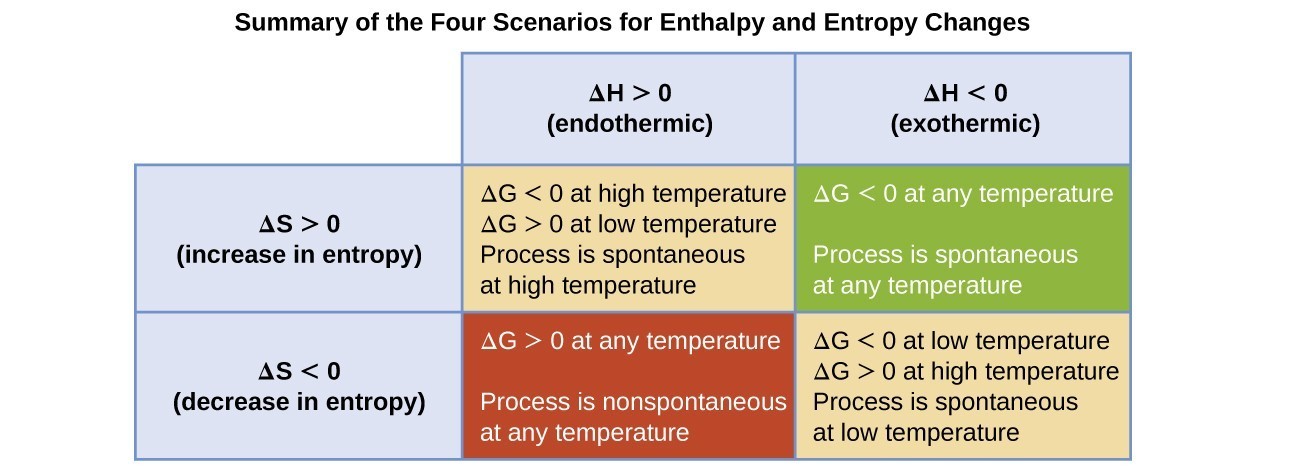
Let's summarize these four scenarios. This is one of the most important conceptual frameworks in chemical thermodynamics.
The Four Scenarios for Spontaneity
-
is negative, is positive: (Exothermic, more disorder). Both terms favor spontaneity. The term is negative, and the term is also negative. will be negative at all temperatures. The reaction is always spontaneous.
Example: The decomposition of hydrogen peroxide: . -
is positive, is negative: (Endothermic, more order). Both terms oppose spontaneity. The term is positive, and the term is also positive. will be positive at all temperatures. The reaction is never spontaneous.
Example: The formation of ozone from oxygen: . -
is positive, is positive: (Endothermic, more disorder). The enthalpy term is unfavorable, but the entropy term is favorable. The favorable entropy term () will dominate at high temperatures. will become negative only at high temperatures.
*Example: Melting ice: . This requires energy input () but increases disorder (). It is spontaneous only above 0°C (273 K). -
is negative, is negative: (Exothermic, more order). The enthalpy term is favorable, but the entropy term is unfavorable. The favorable enthalpy term () will dominate at low temperatures, when the unfavorable term is small. will become negative only at low temperatures.
*Example: Freezing water: . This releases heat () but creates more order (). It is spontaneous only below 0°C (273 K).
The point where the reaction "switches" from non-spontaneous to spontaneous occurs when . At this threshold temperature, the system is at equilibrium, and . We can therefore find this temperature by rearranging the equation to . We will explore calculations using this relationship in our next lesson.
Conclusion
In this lesson, you have been introduced to Gibbs free energy, a cornerstone concept that elegantly combines the effects of enthalpy and entropy to provide a single, definitive criterion for chemical and physical change. You have seen how the pivotal equation, , is not just a random formula but is derived directly from the Second Law of Thermodynamics.
Key Takeaways:
- Gibbs Free Energy () is a thermodynamic potential that measures the maximum "free" or useful work obtainable from a system at constant temperature and pressure.
- The change in Gibbs free energy is defined by the equation .
- The sign of predicts spontaneity: for a spontaneous process, for a non-spontaneous process, and for a system at equilibrium.
- The spontaneity of a reaction is determined by the interplay of enthalpy (), entropy (), and temperature (). Depending on the signs of and , a reaction can be spontaneous at all, none, high, or low temperatures.
You now have the complete conceptual toolkit for understanding thermodynamic spontaneity. In our next lesson, we will put this knowledge into practice. You will learn to use the sign of to predict the spontaneity of processes under various temperature conditions and perform the necessary calculations.