Welcome to the first lesson of our second module. We've just completed our survey of the essential tools from calculus, culminating in partial derivatives, which allow us to describe how functions change in a multi-dimensional world. Now, we shift our focus from the mathematical description of change to the physical causes of change. This module, "Foundational Physics: Mechanics and Energy," begins that journey.
Today, we will address the learning outcome: Describe motion and its causes using Newton's three laws. These laws form the bedrock of classical mechanics, the branch of physics that describes the motion of objects we encounter every day. For your goal of becoming a chemical engineer, a deep understanding of these principles is non-negotiable, as they govern everything from fluid flow in pipes to the motion of particles in a reactor. We'll start by defining the central concept of force and then examine each of Newton's laws in turn.
1. The Concept of Force
Before we can understand the laws of motion, we must have a clear definition of what causes it. In physics, a force is simply a push or a pull on an object. Crucially, force is a vector quantity, meaning it has both a magnitude (how strong the push or pull is) and a direction.
When we analyze an object's motion, we are only concerned with external forces—those that originate outside the object itself. The forces that parts of the object exert on each other are internal forces and do not cause a change in the object's overall motion. The vector sum of all external forces acting on an object is called the net force. It is this net force that determines how an object's motion will change.
Let's begin by reading a formal introduction to these concepts.
Chapter 5. Newton's Laws of Motion
This section from the OpenStax University Physics textbook provides the foundational definitions for our study of dynamics.
Please read the first part of section 5.1, "Forces." Start at the beginning and read up to the subsection titled "Development of the Force Concept." Focus on the definitions of dynamics and kinematics, the working definition of force as a push or a pull, and the introduction to free-body diagrams as a tool for visualizing external forces.
2. Newton's First Law: The Law of Inertia
Newton's First Law describes the behavior of an object when the net force acting on it is zero. It establishes a baseline state of motion.
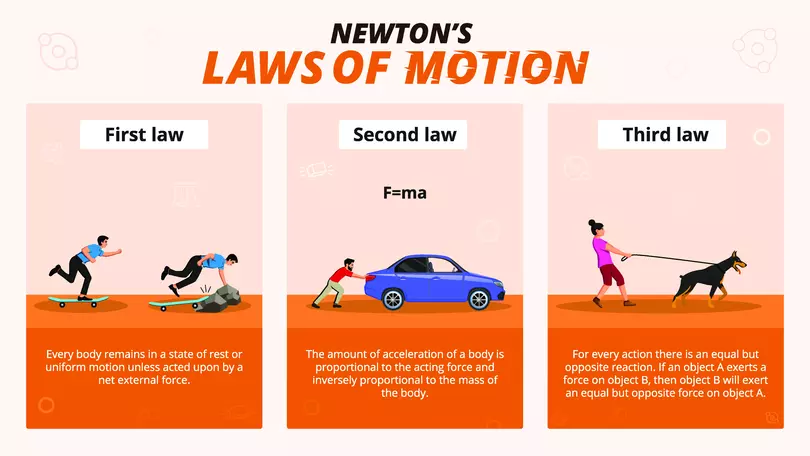
Newton's First Law of Motion: A body at rest remains at rest, or, if in motion, remains in motion at a constant velocity unless acted upon by a net external force.
This law introduces the concept of inertia, which is an object's inherent resistance to changes in its state of motion. The more mass an object has, the more inertia it has—it's harder to get it moving, and harder to stop it once it is moving. When the net force on an object is zero, we say it is in equilibrium. This doesn't necessarily mean it's stationary; an object moving at a constant speed in a straight line is also in equilibrium.
The following video provides a concise and engaging explanation of this core idea.
Newton's Laws: Crash Course Physics #5
This clip from Crash Course Physics introduces the concept of inertia and its connection to mass.
Watch the section on Newton's First Law, from the beginning. Pay attention to the definition of inertia and the example distinguishing a beach ball from a bowling ball.
To solidify this concept, let's turn back to our textbook for a more detailed look at the implications of the First Law.
Chapter 5. Newton's Laws of Motion
This section delves deeper into the First Law, friction, and the idea of an inertial reference frame.
Please read the entire section 5.2, "Newton's First Law." As you read, focus on how friction is the external force that makes objects slow down in our everyday experience, the formal definition of inertia, and the vector form of the First Law, which states that velocity is constant when the net force is zero.
3. Newton's Second Law: Force, Mass, and Acceleration
The First Law tells us what happens when there is no net force. The Second Law provides the quantitative relationship that describes what happens when there is a net force: the object accelerates.
Newton's Second Law of Motion: The acceleration of an object is directly proportional to the net force acting on it and inversely proportional to its mass.
Mathematically, this is expressed in one of the most famous equations in physics:
Where is the net external force, is the object's mass, and is its acceleration. This equation is the heart of dynamics. It tells us that if we know the forces acting on an object, we can predict its exact motion.
The following video explains this relationship and introduces another powerful way to think about the Second Law: in terms of momentum.
Newton's Law of Motion - First, Second & Third - Physics
The Organic Chemistry Tutor provides a detailed walkthrough of the Second Law, its implications, and its connection to momentum.
Please watch the segment from this timestamp. Focus on the relationship between force, mass, and acceleration, and how the Second Law can also be expressed as the rate of change of momentum (\vec{F}_{\text{net}} = \Delta\vec{p} / \Delta t). This connection to momentum (\vec{p}=m\vec{v}) provides deeper insight into what "quantity of motion" means.
4. Newton's Third Law: Action and Reaction
The first two laws describe how an object responds to forces. The Third Law describes the nature of the forces themselves, revealing that they always occur in interacting pairs.
Newton's Third Law of Motion: For every action, there is an equal and opposite reaction.
This means that if object A exerts a force on object B, then object B simultaneously exerts a force on object A that is equal in magnitude and opposite in direction.
A common point of confusion is to think these forces cancel each other out. They don't, because they act on different objects. The "action" force acts on object B, while the "reaction" force acts on object A. To determine an object's acceleration, you only consider the forces acting on that object.
This law explains how we move. When you walk, you push backward on the ground (action); the ground pushes forward on you (reaction), causing you to accelerate forward. A rocket expels gas backward (action); the gas pushes the rocket forward (reaction).
The next video gives some excellent intuitive examples to help you understand this final law.
Newton's Law of Motion - First, Second & Third - Physics
This segment provides clear, practical examples of the Third Law in action.
Watch the explanation starting from this point. The examples of a person on a boat and an astronaut in space are particularly useful for understanding how action-reaction pairs work.
Conclusion
In this lesson, we have laid the foundation for our study of mechanics by exploring Newton's three laws of motion. These principles are not just historical artifacts; they are the tools you will use to analyze and predict the behavior of physical systems.
Key Takeaways:
- Newton's First Law (Inertia): An object's velocity (which can be zero) remains constant unless a net external force acts upon it. This defines the state of equilibrium.
- Newton's Second Law (F=ma): A net external force causes an object to accelerate. The acceleration is proportional to the force and inversely proportional to the object's mass ().
- Newton's Third Law (Action-Reaction): Forces always come in pairs. If object A pushes on object B, object B pushes back on object A with an equal and opposite force. These forces act on different bodies.
Together, these laws provide a complete framework for analyzing the causes of motion. The First Law sets the default condition (equilibrium), the Second Law quantifies the result of non-equilibrium, and the Third Law describes the nature of the forces that cause it.
In our next lesson, we will focus on the practical skill of applying these laws. Your learning outcome will be to construct free-body diagrams to represent all forces acting on an object in a given scenario. This is the essential first step in translating a physical problem into a set of equations that you can solve using these laws.