In our previous lesson, we established the foundations of integration, understanding it as a process of accumulation and learning to evaluate simple integrals using basic antiderivative rules. While those rules are essential, they are not sufficient for the more complex functions you will frequently encounter in chemical engineering, particularly those involving compositions or products of functions.
Today, we will significantly expand your integration toolkit by learning two of the most powerful and versatile techniques in calculus: integration by substitution and integration by parts. Think of these as the integration-equivalents of the chain rule and product rule from differentiation. Mastering them will unlock your ability to solve a vast new range of problems, from reaction kinetics to transport phenomena.
1. Integration by Substitution: Undoing the Chain Rule
Integration by substitution, often called u-substitution, is the primary method for handling integrals of composite functions—that is, a function nested inside another function. The core idea is to simplify the integral by making a "substitution" that changes the variable of integration from to a new variable, .
The strategy hinges on pattern recognition. You are looking for an integrand that contains both a function, let's call it , and its derivative, (or a constant multiple of it).
The general procedure is as follows:
- Identify
u: Choose a part of the integrand, usually the "inner function" , to be your . A good choice for is one whose derivative also appears in the integrand. - Find
du: Calculate the derivative of with respect to , which gives you . - Substitute: Replace all expressions involving in the integral with their corresponding expressions in and . If done correctly, the integral should now be simpler and only in terms of .
- Integrate: Evaluate the new integral with respect to .
- Substitute Back: Replace with the original expression to get the final answer in terms of .
The following reading provides a formal definition and a clear, step-by-step problem-solving strategy for this method.
6.2 Integration by Substitution – Techniques of Calculus 1
This material from Penn State University explains the theory behind substitution and lays out a clear procedure for applying it to indefinite integrals.
Please read the introduction and the first two sections, "Substitution with Indefinite Integrals" and the "Problem-Solving Strategy". Focus on understanding how the choice of u leads to a simpler integral.
To see this method in action across various function types, the following video provides excellent worked examples.
How To Integrate Using U-Substitution
This video from The Organic Chemistry Tutor demonstrates how to apply u-substitution to several different kinds of integrals.
Watch the following examples to see the pattern recognition process: Polynomial example: A classic case where u is a polynomial inside a power. Trigonometric example: Shows how to handle trig functions. Exponential example: Where the exponent becomes the choice for u. Square root example: Reinforces that the expression inside the radical is often a good choice for u.
Substitution for Definite Integrals
When applying u-substitution to a definite integral, there's one extra, crucial step: you must change the limits of integration. If your original integral has limits from to , your new integral in terms of will have limits from to .

This is a powerful step because it means you do not need to substitute back to after integrating. You can simply evaluate the new integral with the new limits.
Let's return to the Penn State reading to see the formal rule for this.
6.2 Integration by Substitution – Techniques of Calculus 1
This section extends the method to definite integrals.
Read the section "Substitution for Definite Integrals". Pay close attention to the formula showing how the limits a and b are transformed into g(a) and g(b).
2. Integration by Parts: Undoing the Product Rule
While u-substitution works for composite functions, it generally fails for products of unrelated functions, like . For these cases, we need integration by parts.
This technique comes directly from the product rule for differentiation: . If we integrate both sides and rearrange, we arrive at the integration by parts formula:
The strategy is to break the original integrand into two parts: and . The goal is to choose these parts such that the new integral, , is easier to solve than the original one.
A good guideline for choosing is the LIATE mnemonic, which prioritizes function types in this order:
- Logarithmic (e.g., )
- Inverse trigonometric (e.g., )
- Algebraic (e.g., )
- Trigonometric (e.g., )
- Exponential (e.g., )
Whatever comes first in this list is typically the best choice for .
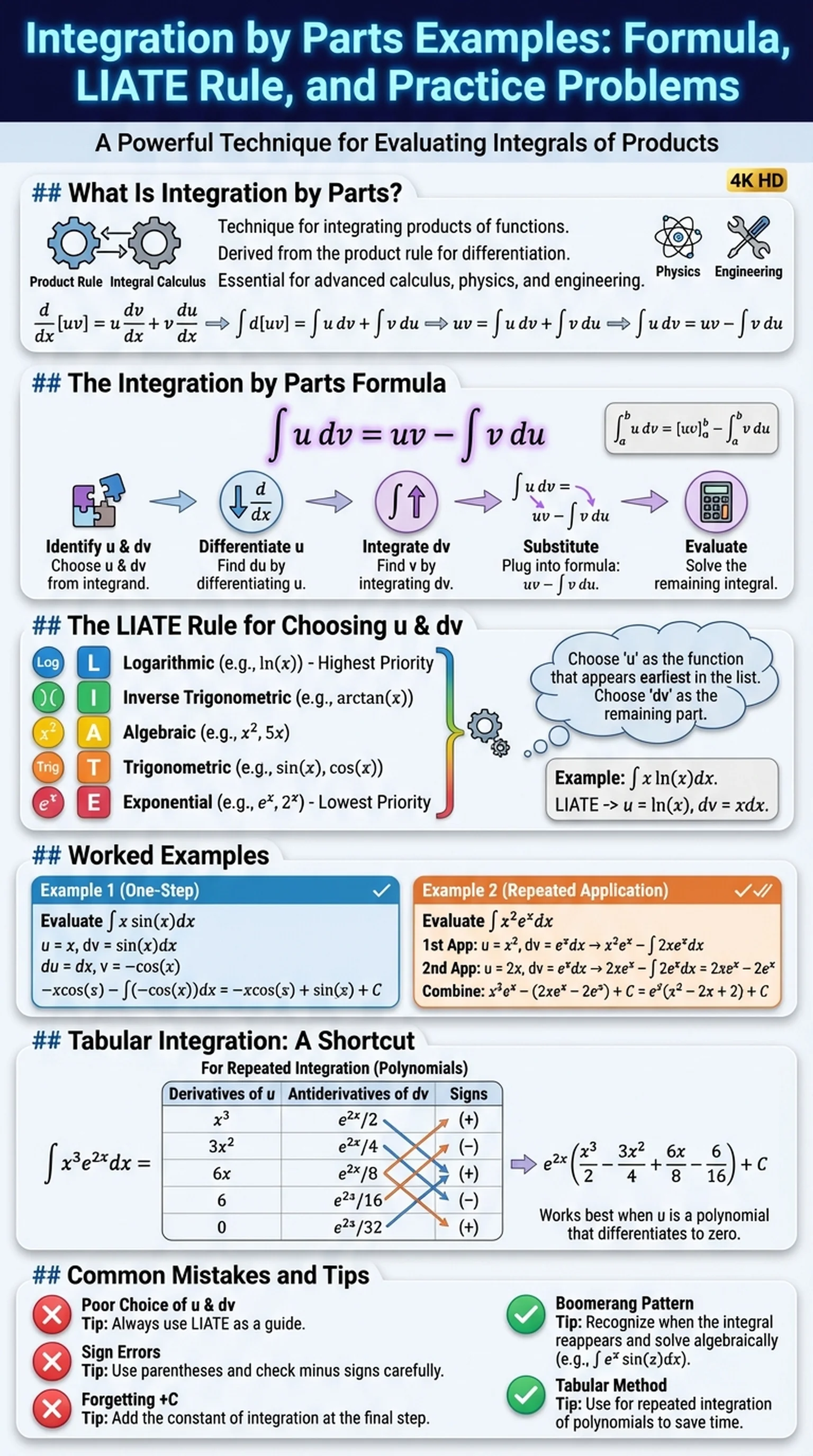
The following reading will walk you through the derivation of the formula and its application in several key scenarios.
Calculus II - Integration by Parts
This guide from Paul's Online Math Notes is a thorough introduction to integration by parts, covering its derivation, basic application, and more advanced cases.
Please read the following sections: Start from the introduction to see how the formula is derived from the product rule and formally stated. Work through Example 1 (\int x e^{6x} dx), which shows a standard application. Read the section on definite integrals and review Example 2 to see how to handle the bounds. Review Example 4, which demonstrates a case where the technique must be applied twice. Finally, look at Example 8. This shows a fascinating "cyclic" case where you solve for the integral algebraically—a powerful trick to have in your back pocket. The text also mentions the tabular method in Example 9, a shortcut for repeated applications shown in the infographic above.
For a supplementary visual walkthrough of these same concepts, from the derivation to definite integrals, consider watching this video.
Integration By Parts | Calculus 2 Lesson 11 - JK Math
This video from JK Math provides a step-by-step tutorial on integration by parts.
You can use the video to reinforce the concepts from the reading: Derivation of the Formula First Example (\int x e^x dx) Second Example (\int x \sin(x) dx) The LIATE Guideline Repeated Application (\int x^2 \cos(x) dx) Cyclic Application (\int e^x \sin(x) dx) Definite Integral Example
Conclusion
In this lesson, you've added two indispensable techniques to your calculus arsenal. These methods are the workhorses of integration, and you will rely on them continuously as you advance in your engineering studies.
Key Takeaways:
- Integration by Substitution (U-Substitution) is used for composite functions (think reverse chain rule). The key is to choose a substitution that simplifies the integral. For definite integrals, you must change the limits of integration to match the new variable .
- Integration by Parts is used for products of functions (think reverse product rule). The key is to choose and such that is simpler than the original integral. The LIATE mnemonic is a valuable guide for choosing . For definite integrals, you evaluate the term across the limits.
With these techniques, you are now equipped to handle a much broader and more realistic set of integration problems. In our next lesson, we will put this new power to use by setting up and evaluating definite integrals to calculate important physical quantities like the area between curves and the work done by a variable force.