Welcome back to our study of foundational physics. In the last lesson, we explored Newton's Second Law and learned how to calculate the acceleration of an object when we know the net force acting upon it. We saw that unbalanced forces cause changes in motion. Today, we will look at this from a different perspective: the perspective of energy.
This lesson introduces the concept of work. In physics, work isn't just about effort; it's a precise measure of how a force transfers energy to or from an object as it moves. Understanding work is the first step toward the powerful principles of energy conservation that are fundamental to all fields of engineering, including chemical engineering. We will cover how to calculate work done by both constant forces, which builds on our previous analysis, and variable forces, which will reconnect with your calculus skills.
1. The Physical Definition of Work
In everyday language, "work" means applying effort. You might feel like you're doing work by pushing against a stationary wall, but in physics, no work is done unless the force causes displacement.
A quick video from the "Professor Dave Explains" channel will introduce this core concept and the basic formula.
This video provides a concise definition of work in physics, contrasting it with the colloquial meaning.
Watch the segment from the introduction to the end of the discussion on positive and negative work. Pay attention to three key ideas: The formula for work done by a constant force: W = Fd. The fact that only the component of force parallel to the displacement does work. The distinction between positive work (force aids motion) and negative work (force opposes motion).
As the video explained, if a constant force acts on an object that undergoes a displacement , the work done is given by:
where and are the magnitudes of the force and displacement vectors, and is the angle between them.
Since you have a background in linear algebra, you will recognize this as the definition of the dot product of two vectors. This provides a more compact and powerful notation:
If the force and displacement vectors are expressed in Cartesian components, and , the work is simply:
The following video from "The Organic Chemistry Tutor" provides excellent worked examples showing both methods.
Work Done By a Force - Incline Planes & Dot Product Formula - Physics
This video walks through calculating work done by a constant force using both the Fd \cos\theta formula and the dot product method.
Watch the first two examples in the video: The first example, from the beginning to the first calculation, shows the direct application of W = Fd \cos\theta. The second part, from the introduction of the dot product to the end of the first problem's re-calculation, demonstrates how to solve the same problem by breaking the vectors into components. Note how it arrives at the same answer.
Application: Pressure-Volume (PV) Work
A crucial application of work in chemical engineering is the work done by an expanding or compressed gas. This is the principle behind engines, turbines, and many chemical processes.
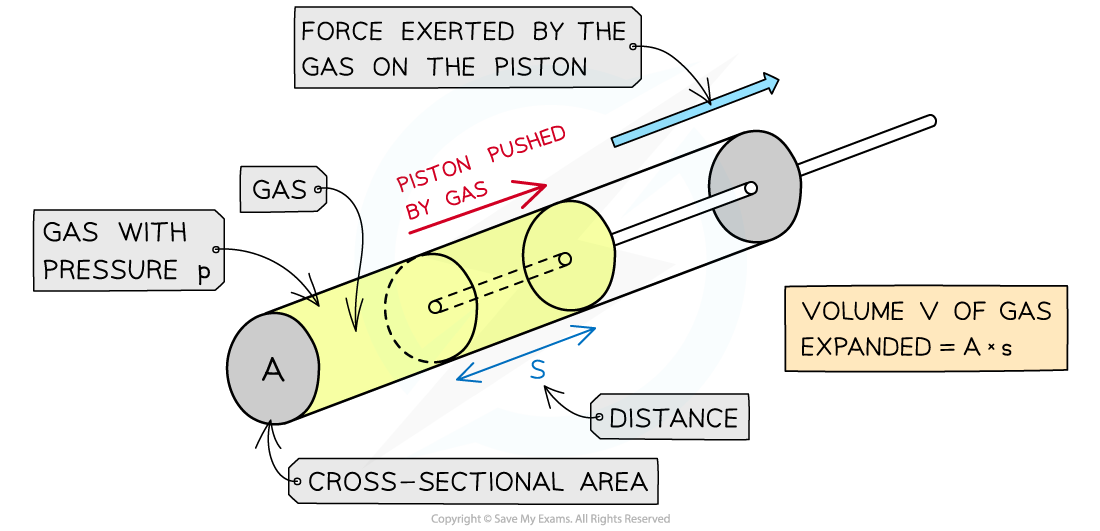
Consider the gas in the cylinder above. The gas exerts a constant pressure on the piston face, which has an area . The force exerted by the gas is . If the gas expands and pushes the piston a distance , the work done by the gas is:
Since the product of the area and the distance is the change in volume, , we get the formula for PV work at constant pressure:
By convention in chemistry and thermodynamics, work done by the system (like an expanding gas) on its surroundings is considered negative, as the system loses energy. Work done on the system (like a gas being compressed) is positive. Thus, the formula is usually written with a negative sign:
where is the constant external pressure the system is working against. We will explore this sign convention and its implications in much more detail in Module 12 on thermodynamics.
2. Work Done by a Variable Force
What if the force changes as the object moves? Common examples include:
- Stretching a spring: The more you stretch it, the harder you have to pull (Hooke's Law).
- Lifting a heavy chain from the ground: As you lift it, the length of chain hanging (and thus its weight) decreases.
- Two molecules interacting: The electrostatic force between them changes with distance.
In these cases, we can no longer use . Instead, we must use calculus.

As the image shows, the work done is the area under the force vs. displacement graph. You'll recall from your calculus studies that finding the area under a curve is done with a definite integral. Therefore, the work done by a variable force in moving an object from position to is:
This powerful definition encompasses the constant force case as well. If (a constant), the integral becomes , just as we expect.
The following resource from Paul's Online Math Notes provides clear examples of how to apply this integral.
This document provides a great review of the calculus-based definition of work and applies it to classic physics problems.
First, read the brief introductory section to review the basic formulas: read the introduction. Next, carefully work through Example 1, which calculates the work done in stretching a spring. Pay attention to how Hooke's Law (F=kx) is used to find the force function, and then how this function is integrated over the correct interval to find the final work done. Finally, review Example 2, which deals with lifting a bucket and cable from a mine shaft. This is a great example where the force changes because the weight of the remaining cable changes. Follow the logic for setting up the force function, F(x), and see how it is used in part (a) to calculate the work done over the first half of the lift by setting up and solving the integral.
These examples highlight the essential strategy for variable-force problems:
- Define a coordinate system: Choose an origin and a positive direction.
- Find the force function F(x): Express the force as a function of position . This is often the most challenging step.
- Set the limits of integration: Determine the start and end positions, and .
- Evaluate the integral: Compute .
Conclusion
In this lesson, we have formally defined work and established the methods for its calculation in various scenarios. This concept bridges the gap between the forces we studied previously and the energy principles we will explore next.
Key Takeaways:
- In physics, work is the energy transferred when a force causes an object to be displaced.
- For a constant force, work is calculated using the dot product: .
- A key application in chemical engineering is PV work, where an expanding or compressed gas does work: for a constant external pressure.
- For a variable force, work is the area under the Force-Displacement curve, found by evaluating the definite integral: .
In our next lesson, we will see the direct consequence of doing work on an object. We will introduce the work-energy theorem, which states that the total work done on an object equals the change in its kinetic energy. This powerful theorem will give us a new and often simpler way to solve dynamics problems.