Welcome to the next lesson in our physics foundation module. In our previous session, we focused on static equilibrium, where all forces on an object cancel out, resulting in a net force of zero and no change in motion. Today, we shift our attention to the more dynamic situations you'll frequently encounter in engineering: what happens when the forces don't balance?
This lesson introduces Newton's Second Law of Motion, the fundamental principle that connects force, mass, and acceleration. You will learn to solve for an object's acceleration when you know the forces acting on it, or conversely, to determine the net force required to produce a specific acceleration. This is the heart of dynamics and is crucial for analyzing everything from fluid flow in chemical reactors to the motion of machinery. The systematic, equation-based approach we'll use builds directly on the skills you developed in the last lesson.
1. From Equilibrium to Acceleration: Newton's Second Law
In the last lesson, the core equation was . When the forces acting on an object are unbalanced, there is a net force, and the object accelerates. Newton's Second Law precisely describes this relationship:
Let's break this down:
- is the vector sum of all external forces acting on the object (the net force).
- is the mass of the object, which is a measure of its inertia, or its resistance to being accelerated.
- is the acceleration of the object, the rate at which its velocity changes.
This simple-looking equation is a cornerstone of physics. It's a vector equation, which means it applies independently to each dimension of motion. For 2D problems, we'll write two separate scalar equations:
Here, and are the components of the object's acceleration along the x and y axes. If an object only accelerates in one direction (e.g., horizontally), the acceleration component in the other direction is zero.
The image below illustrates this concept. In both scenarios, multiple forces act on the car. These forces add up to produce a single net force, , which in turn causes the car to accelerate, , in the same direction as the net force.
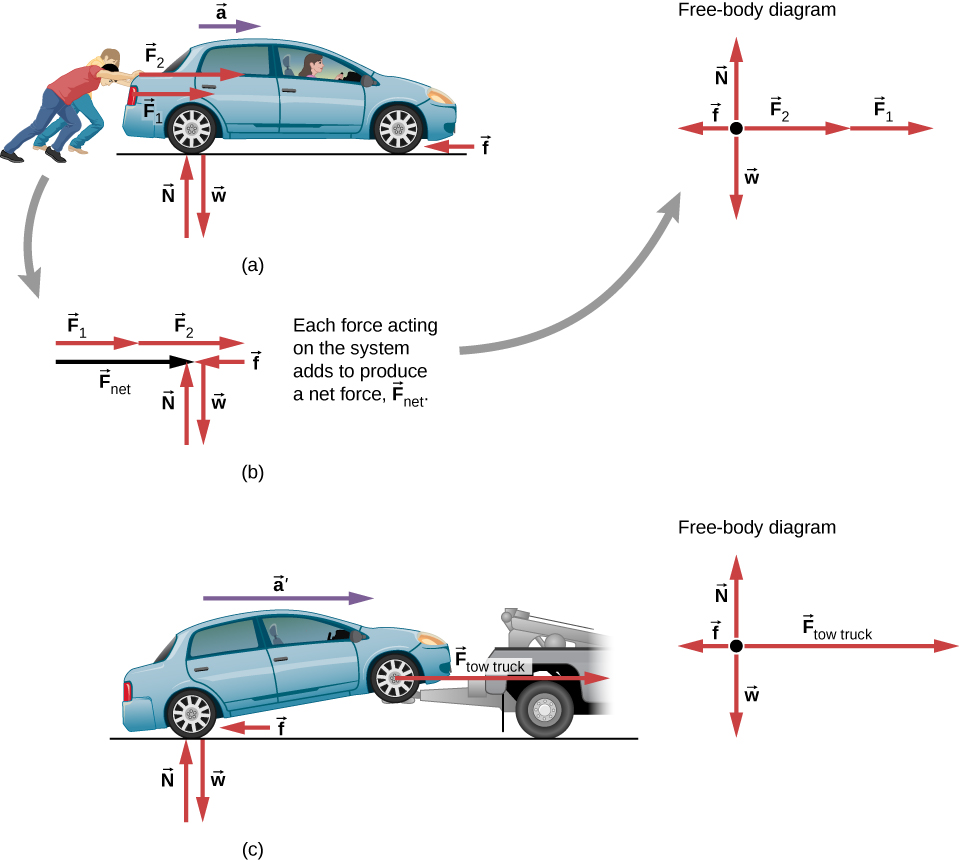
2. The Strategy for Solving Dynamics Problems
The good news is that our problem-solving strategy for dynamics is a direct extension of the one we used for statics. The main change is that the sum of forces in a given direction now equals instead of zero.
The following resource from the University of Wisconsin-Green Bay provides an excellent overview of the mindset and steps for tackling these problems.
Dynamics (Force or Newtons 2nd Law) Problems - Physics - University of Wisconsin-Green Bay
This guide provides a concise, high-level framework for approaching any problem involving Newton's Laws.
Please read the section titled "How to Solve Force Problems." Pay close attention to the five key steps: Identify the Problem: Recognize that you need to relate force and motion. Draw a Picture: This emphasizes the critical role of the free-body diagram and choosing a smart coordinate system. The tip to align an axis with the acceleration is very important. Select the Relation: All these problems start with \sum \vec{F} = m\vec{a}. Solve the Problem: Break the vector equation into components and solve the algebra. Understand the Results: Check if your answer is reasonable.
This framework is universal. Now, let's see it in action through a series of classic examples that illustrate how to apply these steps.
3. Worked Examples in Dynamics
Example 1: Apparent Weight in an Elevator
A common and intuitive application of Newton's Second Law is understanding why you feel heavier or lighter in an accelerating elevator. The reading on the scale is the normal force it exerts on you. Let's see how acceleration changes this force.
6.1 Solving Problems with Newton's Laws
This example from OpenStax's University Physics walks through the calculation of the normal force (scale reading) on a person inside an elevator that is accelerating.
Please read through Example 6.3, "What Does the Bathroom Scale Read in an Elevator?" Focus on these points: The setup of the free-body diagram in Figure 6.5(b), which correctly isolates the person as the system of interest. The application of Newton's Second Law: the equation \sum F_y = F_N - w = ma_y. How the final scale reading changes depending on the acceleration: Part (a): Upward acceleration (a > 0) increases the normal force, making you feel heavier. Part (b): Constant velocity (a = 0) results in the normal force equaling your weight, just as in a static case.
This example is powerful because it directly connects a mathematical result () to a physical sensation you've likely experienced.
Example 2: Pulling a Block at an Angle
Now let's look at a 2D problem. What happens when you pull a block with a force that is directed at an angle? Only part of your force contributes to the horizontal acceleration, while the other part works against gravity.
Newton's Laws - Problem Solving
This video from "Physics for College Students" provides a clear, step-by-step solution to exactly this type of problem.
Please watch the first example presented, from the start of the problem setup to its solution. As you watch, observe how the presenter: Draws the free-body diagram and correctly resolves the angled force FA into its x and y components. Applies \sum F_y = ma_y = 0 to find the normal force, noting that it's not equal to mg. Applies \sum F_x = ma_x using the x-component of the force to solve for the acceleration.
Example 3: Connected Objects - The Atwood Machine
A classic physics problem that is a great model for more complex coupled systems is the Atwood machine: two masses connected by a string over a pulley. Since they are connected, they accelerate together as a system.
Newton's Laws - Problem Solving
The same video provides an excellent walkthrough of solving an Atwood machine problem.
Watch the segment from the Atwood machine example. This problem requires you to analyze two objects simultaneously. Focus on: Defining a consistent positive direction for the motion of the entire system. In the video, up is positive for m1 and down is positive for m2. Drawing a separate free-body diagram for each mass. Writing Newton's Second Law for each mass, resulting in two equations. Solving the two equations simultaneously to find the two unknowns: the acceleration (a) and the tension (T). The trick of adding the two equations together to eliminate tension is a common and useful technique.
4. Practice Problem: A Modified Atwood Machine
Now it's your turn to apply the strategy to a system involving both horizontal and vertical motion.
6.1 Solving Problems with Newton's Laws
This OpenStax example features a block on a frictionless table connected by a string to a hanging block. This is a common setup in introductory physics.
Find Example 6.4, "Two Attached Blocks." Before reading the solution, take a moment to solve it on your own: Draw a separate FBD for block 1 (on the table) and block 2 (hanging). For block 1, write the equations for \sum F_x and \sum F_y. Note that it only accelerates in the x-direction. For block 2, write the equation for \sum F_y. It only accelerates vertically. You should now have a system of two equations with two unknowns (acceleration a and tension T). Try to solve for them algebraically. After your attempt, read the provided solution to check your work and reasoning. Pay attention to the final comment: why must the tension be less than the weight of the hanging block?
Conclusion
In this lesson, we made the crucial leap from static equilibrium to dynamics. You've learned how to use Newton's Second Law, , to predict the motion of an object based on the forces acting upon it. This principle is one of the most powerful tools in all of science and engineering.
Key Takeaways:
- An unbalanced or net force on an object causes it to accelerate.
- Newton's Second Law, , is the governing equation for dynamics problems.
- The problem-solving strategy involves drawing a free-body diagram, choosing an appropriate coordinate system (ideally with one axis along the direction of acceleration), decomposing forces, and applying the Second Law to each axis independently.
- For systems with multiple connected objects, you must analyze each object with its own FBD and equation, then solve the resulting system of equations.
In our next lesson, we will begin our journey into the concepts of energy. We will start by defining work as a measure of energy transfer by a force, a concept that builds directly on the force analysis you have mastered today.