Hello! In our previous lessons, we explored the mechanics of solid objects, culminating in the powerful principle of energy conservation. We're now going to pivot from the world of rigid bodies and discrete forces to the continuous medium of fluids. This is a critical step toward your goal of becoming a chemical engineer, as so much of chemical processing involves handling, reacting, and separating substances in liquid or gas form.
Today's lesson will establish the foundational concepts of fluid statics. We will first define pressure in a general sense and then focus specifically on hydrostatic pressure—the pressure exerted by a fluid at rest due to gravity. By the end of this lesson, you will be able to calculate the pressure at any depth within a static fluid, a skill essential for designing everything from storage tanks to complex piping networks.
1. What is Pressure?
At its core, pressure is a measure of how concentrated a force is. You are familiar with the concept of force from our study of Newton's laws. Pressure, , takes this a step further by considering the area, , over which that force, , is distributed.
The formal definition is:
The standard unit for pressure is the Pascal (Pa), where .
This relationship explains many everyday phenomena. A sharp knife cuts better than a dull one because the same force is applied over a much smaller area, resulting in immense pressure. Similarly, snowshoes work by distributing a person's weight over a large area, reducing the pressure on the snow to prevent them from sinking.
To get a feel for this fundamental concept, please watch the beginning of the following video.
Introduction to Pressure & Fluids - Physics Practice Problems
This video from The Organic Chemistry Tutor provides a clear introduction to the concept of pressure and works through a simple calculation.
Watch the first two sections of the video. From the beginning to the explanation of the relationship between pressure, force, and area. The example problem from calculating the pressure exerted by a rectangular block. Note how the force is simply the weight of the block (F=mg), a familiar calculation.
2. Hydrostatic Pressure: The Pressure in a Fluid
Now, let's extend this concept to fluids. Imagine a column of water in a container. The water at the bottom of the container must support the weight of all the water above it. This weight creates pressure. This pressure, caused by the weight of a fluid, is called hydrostatic pressure.
To derive the formula for hydrostatic pressure, we can use the same fundamental equation, , and apply it to a column of fluid.
Consider a cylindrical element of fluid at rest within a larger body of fluid, as shown in the diagram below.
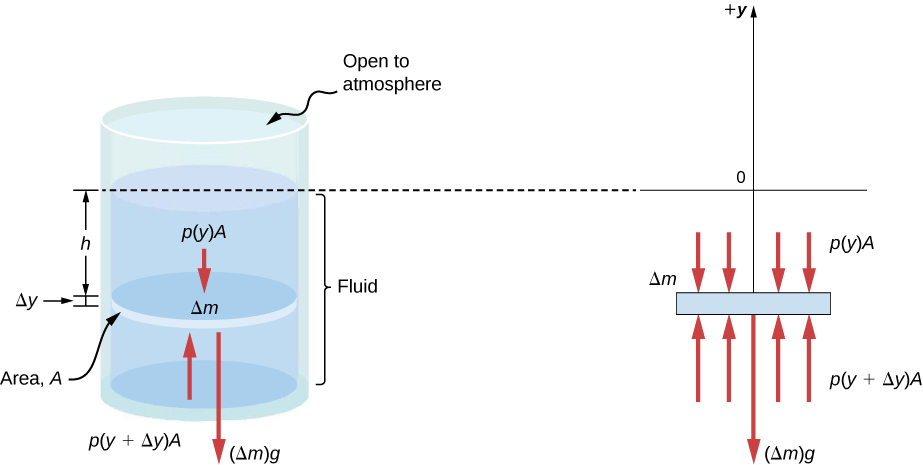
Let's derive the formula for the pressure difference between two points in the fluid.
- The Force (F) acting on the bottom face of the fluid column is the weight of the column itself. We know that weight is .
- The mass (m) of the fluid can be expressed using its density () and volume (): .
- The volume (V) of a cylindrical column is its cross-sectional area () multiplied by its height (): .
- Substituting these into our pressure equation:
- The area cancels out, leaving us with the elegant and powerful formula for hydrostatic pressure (often called gauge pressure):
Where:
- (rho) is the density of the fluid (e.g., for fresh water, ).
- is the acceleration due to gravity ().
- is the depth below the surface of the fluid.
The following two videos walk through this derivation, one using algebra and the other using a free-body diagram, which should be familiar from your earlier physics lessons.
Introduction to Pressure & Fluids - Physics Practice Problems
This video provides a straightforward algebraic derivation of the hydrostatic pressure formula.
Watch the section from the derivation. Pay close attention to how the volume and mass are substituted into the main pressure equation, leading to the cancellation of the area term.
This video from Guelph Physics uses a free-body diagram and Newton's First Law to derive the pressure difference formula, reinforcing your mechanics knowledge.
Watch the derivation from the force analysis. This approach treats a "plug" of water as an object in static equilibrium, where the upward force from pressure below must balance the downward force from pressure above plus the weight of the plug itself.
3. Absolute Pressure
The formula tells us the pressure generated by the fluid itself. However, in an open container, the surface of the fluid is also being pushed down by the atmosphere. Therefore, the total or absolute pressure at a depth is the sum of the atmospheric pressure () and the hydrostatic pressure.
14.3: Fluids, Density, and Pressure (Part 2) - Physics LibreTexts
This section from LibreTexts Physics formally presents the equation for absolute pressure.
Read the section Pressure at a Depth. This part introduces the concept and gives the final equation for absolute pressure: p = p_0 + \rho gh Here, p_0 represents the pressure at the surface, which is typically atmospheric pressure.
The term is often referred to as gauge pressure, as it is the pressure that most mechanical gauges measure—the pressure relative to the surrounding atmosphere.
4. The Hydrostatic Paradox
One of the most surprising consequences of the hydrostatic pressure formula is what it doesn't include. Notice that the pressure depends only on depth (), fluid density (), and gravity (). It does not depend on the total volume of the fluid, the surface area, or the shape of the container.
This leads to the "hydrostatic paradox": the pressure at the bottom of a narrow tube filled with water to a height of 10 meters is the same as the pressure at the bottom of a large lake 10 meters deep.
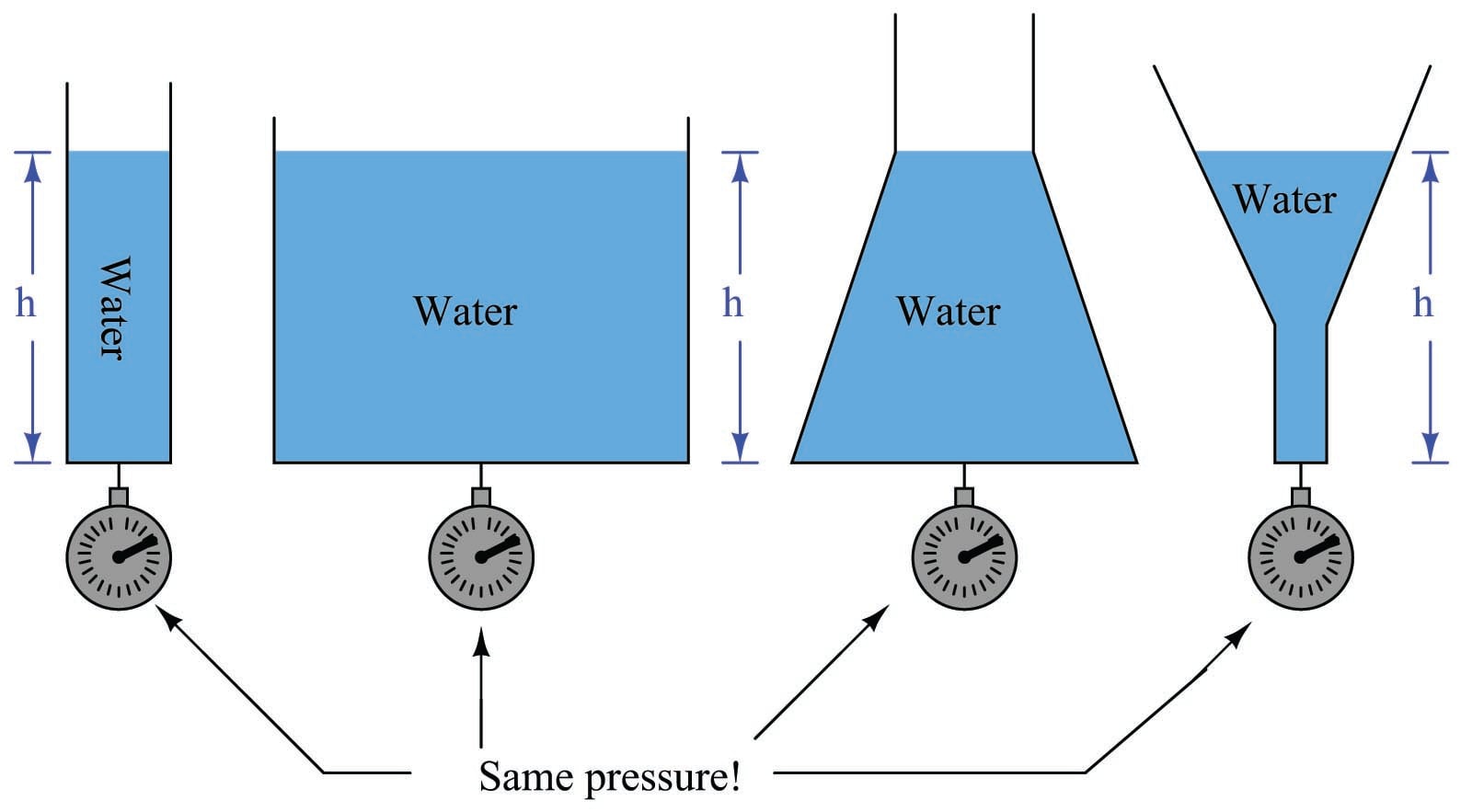
This might seem counterintuitive. How can the small amount of water in the narrow vessel exert the same pressure as the massive amount in the wide one?
Pressure in liquids (hydrostatic pressure) | tec-science
This article from tec-science provides an excellent explanation for this paradox using both energy and force considerations.
Please read the section titled Hydrostatic paradox. Focus on the two explanations provided: The energetic argument, which relates to your previous lesson on energy conservation. If the pressure were different, one could create a perpetual motion machine, which is impossible. The force balance argument, which shows how the container's walls exert supporting forces (upwards or downwards) that precisely compensate for the "missing" or "extra" weight of the fluid, so that only the vertical column of fluid directly above the measurement point contributes to the pressure.
5. Calculation Example
Let's put this into practice. A key part of your future work in chemical engineering might involve fluids other than water, and their densities are often given in terms of specific gravity. Specific gravity is the ratio of a substance's density to the density of water.
The following video works through a problem using this concept.
Introduction to Pressure & Fluids - Physics Practice Problems
This video continues with another practical problem, this time involving specific gravity.
Watch the problem from the beginning of the problem to the final answer. Observe how specific gravity is first used to find the fluid's density, and then this density is plugged into the hydrostatic pressure formula P = \rho g h.
Conclusion
In this lesson, we have moved from the mechanics of solids to the foundational principles of fluids at rest. Understanding how pressure behaves in a fluid is the first step towards analyzing the more complex scenarios of fluid flow, heat transfer, and reaction kinetics that are central to chemical engineering.
Key Takeaways:
- Pressure is defined as force per unit area ().
- Hydrostatic pressure is the pressure exerted by a fluid at rest due to its weight. It increases linearly with depth.
- The formula for hydrostatic (gauge) pressure is .
- Absolute pressure is the sum of gauge pressure and the surrounding atmospheric pressure: .
- Hydrostatic pressure at a given depth is independent of the container's shape or the total volume of fluid (the hydrostatic paradox).
In our next lesson, we will continue our journey through fundamental physics by exploring the vocabulary of thermodynamics, defining and distinguishing between open, closed, and isolated systems. This will lay the groundwork for understanding energy exchange in chemical reactions.