Welcome to the final lesson in our module on foundational physics. So far, we have explored the mechanics of motion, forces, energy, and most recently, the pressure within static fluids. These concepts describe the state of physical systems. Now, we will build the vocabulary needed to describe how these systems interact with their environment, specifically by exchanging energy and matter.
This lesson is a crucial bridge to thermochemistry and thermodynamics, which are central to chemical engineering. Your goal is to design and control processes that transform materials, and this almost always involves managing the flow of energy and substances. Today, we will define the fundamental language for this analysis. By the end of our session, you will be able to distinguish between open, closed, and isolated thermodynamic systems.
1. The Language of Thermodynamics: System, Surroundings, and Boundary
Before we can classify systems, we must first agree on what a "system" is. In thermodynamics, we are rarely interested in the entire universe at once. Instead, we focus our attention on a specific, well-defined region of space or quantity of matter. This is our system. Everything outside of it is the surroundings, and the surface, real or imaginary, that separates them is the boundary.
The characteristics of this boundary—what it allows to pass through—determine how the system can interact with its surroundings. To get a clear picture of these core definitions, please watch the following segment from an introductory video on thermodynamics.
Best Introduction to Thermodynamics
This video from Brain Station Advanced clearly defines the foundational terms we'll be using throughout our study of thermodynamics.
Watch the section from the introduction of key terms. Pay attention to the examples used for the system (boiling water), surroundings (the kitchen), and boundary (the pot walls). Note the different properties a boundary can have (e.g., rigid vs. flexible, permeable vs. non-permeable).
To summarize, the key relationship is:
Universe = System + Surroundings
Your work as a chemical engineer will constantly involve defining systems—be it a reactor, a distillation column, or a simple pipe—and analyzing the transfer of energy and mass across their boundaries. The classification of these systems is our next step.
2. Open, Closed, and Isolated Systems
Thermodynamic systems are categorized based on what their boundary allows to cross. There are only two things we are concerned with here: matter (mass) and energy (in the form of heat or work).
This gives us three fundamental types of systems:
- Open System: The boundary is permeable to both matter and energy.
- Closed System: The boundary is permeable to energy, but not to matter.
- Isolated System: The boundary is impermeable to both matter and energy.
The following short video provides a concise visual explanation of these three categories.
Open System, Closed System and Isolated System - Thermodynamics & Physics
This video from The Organic Chemistry Tutor offers a quick and clear summary of the three system types.
Watch the video from the beginning. It walks through each system type with simple, effective animations.
To solidify these definitions with more formal and engineering-relevant examples, please read the following sections from the article "Thermodynamic systems" on tec-science.
Thermodynamic systems | tec-science
This article provides excellent, detailed descriptions of each system type, complete with examples that are highly relevant to engineering, such as turbines and internal combustion engines.
Please read the following three sections: Open thermodynamic systems. Notice the example of the jet engine, where both fuel/air (matter) and work/thrust (energy) cross the boundary. Closed thermodynamic systems. The example of a piston-cylinder during the power stroke is a classic closed system: the mass of gas is fixed, but work is transferred out. Isolated thermodynamic systems. This section defines the ideal isolated system using the familiar example of a thermos flask.
3. Visualizing the Exchange
Diagrams are an effective way to summarize these classifications. The simplest representation focuses purely on the exchange of matter and energy.

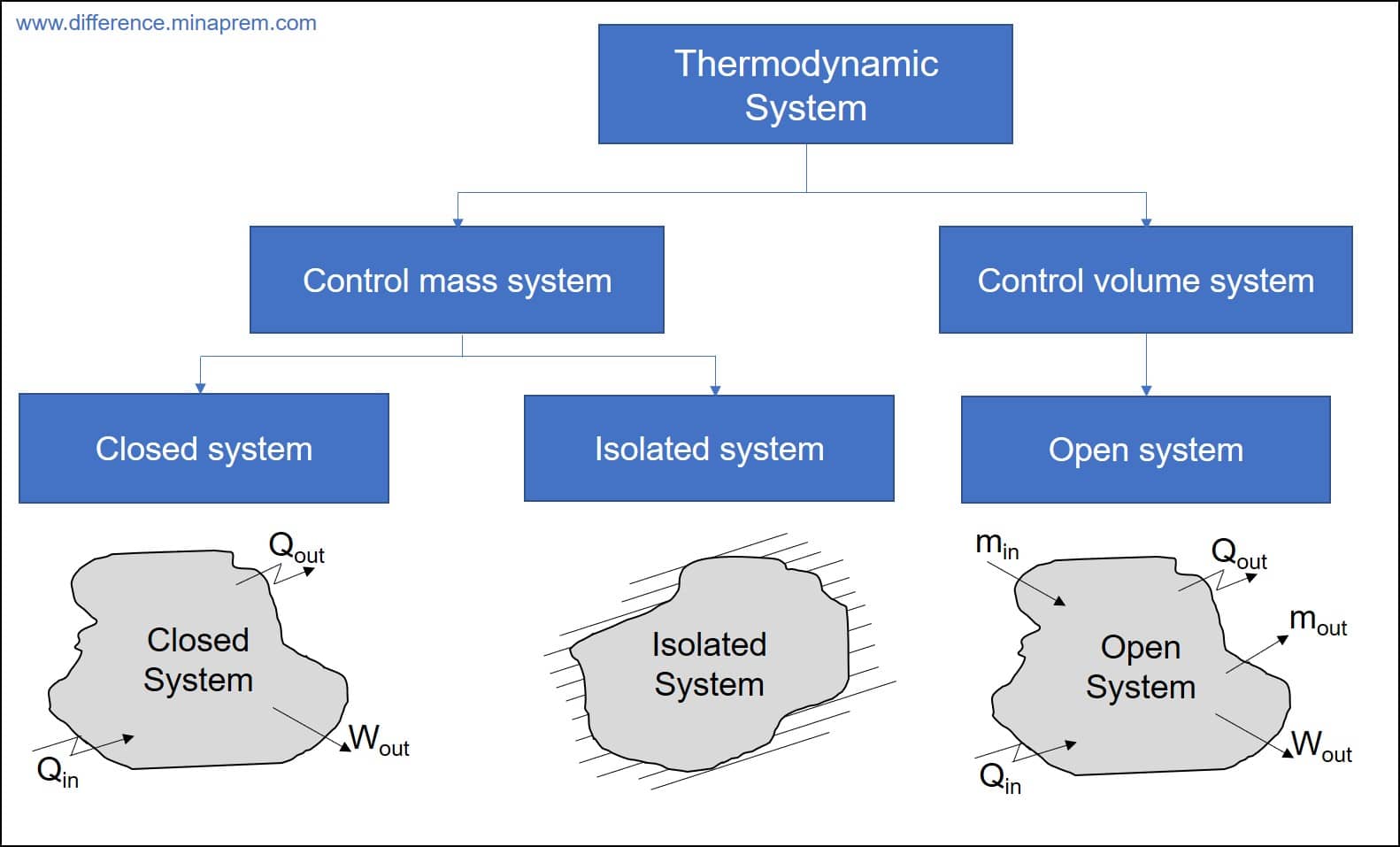
In engineering, particularly in fluid mechanics and thermodynamics, we often use slightly different terminology that you should become familiar with: Control Volume and Control Mass.
- A Control Volume refers to a fixed region in space that we analyze. Matter can flow into and out of this volume. This is another name for an open system. Think of analyzing a specific section of a pipe: the water flows through, but your analysis is fixed on that section of the pipe.
- A Control Mass refers to a fixed quantity of matter. The mass itself is the system, and its boundary may move or change shape, but no mass can enter or leave. This is another name for a closed system. The gas trapped in a piston-cylinder assembly is a perfect example.
The following diagram places these terms into a clear hierarchy.
4. An Important Distinction: The Ideal and the Real
You may have noticed that the examples for isolated systems, like a thermos flask, are often qualified with words like "ideal" or "perfect." This is because a truly isolated system is a theoretical idealization that is practically impossible to achieve.
Even the best thermos will eventually leak heat to the colder surroundings. Therefore, in the real world, most systems that we might model as "isolated" for the purpose of a quick calculation are, in fact, just very well-insulated closed systems.
The surfguppy.com article offers a straightforward take on this practical limitation.
Themodynamic Systems - Open, Closed & Isolated Systems
This resource clearly explains the concept of an isolated system and touches upon its ideal nature.
Read the section on Isolated Systems. Then, scroll down to the comments and read the discussion where a user asks about finding an isolated system in nature. Note the response that the universe itself is often considered the only truly isolated system.
This distinction between an idealized model and physical reality is a recurring theme in science and engineering. Recognizing the assumptions and limitations of a model is just as important as knowing how to use it.
Conclusion
In this lesson, we have established the fundamental classification system for thermodynamics, which is essential for your future studies in chemical engineering. By defining a system and its boundary, we can categorize it based on the transfer of matter and energy.
Key Takeaways:
- A system is the part of the universe we are studying, separated from the surroundings by a boundary.
- An open system (or control volume) exchanges both matter and energy with its surroundings. Examples include a boiling pot of water, a turbine, or a human being.
- A closed system (or control mass) exchanges energy but not matter. Examples include a sealed container of gas or the contents of a piston-cylinder during compression.
- An isolated system is an idealized concept where neither matter nor energy is exchanged. A thermos flask is a common approximation.
This lesson concludes our foundational module on mechanics and energy. We have journeyed from the motion of single objects to the behavior of fluids and now to the language used to describe energy exchange.
In our next module, we will shift our focus from the macroscopic world to the microscopic. We will begin exploring The Building Blocks of Matter, starting with the structure of the atom. Understanding the atom is the first step in understanding chemical properties and reactions, the very heart of chemical engineering.