Introduction
In our last lesson, we established a powerful relationship between temperature, activation energy, and reaction rate using the Arrhenius equation. We learned that we can speed up a reaction by increasing the temperature, which gives more molecules the energy needed to overcome the activation energy barrier, . However, in many industrial and biological systems, raising the temperature is not always practical or even desirable. It can be expensive, cause unwanted side reactions, or damage sensitive materials.
This lesson explores a different, often more elegant, way to increase reaction rates: catalysis. We will investigate how a catalyst works by providing an alternative, lower-energy pathway for a reaction to follow. You will learn how to describe this effect using energy diagrams and connect it back to the concepts of activation energy and the Arrhenius equation. For a chemical engineer, understanding catalysis is not just academic; it is a fundamental tool for designing efficient, economical, and sustainable chemical processes.
How Catalysts Work: A Lower-Energy Shortcut
At its core, a catalyst is a substance that increases the rate of a chemical reaction without being consumed by the reaction itself. It participates in the process, but it is regenerated by the end, ready to facilitate another reaction cycle.
How does it achieve this? Instead of lowering the original energy barrier, it provides an entirely new route for the reaction to take—a "shortcut" with a lower activation energy.
A fantastic analogy for this is getting from one valley to another over a mountain.
The effect of catalysts on rates of reaction
The author of this Chemguide article provides a clear definition of a catalyst's function and a powerful analogy to understand it.
Please read the section beginning with "Catalysts and activation energy". Pay close attention to the mountain and tunnel analogy. It perfectly illustrates the subtle but crucial point that a catalyst provides an alternative route rather than changing the original one.
As you just read, the catalyst doesn't magically lower the mountain. It builds a tunnel through it. The original high-energy path still exists, but most particles will now follow the much easier catalyzed path, dramatically speeding up the overall process.
This effect is best visualized using a reaction coordinate diagram (or potential energy diagram), which plots the energy of the system as reactants are converted into products.
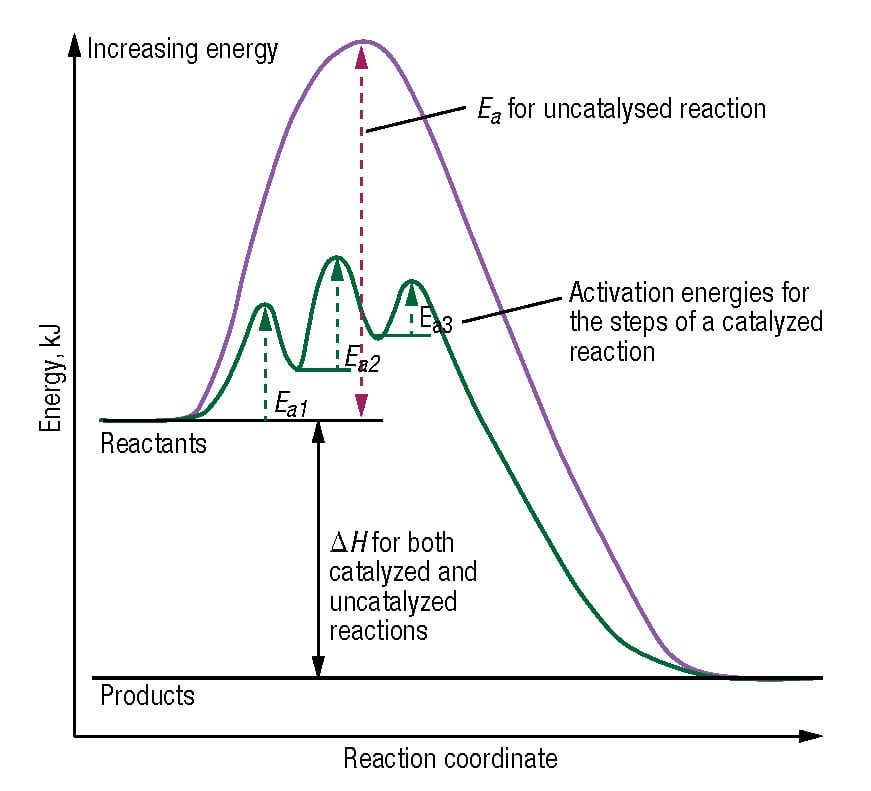
This diagram reveals several key features of catalysis:
- Lower Activation Energy: The peak of the energy hill for the catalyzed reaction (green path) is much lower than for the uncatalyzed reaction (purple path). This lower peak represents the lower overall activation energy, .
- Alternative Mechanism: The catalyzed path often involves multiple steps with intermediate states, as shown by the smaller peaks and valleys in the green curve. This is the new "route" the catalyst provides.
- Unchanged Enthalpy (): The starting energy of the reactants and the final energy of the products are the same for both paths. Therefore, the overall enthalpy change () of the reaction is unaffected by the catalyst. A catalyst makes a reaction faster, but it does not change how much energy is ultimately released or absorbed.
The following video provides a dynamic walkthrough of these diagrams.
Potential Energy Diagrams - Chemistry - Catalyst, Endothermic & Exothermic Reactions
This short segment from The Organic Chemistry Tutor clearly illustrates the effect of a catalyst on a potential energy diagram.
Watch the clip from this point. The presenter directly compares the uncatalyzed and catalyzed pathways, highlighting the reduction in activation energy.
The Impact on Reaction Rate
Now, let's connect this back to the kinetics we've learned. The Arrhenius equation from our previous lesson was:
A catalyst works by lowering the value of . Because is in a negative exponent, decreasing it makes the exponent less negative, which causes the entire exponential term, , to increase significantly. As a result, the rate constant, k, increases, and the reaction speeds up.
We can also visualize this using the Maxwell-Boltzmann distribution, which shows the range of kinetic energies of molecules at a given temperature.
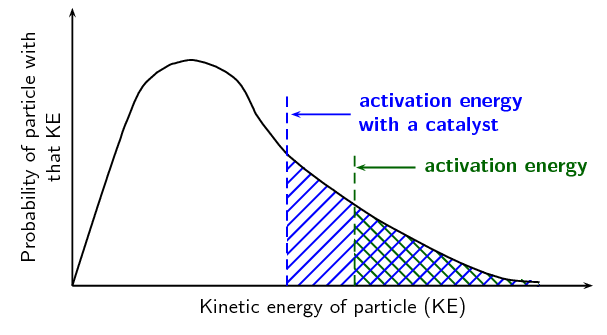
Without a catalyst, only the small fraction of molecules in the tail of the curve (to the right of the green line) have enough energy to react. By lowering the activation energy threshold (shifting the line to the left, to the blue position), the catalyst makes it so that a much larger proportion of the molecules now have sufficient energy. This increase in the number of effective collisions is what causes the dramatic increase in reaction rate.
Types of Catalysts and Real-World Applications
Catalysts are broadly classified into two types based on their physical phase relative to the reactants. Understanding this distinction is crucial in chemical engineering, as it dictates reactor design and operation.
12.8: Catalysis - Chemistry LibreTexts
This article from Chemistry LibreTexts provides a solid overview of catalysis, including the two main types and important industrial examples.
First, quickly review the introductory section "Learning Objectives" to solidify the main concepts. Then, read the section "Homogeneous Catalysts". Note how the catalyst (NO) participates in the reaction mechanism but is regenerated at the end. Finally, read the section on "Heterogeneous Catalysts", paying close attention to the steps involved (adsorption, reaction, desorption) and the example of the catalytic converter. This is a prime example of chemical engineering in action.
As you read, here's a summary of the key distinctions:
- Homogeneous Catalysts: Exist in the same phase as the reactants (e.g., a liquid catalyst dissolved in a liquid solution of reactants). The catalysis of ozone decomposition by nitric oxide gas in the atmosphere is a classic example.
- Heterogeneous Catalysts: Exist in a different phase from the reactants. Most commonly, a solid catalyst is used for a gas or liquid-phase reaction. These are workhorses of the chemical industry because they are easily separated from the product stream.
The catalytic converter in your car is a perfect example of heterogeneous catalysis. A hot exhaust stream containing harmful gases like carbon monoxide (CO) and nitrogen oxides (NOx) flows over a solid ceramic honeycomb coated with precious metals like platinum and rhodium. These metals act as catalysts, providing an active surface where the harmful gases are rapidly converted into harmless carbon dioxide (), nitrogen (), and water. This process is a miniature, high-speed chemical plant that makes modern transportation possible while minimizing air pollution.
Conclusion
In this lesson, we have added a second major tool for controlling reaction rates to our toolkit. While increasing temperature makes molecules move faster, catalysts provide them with a more efficient path. This concept of optimizing a process by changing the underlying mechanism, rather than just forcing it with brute energy, is a recurring theme in engineering and should resonate with your interest in systems and strategy.
Key Takeaways:
- A catalyst increases a reaction's rate by providing an alternative reaction mechanism with a lower activation energy ().
- Catalysts are not consumed in the reaction and do not affect the overall enthalpy change (). They only change the speed of the reaction, not the final outcome.
- By lowering , a catalyst increases the rate constant (k) as described by the Arrhenius equation.
- Catalysts can be homogeneous (same phase as reactants) or heterogeneous (different phase), the latter being fundamental to many large-scale industrial processes like those using catalytic converters.
The idea that a catalyst provides a new "mechanism" with intermediate steps is a crucial one. This leads us directly to our next topic. So far, we've treated reactions as if they happen in a single leap from reactant to product. In the next lesson, we will dissect these "leaps" and learn to distinguish between the overall balanced equation and the series of elementary steps that make up the true reaction mechanism.