Introduction
In our last lesson, we discovered that catalysts speed up reactions by providing a different, lower-energy pathway, or mechanism. This idea hinted that what we write as a single balanced chemical equation might not tell the whole story of what's happening at the molecular level. Today, we're going to pull back the curtain on this process.
This lesson explores the concept of a reaction mechanism, the step-by-step sequence of events that reactants undergo to become products. We will learn to distinguish the overall reaction—the summary of start and end points—from the individual elementary steps that make up the journey. Along the way, we'll identify a crucial type of transient species known as a reaction intermediate, which is key to understanding how these multi-step processes unfold.
The Anatomy of a Reaction: Mechanisms and Elementary Steps
A balanced chemical equation, like , is a fantastic tool for stoichiometry. It tells us the ratio of reactants consumed and products formed. However, it's like saying a trip starts in New York and ends in Los Angeles; it gives you the beginning and end, but none of the details about the route, the stops, or the method of travel.
The reaction mechanism provides that detailed itinerary. It is the sequence of individual chemical events, called elementary steps or elementary reactions, that sum up to the overall reaction. Each elementary step represents a single molecular event, such as a collision between two molecules, or a single molecule breaking apart.
Let's look at a concrete example. The overall reaction between nitrogen dioxide and carbon monoxide is:
This reaction doesn't happen in a single event. A widely accepted mechanism proposes that it occurs in two distinct elementary steps.

As you can see from the diagram, the two proposed steps are:
- Step 1:
- Step 2:
If we add these two steps together and cancel out species that appear on both the reactant and product sides, we get the overall reaction. Watch how this is done.
Reaction mechanism and rate law | Kinetics | AP Chemistry | Khan Academy
This Khan Academy video provides a clear, step-by-step demonstration of what a reaction mechanism is and how to sum its elementary steps to verify that they match the overall reaction.
Watch from the beginning to this point. The presenter walks through the same example reaction, showing how to add the elementary steps and cancel common species to arrive at the overall balanced equation.
Reaction Intermediates: The Transitory Players
In the process of adding the elementary steps, you'll notice some species appear and then disappear. In our example, the molecule is produced in Step 1 but is then immediately consumed as a reactant in Step 2.
Such a species is called a reaction intermediate. It is a substance that is formed in one elementary step and consumed in a subsequent step. Because they don't appear in the final, overall equation, they are easy to overlook, but their existence is crucial evidence for a proposed mechanism.
Reaction mechanism and rate law | Kinetics | AP Chemistry | Khan Academy
Let's continue with the same Khan Academy video, which now explicitly defines and identifies the intermediate in our example.
Please watch the short segment from defining intermediates. This will solidify your understanding of how to spot these species within a mechanism.
It's important to distinguish an intermediate from a catalyst.
- An intermediate is produced first (as a product) and then consumed later (as a reactant).
- A catalyst, as we saw in the last lesson, is consumed first (as a reactant) and then regenerated later (as a product).
Both catalysts and intermediates cancel out and do not appear in the overall balanced equation, but their roles in the mechanism are opposite.
Elementary vs. Overall Reactions: The Key Distinction
The most important practical difference between an elementary reaction and an overall reaction lies in how we determine their rate laws.
For an elementary reaction, because it represents a single molecular collision, the rate law can be written directly from its stoichiometry. The reactant coefficients become the exponents (orders) in the rate law for that step.
For an overall reaction, which is a composite of multiple steps, you cannot determine the rate law from the overall balanced equation. The overall rate law is determined by the mechanism, specifically by its slowest step (which we'll cover in the next lesson).
Elementary Reactions: AP® Chemistry Review | Albert Blog & Resources
This article from Albert.io does an excellent job of breaking down the fundamental properties of elementary reactions and contrasting them with multi-step mechanisms.
First, read the introduction and the section "What Is an Elementary Reaction?" to get a formal definition. Then, skip down and study the table in the section "Comparing Elementary and Multi-step Mechanisms". This table provides a concise summary of the critical differences.
The number of molecules that participate as reactants in an elementary step is called its molecularity.
- Unimolecular: One molecule reacts (e.g., a decomposition). . Rate = .
- Bimolecular: Two molecules collide and react. or . Rate = or Rate = .
- Termolecular: Three molecules collide simultaneously. These are very rare.
The rarity of termolecular reactions makes intuitive sense. Given your interest in statistics and strategy, you can think of it in terms of probability. The chance of two cars colliding at an intersection is low, but plausible. The chance of three cars, all arriving from different directions, colliding at the exact same point at the exact same instant is exceedingly improbable. The same logic applies to molecules.
Visualizing Mechanisms with Energy Diagrams
We can connect the abstract concept of a mechanism back to the reaction coordinate diagrams we've used previously. While a single-step reaction has one energy hump (one transition state), a multi-step reaction will have a series of humps and valleys.
- Each hump corresponds to the high-energy transition state of an elementary step.
- Each valley between the humps represents a reaction intermediate.
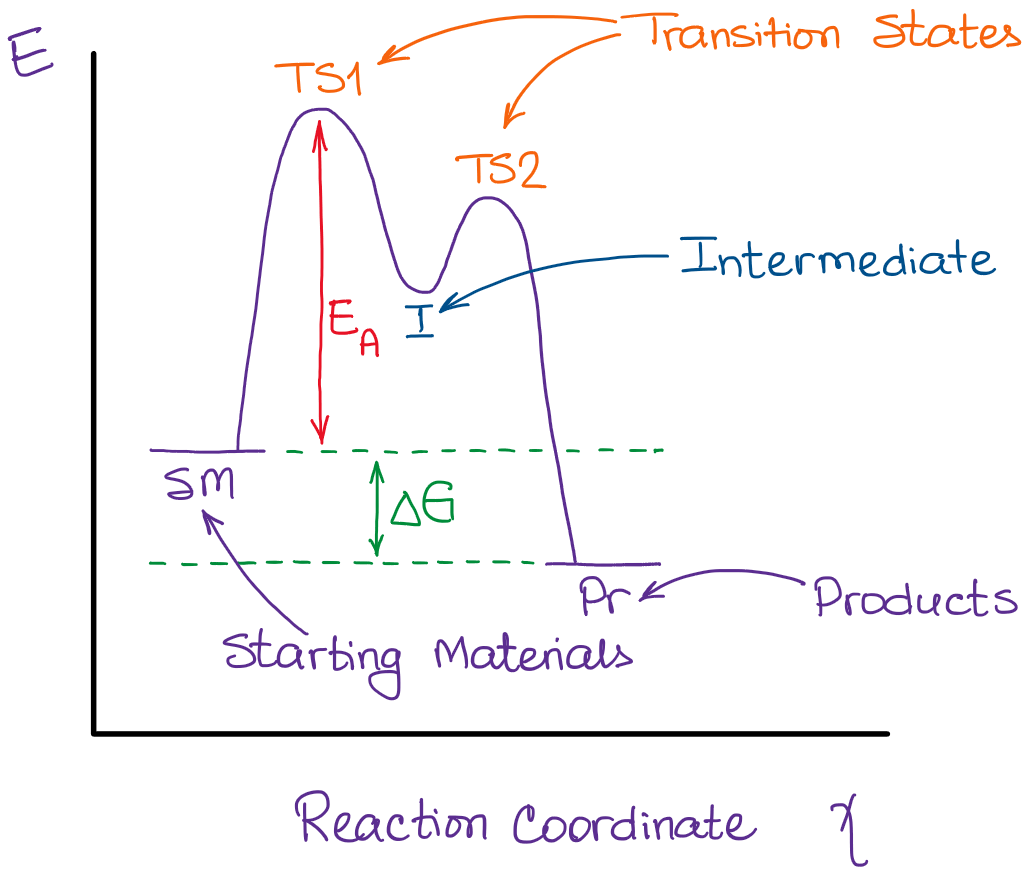
This diagram clearly distinguishes an intermediate from a transition state. The intermediate I sits in an energy valley. This means it's a real, albeit transient, molecule with a finite lifetime. It's more stable than the transition states but less stable than the initial reactants or final products. In contrast, the transition states TS1 and TS2 are at the very peak of the energy hills; they are not molecules that can be isolated, but rather represent the maximally unstable arrangement of atoms as they transition from one state to another.
14.3 Reaction Mechanisms, Catalysts, and Reaction Coordinate Diagrams | General Chemistry
This video from Chad's Prep provides an excellent visual explanation of how to interpret these multi-step diagrams.
Watch the segment from this point. The presenter directly links the number of "hills" to the number of steps and the "valleys" to the intermediates.
Conclusion
In this lesson, we have deconstructed chemical reactions from a simple one-line summary into a detailed, step-by-step mechanism. This shift in perspective is fundamental to chemical kinetics and, by extension, to chemical engineering, where controlling reaction pathways is paramount.
Key Takeaways:
- A reaction mechanism is the sequence of elementary steps that describe how a reaction occurs at the molecular level.
- An elementary step is a single molecular event. Its rate law can be determined directly from its stoichiometry.
- An overall reaction is the sum of all elementary steps. Its rate law cannot be determined from its stoichiometry and must be found experimentally.
- A reaction intermediate is a species that is created in an early elementary step and consumed in a later one. It does not appear in the overall balanced equation.
- Multi-step mechanisms can be visualized on reaction coordinate diagrams, where intermediates occupy the energy minima (valleys) between the transition states (peaks).
We've now seen that most reactions are a series of steps. But are all steps created equal? Logically, the overall speed of any multi-stage process, whether in a factory or a chemical reaction, is limited by its slowest stage. In our next lesson, we will explore this "bottleneck" concept by defining the rate-determining step and learning how it allows us to predict the overall rate law for a proposed mechanism.