Introduction
Welcome to our new module on Chemical Kinetics! In our previous module, we delved into differential equations, which are mathematical tools for describing how systems change over time. The core concept was the rate of change, symbolized as . We now pivot from pure mathematics to its direct application in chemistry, where this very same concept is central.
Chemical kinetics is the study of how fast chemical reactions proceed. This is distinct from thermodynamics (which we'll explore later), a field that tells us if a reaction is favorable to occur at all. A reaction can be thermodynamically spontaneous but proceed so slowly that it's practically unobservable, like the conversion of diamond to graphite. Kinetics, therefore, is crucial for any practical application, from industrial manufacturing to biological processes.
In this first lesson, we will focus on the fundamental language of kinetics. You will learn how to define and quantify the speed of a reaction, and we will distinguish between the average rate over a period of time and the instantaneous rate at a specific moment. This will involve analyzing concentration-versus-time data, a task that should resonate with your experience in data analysis and provides a tangible context for the calculus concepts you've studied.
What is a Reaction Rate?
At its simplest, a reaction rate is a measure of how quickly reactants are used up or products are formed. It’s analogous to the speed of a car, which is the change in distance over a change in time. For a chemical reaction, the rate is the change in concentration over a change in time.
The following resource provides a clear introduction to this concept, defining the rate with respect to both reactants and products.
This reading from a University of Wisconsin text introduces the foundational definitions and equations for reaction rate.
Start by reading the section titled Chemical Kinetics: A Qualitative Approach. Focus on the definitions for the rate of decomposition of a reactant and the rate of formation of a product. Pay close attention to the use of the negative sign for reactants. Then, review the definitions in the Glossary for average rate, initial rate, instantaneous rate, and reaction rate.
As you read, note two key points:
- The Sign Convention: The rate of consumption of a reactant is given a negative sign () because its concentration decreases. Since reaction rates are, by convention, positive values, the extra negative sign cancels out the negative change in concentration. The rate of formation of a product is positive () because its concentration increases.
- Units: Reaction rates are typically expressed in units of concentration per unit of time, most commonly molarity per second (M/s).
A Single Rate for the Whole Reaction
Consider the decomposition of ammonia: .
For every two molecules of ammonia that decompose, one molecule of nitrogen and three molecules of hydrogen are formed. This means they are consumed and produced at different rates. To avoid ambiguity and define a single, unique rate for the overall reaction, we divide the rate of change of each substance by its stoichiometric coefficient.
For a general reaction , the rate is defined as:
This ensures that we get the same positive value for the reaction rate regardless of which reactant or product we monitor. The following video explains this relationship very clearly.
Chemical Kinetics - Initial Rates Method
This segment from The Organic Chemistry Tutor demonstrates how to relate the rates of individual species to the overall reaction rate using stoichiometry.
Please watch the portion of the video that shows how to write the rate expression for a general reaction, starting from the example reaction.
Average vs. Instantaneous Rate
Reaction rates are not usually constant. Typically, a reaction is fastest at the beginning when reactant concentrations are high and slows down as reactants are consumed. This brings us to an important distinction, which is wonderfully explained with a simple analogy in the video below.
Average and Instantaneous Rate of a chemical reaction | Chemical Kinetics | Chemistry | Khan Academy
This Khan Academy video uses the analogy of a car trip to build an intuitive understanding of average versus instantaneous speed, which directly maps to reaction rates.
Watch the first part of the video, which covers the car speed analogy and then explains why reaction rates change over time.
Average Rate
The average rate is the rate calculated over a finite, measurable time interval, . It's like calculating your average speed for a whole trip by dividing the total distance by the total time. On a graph of concentration versus time, the average rate is the slope of the secant line connecting the two points that define the interval.

To calculate it, you simply take the concentration at the start and end of the interval and divide by the time elapsed.
Sample Exercise 14.1 Calculating an Average Rate of ...
This document provides a concise, worked example of how to calculate the average rate from data.
Read through Sample Exercise 14.1 to see a step-by-step calculation. The "Plan" and "Solve" sections clearly lay out the formula and its application. The Plan reiterates the formula we've discussed.
Instantaneous Rate
The instantaneous rate is the rate at a single, specific moment in time. This is analogous to looking at your car's speedometer at a particular instant. From a calculus perspective, this is the derivative of the concentration with respect to time, .
Graphically, the instantaneous rate is the slope of the tangent line to the concentration-versus-time curve at that specific point. The initial rate is a particularly important value in kinetics, and it is simply the instantaneous rate at time .
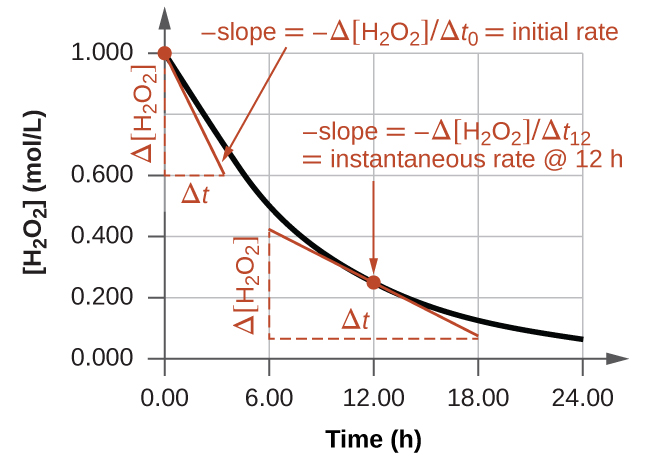
The next video provides an excellent visual demonstration of how the average rate (slope of a secant line) becomes the instantaneous rate (slope of a tangent line) as the time interval shrinks to zero. This is a perfect visual representation of the limit definition of a derivative, which you've encountered in your calculus studies.
Average and Instantaneous Rate of a chemical reaction | Chemical Kinetics | Chemistry | Khan Academy
This part of the Khan Academy video connects the graphical concepts of secant and tangent lines to the calculation of average and instantaneous rates.
First, watch how an average rate is calculated from a graph between two points. Then, focus on the brilliant explanation of how this leads to the instantaneous rate, showing how to calculate the slope of the tangent line (tangent slope).
Let's Practice
Consider the decomposition of hydrogen peroxide from the reading, shown again in the graph Instantaneous Reaction Rate Graph. The data is also tabulated below:
| Time (h) | [H₂O₂] (M) |
|---|---|
| 0.00 | 1.000 |
| 6.00 | 0.500 |
| 12.00 | 0.250 |
| 18.00 | 0.125 |
| 24.00 | 0.0625 |
Your task:
- Calculate the average rate of decomposition of H₂O₂ over the time interval from 6.00 h to 18.00 h.
- Looking at the
Instantaneous Reaction Rate Graph, how does the value you just calculated compare to the instantaneous rate at t = 12.00 h? Is it faster, slower, or about the same? Why?
Take a moment to work this out. The solution is below.
Solution:
-
Average Rate Calculation:
-
Comparison: The instantaneous rate at t=12.00 h, given by the slope of the tangent line, is (as calculated in some textbooks using this graph). Our calculated average rate of is faster. This makes sense because the average rate is calculated over an interval (6h to 18h) where the reaction rate is continuously decreasing. The rate in the first half of the interval (6h to 12h) is faster than the rate in the second half (12h to 18h), so the average over the whole interval is pulled up by the faster initial part.
Conclusion
In this lesson, we laid the groundwork for our study of chemical kinetics. We established a precise definition for reaction rate and saw how to express it unambiguously even when reactants and products have different stoichiometric coefficients.
Key Takeaways:
- Reaction Rate is the change in concentration of a species over time. It's negative for reactants and positive for products, with units typically in M/s.
- The overall rate for a reaction is normalized by stoichiometric coefficients to provide a single, consistent value.
- Average Rate is calculated over a finite time interval () and corresponds to the slope of a secant line on a concentration-time graph.
- Instantaneous Rate is the rate at a specific moment () and corresponds to the slope of the tangent line—a direct application of the derivative from calculus. The rate at t=0 is the initial rate.
So far, we have learned how to determine a reaction's rate by analyzing experimental data. In our next lesson, we will move from measuring rates to predicting them. We will introduce the rate law, a powerful equation that mathematically connects the reaction rate to the concentrations of the reactants. This will be our first step toward building predictive models of chemical change.