Introduction
In our previous lesson, we saw how the roots of the characteristic equation determine the behavior of a second-order system. Specifically, we discovered that complex conjugate roots, , give rise to solutions of the form , which describe damped oscillations. We used a key relationship called Euler's formula to make this connection, but we didn't explore it in depth.
This lesson is dedicated to building a solid foundation in the mathematics of complex numbers. We will formalize their representation in different forms—rectangular and polar—and dive into the origin and application of Euler's formula. Mastering this topic is not just about solving differential equations; it's a gateway to more advanced topics in chemical engineering, including process control, systems analysis, and understanding wave phenomena in quantum mechanics. By the end of this lesson, you will be able to fluidly convert complex numbers between forms and apply Euler's formula to simplify complex calculations.
From Cartesian to Complex: The Rectangular Form
You are likely familiar with representing points on a 2D plane using Cartesian coordinates . Complex numbers use a very similar idea. A complex number is typically written in rectangular form as:
where is the real part and is the imaginary part. Instead of an x-y plane, we visualize these numbers on the complex plane, where the horizontal axis is the real axis and the vertical axis is the imaginary axis.
4. Polar and Exponential Forms
This first section from Paul's Online Notes introduces the geometric interpretation of complex numbers.
Please read the section titled Geometric Interpretation. Focus on how a complex number is represented as a point or vector and how the modulus, or absolute value, corresponds to the length of this vector.
This geometric view is the first step. The number is simply the point in this new plane.
A New Perspective: Polar Coordinates
Representing the point with Cartesian coordinates is not the only way. We can also use polar coordinates , where is the distance from the origin and is the angle measured from the positive real axis.
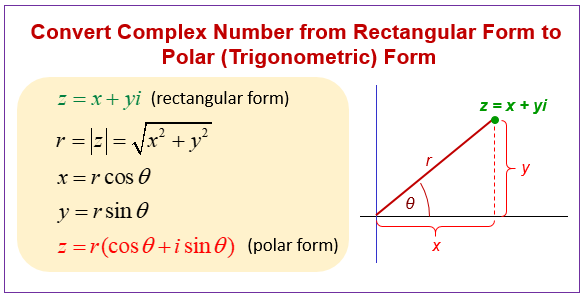
In the context of complex numbers:
- is called the modulus (or absolute value) of , denoted as . It's calculated using the Pythagorean theorem: .
- is called the argument of , denoted as . It's calculated using trigonometry: .
From basic trigonometry, we know and . Substituting these into the rectangular form gives us the polar form of a complex number:
The following reading explains this in detail and walks through the process of converting a complex number from rectangular to polar form.
4. Polar and Exponential Forms
These sections will guide you through the mechanics of converting to polar form.
First, read the section on Polar Form. Pay close attention to the definitions of the argument and the principal value of the argument, which is the unique angle in the range -\pi < \theta \le \pi. Next, work through Example 1 just below, which shows how to convert specific complex numbers. Note the care taken to place the angle \theta in the correct quadrant.
The Magical Bridge: Euler's Formula
Now we arrive at the centerpiece of this topic: Euler's formula. It provides a stunningly simple connection between the exponential function and trigonometric functions.
Euler's Formula:
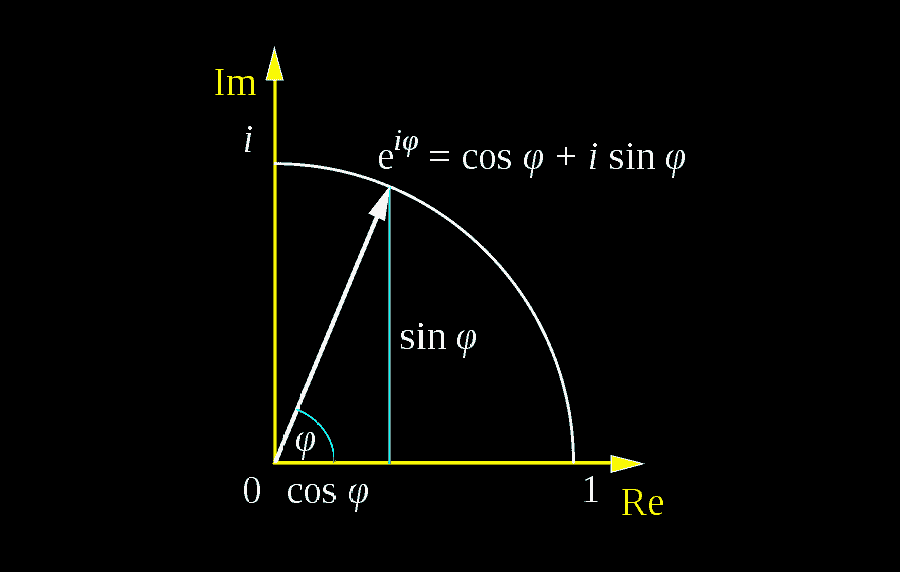
This formula is not an arbitrary invention; it arises naturally from the properties of these functions. Given your interest in "the why," the following video provides two beautiful explanations for this identity. The first is geometric and intuitive, while the second is a more rigorous proof using Taylor series, which may resonate with your previous calculus studies.
Why do trig functions appear in Euler's formula?
This video from the channel jHan offers two distinct and powerful explanations for why Euler's formula is true.
First, watch the geometric derivation, which treats e^{ix} as a function that traces a path on the complex plane. This part runs from the introduction to the first conclusion (geometrical argument). Then, continue with the second, more formal proof that uses Maclaurin series expansions for e^x, \sin x, and \cos x. This part covers the remainder of the video (calculus argument).
Understanding both of these perspectives gives you a robust mental model for this crucial formula. It's not just a rule to memorize; it's a deep and fundamental connection within mathematics.
The Power of Exponentials: A Simpler Way to Calculate
By combining the polar form with Euler's formula , we arrive at the elegant exponential form:
This form is incredibly powerful because it transforms complex arithmetic. Operations that are tedious in rectangular form, like multiplication and division, become simple using the rules of exponents.
4. Polar and Exponential Forms
This final reading from Paul's Online Notes introduces the exponential form and shows how it simplifies arithmetic.
Read the section on Exponential Form to see how it's derived. Then, continue to the formulas that show how to find the multiplicative inverse and, more importantly, the product and quotient of two complex numbers using this form.
The key rules are:
- Multiplication:
(Multiply the moduli, add the arguments) - Division:
(Divide the moduli, subtract the arguments)
This is why complex roots in our ODE solutions led to products of exponentials and trigonometric functions—it's the rules of exponents applied to complex numbers!
Practice and Application
With the theory in place, let's work through some concrete examples. This video from MIT OpenCourseWare is a guided problem-solving session that covers all the concepts we've discussed: converting between forms, visualizing the geometry, and using the exponential form to perform calculations.
Complex Numbers and Euler's Formula | MIT 18.03SC Differential Equations, Fall 2011
This video walks through a set of problems applying the concepts of rectangular form, polar form, and Euler's formula. I recommend pausing the video at the start of each problem part (A, B, C, etc.) to try solving it yourself before watching the solution.
The video covers: Converting from rectangular to polar form. Converting from polar to rectangular form. Drawing the geometric triangle that relates the two forms. Using the polar form to easily compute the reciprocal and roots of complex numbers.
Working through these problems is the best way to solidify your understanding and become comfortable with the mechanics of complex number manipulation.
Conclusion
In this lesson, we established a comprehensive understanding of complex numbers, moving beyond a simple tool for solving ODEs. You now have a framework for representing them, visualizing them, and performing calculations with them efficiently.
Key Takeaways:
- Complex numbers can be represented in three main ways:
- Rectangular Form: , useful for addition and subtraction.
- Polar Form: , which highlights the magnitude and direction.
- Exponential Form: , which is ideal for multiplication, division, and powers.
- Euler's Formula () is the fundamental bridge connecting these forms. It reveals that the exponential function with an imaginary argument traces a circle, inherently linking it to trigonometric functions.
- The exponential form simplifies complex arithmetic by leveraging the standard rules of exponents.
This lesson concludes our module on differential equations. We have built a powerful mathematical toolkit for modeling dynamic systems. In our next module, we will shift our focus to Chemical Kinetics, where we will study the rates of chemical reactions. The concept of "rate of change" will be central, and the exponential functions we have studied so deeply will reappear as we model how reactant concentrations change over time.