In our previous lesson, we journeyed into the heart of the atom, discovering its three fundamental components: protons, neutrons, and electrons. We established that the dense central nucleus, containing protons and neutrons, accounts for an atom's mass, while the surrounding electrons define its volume. This foundational model sets the stage for understanding what makes one element different from another.
Today, we will build directly on that knowledge to explore how the number of these subatomic particles gives an element its unique identity. You will learn to use atomic number and mass number to describe specific atoms. This will lead us to the important concept of isotopes—variants of the same element—and you will learn the mathematical process for calculating an element's average atomic mass, the very number you see on the periodic table. This skill is a cornerstone of chemical accounting, which is essential for any chemical engineer.
1. The Identity and Mass of an Atom
The single most important property that defines an atom of a particular element is the number of protons in its nucleus. This count is unique to each element.
-
Atomic Number (Z): This is the number of protons in an atom's nucleus. It is the fundamental identifier for an element. For example, any atom with 6 protons is, by definition, a carbon atom (Z=6). Any atom with 92 protons is a uranium atom (Z=92).
-
Mass Number (A): This is the total count of protons and neutrons in the nucleus. Since electrons have negligible mass, the mass number gives us a good approximation of the atom's mass in atomic mass units (amu). The mass number is always a whole number.
To see how we formalize this information and introduce the concept of isotopes, please watch the first part of this video from Professor Dave Explains.
Nuclide Symbols: Atomic Number, Mass Number, Ions, and Isotopes
This video clearly defines atomic number, mass number, and introduces the standard notation used to represent atoms, known as nuclide symbols. It then uses these concepts to define isotopes.
Please watch from the beginning until the 2:35 mark. Focus on how the number of protons (atomic number) identifies the element, while the number of neutrons can vary.
As the video explained, we use a standard nuclide symbol to represent a specific atom:
Where:
- X is the one- or two-letter symbol for the element (e.g., C for Carbon).
- A is the mass number (protons + neutrons), written as a superscript to the top left.
- Z is the atomic number (protons), written as a subscript to the bottom left.
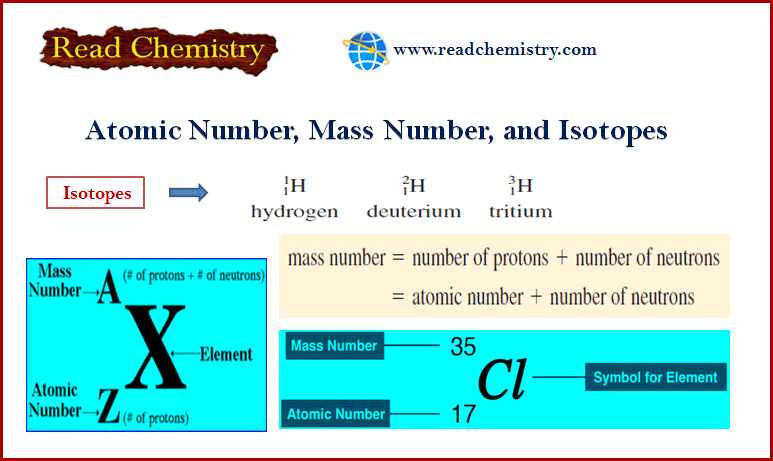
From this notation, you can always determine the number of neutrons by subtracting the atomic number from the mass number: Neutrons = A - Z.
For example, the symbol for one of the most common isotopes of carbon is . We can see it has:
- 6 protons (from Z=6, which also tells us it's carbon)
- 6 electrons (in a neutral atom, electrons = protons)
- 6 neutrons (A - Z = 12 - 6 = 6)
But what if a carbon atom had 7 neutrons? It would still have 6 protons (otherwise it wouldn't be carbon), but its mass number would be 6 + 7 = 13. Its symbol would be . These two atoms, and , are isotopes of carbon.
2. Average Atomic Mass
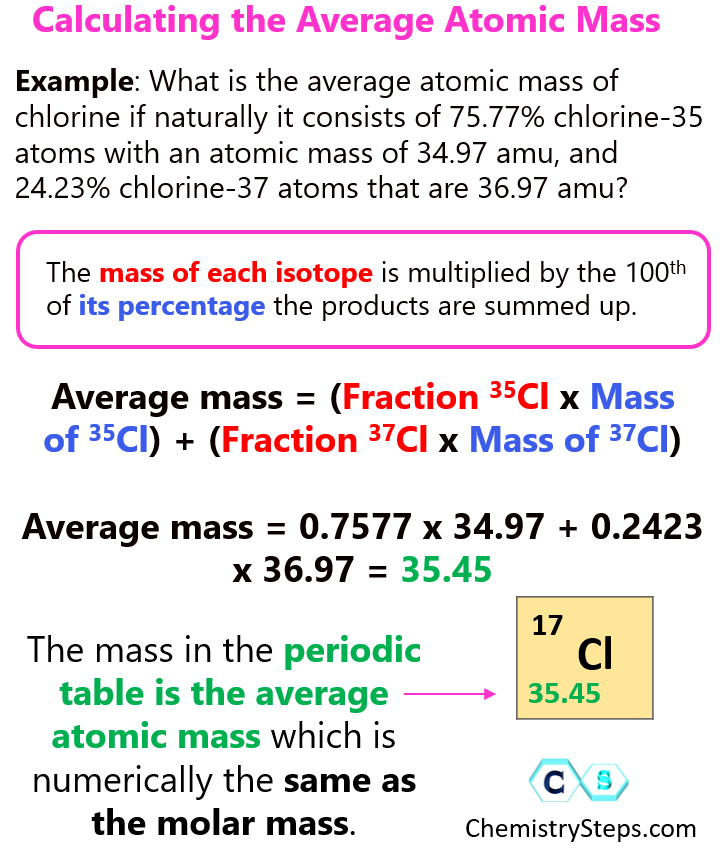
This brings us to a crucial question. If elements can have multiple isotopes, each with a different mass, which mass is listed on the periodic table? If you look at chlorine (Cl), for instance, its mass is listed as 35.45 amu, not a whole number. This is because the value on the periodic table is not the mass of a single atom, but a weighted average of the masses of all its naturally occurring isotopes.
This concept is very similar to calculating a weighted average in statistics or business—a topic you may have encountered in your data analysis work. The "weight" for each isotope is its percent abundance—the fraction of that isotope found in a natural sample of the element.
The following segment of the video you watched earlier explains this concept using chlorine as an example.
Nuclide Symbols: Atomic Number, Mass Number, Ions, and Isotopes
This segment explains why atomic masses on the periodic table are decimals and introduces the idea of a weighted average based on isotopic abundance.
Please watch from this timestamp. Pay close attention to how the relative amounts of chlorine-35 and chlorine-37 influence the final average mass.
The formula for calculating the average atomic mass is:
Avg. Atomic Mass = Σ (mass of isotope × fractional abundance of isotope)
The "Σ" (sigma) is the Greek letter for sum, meaning you perform the calculation in the parentheses for each isotope and then add all the results together. "Fractional abundance" is simply the percent abundance converted to a decimal (e.g., 75% becomes 0.75).
3. Performing the Calculation
Let's ground this concept with a detailed reading and another example. The process is straightforward, but it's important to be precise with the numbers.
Isotope Abundance and Average Atomic Mass | ChemTalk
This article from ChemTalk provides a clear definition of isotopes and distinguishes between atomic mass (of a single atom) and atomic weight (the weighted average). It then provides a step-by-step guide to calculating the average atomic mass using magnesium as an example.
Please read the article from the beginning, focusing on the sections titled "What is an isotope?", "How does isotope abundance impact atomic weight?", and "Using isotope abundance to calculate atomic weight." Note the two methods presented; the second method (using decimal abundances) is the most direct application of the formula.
As you saw in the reading, the calculation involves a simple, repeatable process. A common mistake is forgetting to convert the percent abundances into decimal form. To see this pitfall and how to handle elements with more than two isotopes, let's review a few more examples.
Calculate the average atomic weight from isotopic weights and abundances
This resource from ChemTeam offers several worked examples that reinforce the calculation and introduce variations.
Please review the following examples: Read Example #1 (Carbon) for a straightforward two-isotope calculation. Next, read Example #3 (Silicon). This demonstrates a three-isotope calculation and explicitly points out the common error of using percentages instead of decimals. Finally, review Example #5 (Lithium). This shows a slight variation where you must first calculate the abundances from raw atom counts before finding the weighted average.
4. Practice and Application
Now it's time to put this into practice. The following video walks through several problems. We'll start with a three-isotope calculation and then try a more algebraic challenge.
Average Atomic Mass Practice Problems
This video from The Organic Chemistry Tutor provides clear, narrated solutions to average atomic mass problems.
First, watch the walkthrough for calculating the average atomic mass of silicon, which has three naturally occurring isotopes. This is a direct application of the formula we've been studying. Watch from this timestamp. Next, let's tackle a problem that requires a bit of algebra. Given an element's average atomic mass and its isotopic masses, can you find the abundance of each isotope? This is a common type of problem that tests your understanding from a different angle. Watch how it's solved for boron, from this earlier segment of the video. The key is to define the abundance of one isotope as 'x' and the other as '1-x', since their fractional abundances must sum to 1.
Conclusion
In this lesson, we have added crucial detail to our model of the atom. We have established that the number of protons (atomic number, Z) is the absolute identifier of an element, while the number of neutrons can vary, leading to different isotopes. You now have the mathematical tools to calculate an element's average atomic mass from the masses and natural abundances of its isotopes—explaining the decimal values seen on the periodic table.
Key Takeaways:
- Atomic Number (Z) is the number of protons and defines the element.
- Mass Number (A) is the sum of protons and neutrons in a single atom.
- Isotopes are atoms of the same element with different numbers of neutrons and therefore different mass numbers.
- The Average Atomic Mass of an element is the weighted average of the masses of its naturally occurring isotopes, calculated using their fractional abundances.
So far, our focus has been on the nucleus. In our next lesson, we will shift our attention to the electrons. We will move beyond the simple orbital model and delve into the quantum mechanical model of the atom. This will explain how electrons are arranged in orbitals and energy levels, a concept that is the key to understanding chemical properties and bonding.