Welcome to our next lesson. In our previous session, we focused on the atom's nucleus, learning how atomic and mass numbers define elements and their isotopes. You learned to calculate an element's average atomic mass, a key skill for understanding the values on the periodic table.
Today, we shift our focus from the nucleus to the energy that atoms can absorb and emit. This energy often takes the form of light, or more broadly, electromagnetic radiation. We will explore the fundamental relationship between the properties of light—its wavelength and frequency—and the energy it carries. You will learn to perform calculations using Planck's equation, a cornerstone of quantum mechanics. This is not just abstract physics; it's the basis for many analytical techniques in chemical engineering, such as spectroscopy, which is used to identify substances and determine their concentrations.
1. The Wave Nature of Light
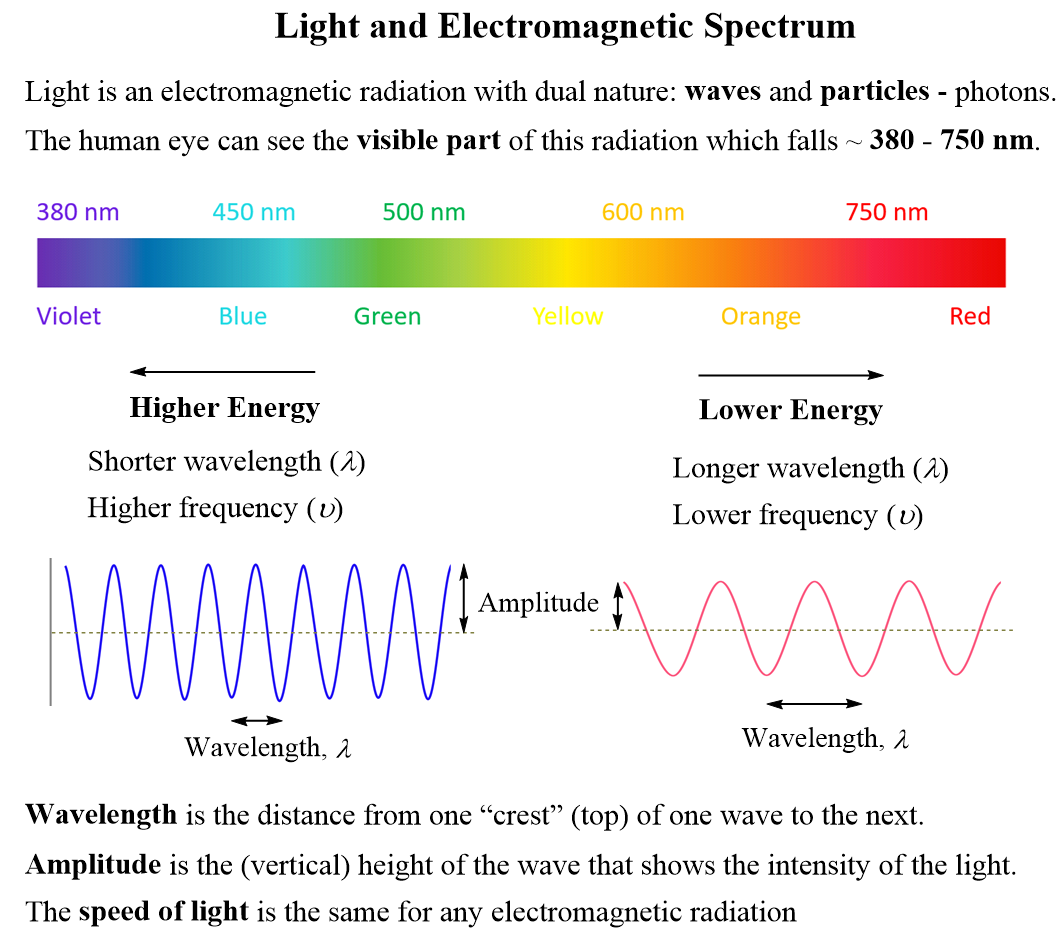
At the turn of the 20th century, scientists primarily understood light as a wave. Like a wave in the ocean, light has a wavelength and a frequency.
- Wavelength (, lambda): The distance between two consecutive peaks (or troughs) of the wave. It's often measured in meters (m) or, for visible light, nanometers (nm), where .
- Frequency (, nu): The number of full wavelengths that pass a point in space each second. Its unit is Hertz (Hz), which is equivalent to cycles per second, or simply s⁻¹.
For any electromagnetic wave traveling in a vacuum, these two properties are linked by a universal constant: the speed of light (), which is approximately meters per second. The equation that connects them is:
This simple equation reveals a crucial inverse relationship: as the wavelength of light gets longer, its frequency must get shorter, and vice versa.
The following video provides a clear walkthrough of how to use this equation to solve for wavelength or frequency, including important unit conversions you'll frequently encounter.
Speed of Light, Frequency, and Wavelength Calculations - Chemistry Practice Problems
The Organic Chemistry Tutor provides excellent, step-by-step examples of calculating wavelength and frequency. This is a great way to refresh your algebraic skills and see the formula in action.
Watch the first two main examples in the video. The first calculates wavelength from frequency, and the second calculates frequency from wavelength. Pay close attention to how the units cancel out. The video also covers converting to different units like nanometers (in the third example), which is a common task.
2. The Particle Nature of Light: Photons and Quanta
The wave model of light was successful, but it couldn't explain certain phenomena, like why heated objects glow specific colors. In 1900, physicist Max Planck proposed a revolutionary idea: energy is not continuous but is emitted or absorbed in discrete packets called quanta (singular: quantum).
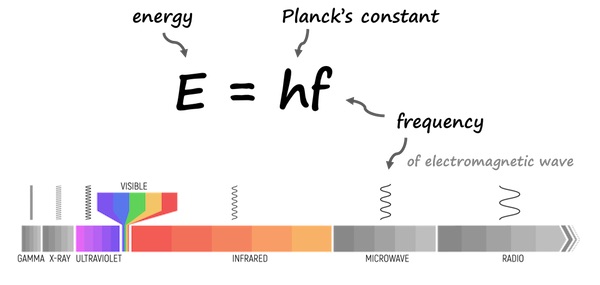
Albert Einstein later extended this idea to light itself, suggesting that light consists of particles called photons. Each photon carries a specific amount of energy—one quantum of light energy. The energy of a single photon is directly proportional to its frequency. This relationship is described by Planck's equation:
Here:
- E is the energy of a single photon, measured in Joules (J).
- is the frequency of the light in Hertz (Hz).
- h is Planck's constant, a fundamental constant of the universe. Its value is (Joule-seconds).
This equation tells us that high-frequency light (like UV or X-rays) is composed of high-energy photons, while low-frequency light (like radio waves) is composed of low-energy photons.
To get a more formal definition of these concepts, the following reading breaks down Planck's equation and provides clear, solved examples.
Planck's Equation: Explanation, Formula & Solved Examples
This resource from Testbook provides a concise summary of Planck's equation, its variables, and the constant itself. It also includes solved examples that apply the formula directly.
Please read the sections titled "Planck’s Equation", which introduces the formula, and "Planck’s Constant" for a definition of this important value. Then, review Example 1 and Example 2 to see how the formula is used to calculate energy from wavelength (by first finding frequency) and directly from frequency.
3. Tying It All Together: A Unified Equation
We now have two fundamental equations:
Since both equations involve frequency (), we can combine them. By rearranging the first equation to solve for frequency () and substituting it into the second equation, we get a new, extremely useful formula:
This single equation directly relates the energy of a photon to its wavelength, without needing to calculate the frequency as an intermediate step. It powerfully illustrates that energy and wavelength are inversely proportional: shorter wavelengths correspond to higher energy.
This relationship is at the heart of many chemical processes and analytical methods. For example, a chemical reaction that requires a lot of energy might only be initiated by high-energy UV light, not by lower-energy visible light.
4. Practice with Calculations
Now, let's apply these formulas to solve some problems. Your experience with data analysis and solving equations will be helpful here, as the main challenge is often keeping track of units and scientific notation.
The following resource provides several worked-out examples. We will focus on a few key types of problems that you are likely to encounter.
Calculations between wavelength, frequency and energy - Probs 1 - 10
This page from ChemTeam is a great collection of practice problems that show how these equations are applied in different scenarios. The step-by-step solutions make the process easy to follow.
Please review the following three problems: Problem #1: This shows you how to calculate the energy of photons when you are given the wavelength. Notice the multi-step process: converting units, finding frequency, then finding energy. It also shows the direct E = hc/λ calculation. Problem #2: This is the reverse process. Given the energy needed to do something (in this case, eject an electron), what is the longest possible wavelength of light that can provide that energy? Problem #8: This is a great practical application related to chemical engineering. It asks for the maximum wavelength of light that can trigger the chemical reaction in photogray eyeglass lenses. This connects the abstract energy calculation to a real-world material transformation.
Conclusion
In this lesson, you've learned to quantify the energy of light. We've established that light behaves as both a wave and a particle (photon), and you can now calculate its properties using fundamental equations.
Key Takeaways:
- Light's wave properties, wavelength () and frequency (), are inversely related by the speed of light: .
- The energy of a light particle (photon) is quantized and is directly proportional to its frequency, as described by Planck's equation: .
- Combining these, we find that a photon's energy is inversely proportional to its wavelength: .
- These relationships allow you to calculate any one of the three properties (energy, wavelength, or frequency) if you know one of the others.
We have taken a major step from the classical world into the quantum one. Our next lesson will apply these concepts directly to the atom. We will explore the quantum mechanical model, which explains how electrons exist in specific energy levels and orbitals around the nucleus. This will be our key to understanding why elements behave the way they do and how they form chemical bonds.