Welcome to your second lesson on calculus. In our last session, we refreshed the fundamental rules for differentiating basic functions like polynomials, trigonometric functions, and exponentials. You learned to break down functions term-by-term using the sum and difference rules. Now, we'll build on that foundation to tackle more realistic and complex functions.
Today's goal is to master the techniques for differentiating functions that are combined through multiplication, division, or composition. We will learn and apply the Product Rule, the Quotient Rule, and the all-important Chain Rule. These rules are the workhorses of differentiation. In your future studies in chemical engineering, you'll find that the mathematical models for phenomena like reaction kinetics, fluid dynamics, and heat transfer often involve functions multiplied, divided, or nested within each other. Mastering these rules is a critical step toward analyzing those complex systems.
1. The Product Rule: Differentiating Multiplied Functions
You might intuitively guess that the derivative of a product of two functions is simply the product of their derivatives. Let's test that idea. Consider , which we can write as where and . We know . However, and , so , which is not . Clearly, a different rule is needed.
The correct approach is beautifully visualized by thinking of the product of two functions, and , as the area of a rectangle whose sides have lengths and . A tiny change in (a ) causes small changes in both side lengths, leading to a change in the total area.
To see a wonderful animation and explanation of this idea, please review the "Product rule" section of the 3Blue1Brown lesson.
Visualizing the chain rule and product rule - 3Blue1Brown
This reading provides a powerful visual intuition for the product rule by representing it as the change in the area of a rectangle with changing side lengths.
Read the section titled Product rule. Focus on understanding how the total change in area, df, is the sum of the two thin rectangles, which correspond to the two terms in the product rule formula.
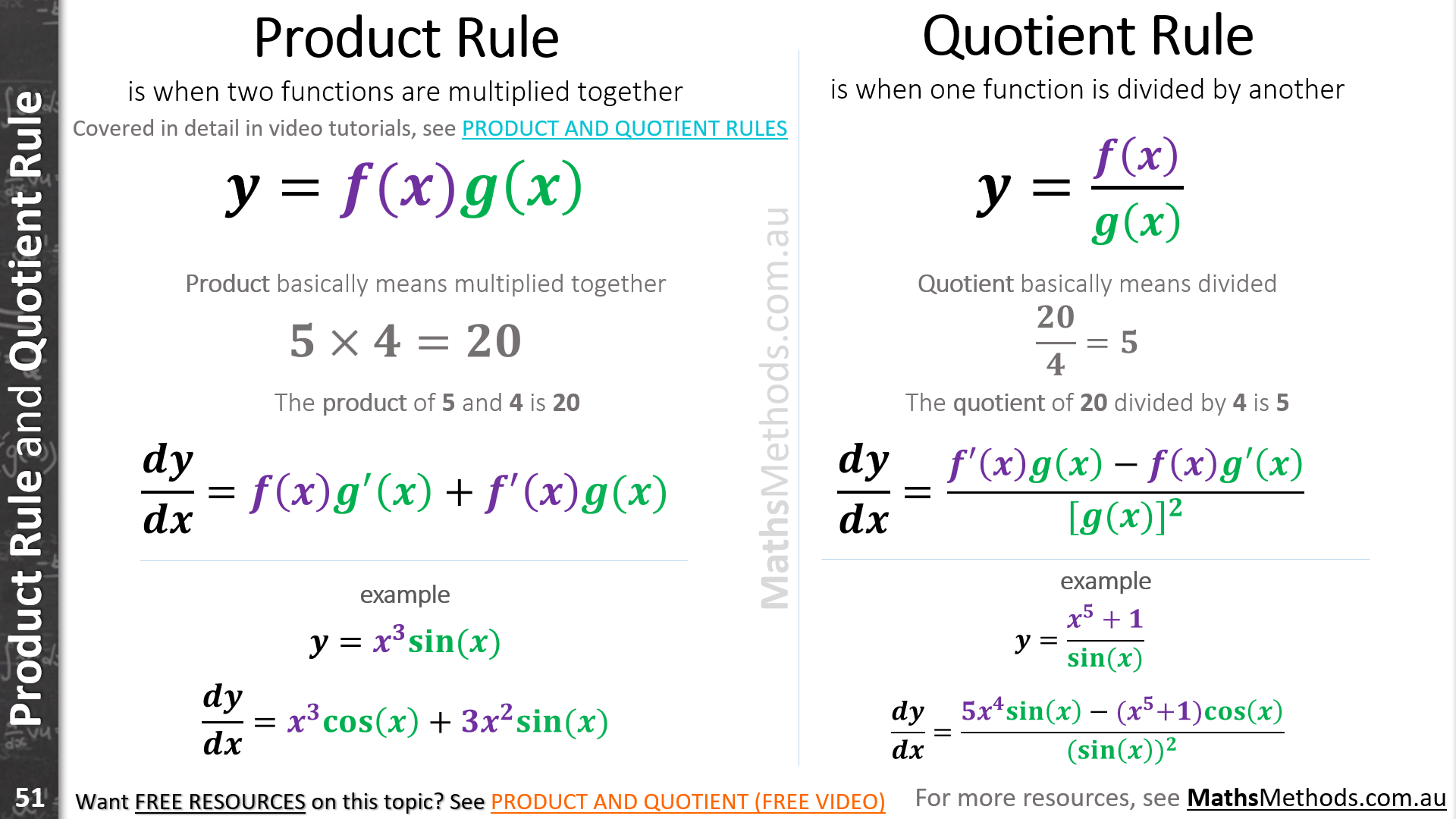
This visualization leads directly to the formal Product Rule. If you have a function , its derivative is:
A common mnemonic to remember this is "the derivative of the first times the second, plus the first times the derivative of the second," or more concisely, "left d-right plus right d-left".
Let's watch a video that walks through some clear examples of applying this rule.
Derivatives of Composite Functions - Chain Rule, Product & Quotient Rule
This video by The Organic Chemistry Tutor provides a clear, step-by-step application of the product rule.
Watch the segment from the beginning until the end of the second example. Pay attention to how the function is broken down into two parts, f(x) and g(x), and their derivatives are found before being assembled into the final formula.
2. The Quotient Rule: Differentiating Divided Functions
Just as with products, we need a specific rule for functions that are divided. The Quotient Rule is used for functions of the form . The formula is:
Important: The order of the terms in the numerator matters because of the subtraction. A useful mnemonic is "low d-high, minus high d-low, over the square of what's below," where "low" refers to the denominator and "high" refers to the numerator .
The image below provides a great summary of both the Product Rule and the Quotient Rule.
Now, let's see the Quotient Rule in action. This video segment demonstrates how to apply it methodically.
Derivatives of Composite Functions - Chain Rule, Product & Quotient Rule
This part of the video explains and applies the quotient rule to a rational function.
Watch the explanation and the first full example from this segment. Notice the care taken to correctly substitute each part into the formula and simplify the numerator.
3. The Chain Rule: Differentiating Composite Functions
The final rule we'll cover is perhaps the most powerful: the Chain Rule. It allows us to differentiate composite functions—that is, a function inside of another function, like or .
The core idea is to differentiate from the "outside in". Imagine peeling an onion; you deal with one layer at a time. For a composite function , the Chain Rule states:
In words:
- Take the derivative of the outer function (), leaving the inner function () unchanged inside it.
- Multiply the result by the derivative of the inner function ().
The 3Blue1Brown lesson offers another brilliant visualization for this concept, using a "chain" of dependent number lines.
Visualizing the chain rule and product rule - 3Blue1Brown
This reading explains the intuition behind the chain rule by showing how a small change in the input x propagates through a series of functions to affect the final output.
Read the section titled Chain rule. Focus on how a small nudge dx causes a nudge dh in the intermediate function, which in turn causes the final nudge df. The derivative is the ratio of the final nudge to the initial one.
A very common application of the Chain Rule is a generalization of the power rule. For any function raised to a power :
Let's watch a few examples to solidify this "outside-in" process, including cases where multiple rules must be used together.
Derivatives of Composite Functions - Chain Rule, Product & Quotient Rule
These clips demonstrate the Chain Rule, from its basic application to more complex scenarios involving multiple nested functions and combinations with the product rule.
First, watch the introduction and the derivation of the Chain Rule from this section for a formal understanding. Next, see how it's applied to a polynomial raised to a power and a nested trigonometric function from this segment. Then, watch the more complex example involving a trigonometric function raised to a power at this timestamp. This shows how to apply the "outside-in" idea multiple times. Finally, see how the Product Rule and Chain Rule are used together in a single problem from this clip. This demonstrates how to structure your work when tackling multi-step problems.
4. Putting It All Together
You now have a complete toolkit for differentiating a vast range of functions. Let's work through an example that combines the product and chain rules, a common scenario in practice.
Problem: Find the derivative of .
Solution:
-
Identify the main structure: This is a product of two functions: and . So, we must start with the Product Rule:
-
Find the derivatives of the parts:
- . (Simple Power Rule)
- To find , we need the Chain Rule.
- The outer function is , and its derivative is .
- The inner function is , and its derivative is .
- So, .
-
Assemble the final answer using the Product Rule:
This systematic, step-by-step process—identifying the outermost operation first and then working inwards—is key to successfully differentiating any complex function.
Conclusion
In this lesson, you've added three essential tools to your calculus repertoire: the Product Rule, the Quotient Rule, and the Chain Rule. You now have the ability to differentiate functions that are constructed by multiplying, dividing, or composing the basic functions we studied previously.
Key Takeaways:
- Product Rule: For , the derivative is .
- Quotient Rule: For , the derivative is . Remember the order matters.
- Chain Rule: For , the derivative is . Work from the outside in.
In our next lesson, we will put these rules to immediate use. We'll explore one of the most common applications of derivatives: solving optimization problems. This involves finding the maximum or minimum values of a function by finding where its derivative is equal to zero—a task that almost always requires the rules you learned today.