Hello! In our last lesson, we mastered the Product, Quotient, and Chain rules, completing your toolkit for differentiating almost any function you'll encounter. Now it's time to put those skills to work on one of the most powerful and practical applications of calculus.
Today, we will learn how to solve optimization problems. This involves translating real-world scenarios into mathematical functions to find the "best" possible outcome—whether that means maximizing profit, maximizing the volume of a container, or minimizing the cost of materials. Your future work in chemical engineering will be filled with such challenges, from designing the most efficient chemical reactor to minimizing the cost of a production process. This lesson will provide you with a systematic method for tackling these problems by finding and classifying the critical points of a function.
1. The Core Idea and A Strategy for Success
At the heart of any optimization problem is the search for an absolute maximum or absolute minimum of a function. As we've touched on, these absolute extrema for a continuous function can only occur at two types of places:
- Critical Points: Points where the first derivative is zero or undefined. These represent potential peaks (local maxima) or valleys (local minima).
- Endpoints: The boundaries of the domain you are considering.
The process of solving an optimization problem involves translating a word problem into a function and then using calculus to find the absolute extremum. The following systematic approach will be our guide:
4.7 Applied Optimization Problems - Calculus Volume 1
This reading from the OpenStax Calculus textbook lays out a clear, six-step strategy for setting up and solving optimization problems. Internalizing this process is the most important part of this lesson.
Please read the blue box titled "Problem-Solving Strategy". Pay close attention to each of the six steps, as we will be applying this exact method to our examples.
To briefly refresh the first step of the calculus part (Step 6 in the strategy), let's watch a quick video on how we find and classify critical points using the first derivative.
Relative Extrema, Local Maximum and Minimum, First Derivative Test, Critical Points- Calculus
This clip from The Organic Chemistry Tutor demonstrates how to find critical points for a cubic polynomial and use a sign chart (the First Derivative Test) to classify them as a local maximum or minimum.
Watch from this section. Notice how setting the derivative to zero yields the critical points, and the sign of the derivative on either side tells you if the function is increasing or decreasing, which in turn identifies the peak or valley.
2. Example 1: Maximizing Area
Let's begin by applying our strategy to a classic geometric problem. This will help solidify the relationship between the objective function, the constraint, and the calculus needed to find the solution. Professor Leonard gives an excellent, detailed walkthrough.
Calculus 1 Lecture 3.7: Optimization; Max/Min Application Problems
This video walks through the entire process for a classic optimization problem: finding the dimensions of a rectangular fence that maximize the enclosed area for a fixed amount of fencing material.
Watch from this segment. Follow along as he: Draws the picture and assigns variables (x and y). Defines the objective function: what we want to maximize (Area = xy). Defines the constraint equation: the limitation given in the problem (Perimeter = 2x + 2y = 100). Uses the constraint to write the objective function in terms of a single variable, A(x). Determines the domain (the endpoints) for x. Finds the critical point by taking the derivative and setting it to zero. Compares the area at the critical point and the endpoints to find the absolute maximum.
The image below shows the complete solution to a similar problem, providing a concise visual summary of the steps you just saw in the video.

3. Example 2: Minimizing Material in Engineering Design
Now, let's tackle a problem more directly related to your chemical engineering goals. A common task is to design a container that holds a specific volume while using the least amount of material, which minimizes cost. Consider designing a standard cylindrical can.
Problem: We want to design a cylindrical can that holds 1000 cm³ (1 liter) of liquid. What dimensions (radius and height) will minimize the amount of aluminum needed, i.e., minimize the surface area?
Let's set this up using our strategy before watching the solution.
- Variables & Diagram: The key dimensions are the radius and height .
- Objective Function (Minimize): We want to minimize the surface area (S). The surface area of a cylinder consists of the top and bottom circles and the rectangular side.
- Area of top and bottom:
- Area of the side: (circumference times height)
- So,
- Constraint Equation: The volume (V) is fixed at 1000 cm³. The volume of a cylinder is the area of the base times the height.
- So,
Now that we have the setup, let's watch how to solve it. This example also introduces another method for classifying the critical point: the Second Derivative Test. If the second derivative at a critical point is positive, the function is concave up, implying a local minimum. If it's negative, the function is concave down, implying a local maximum.
Calculus 1 Lecture 3.7: Optimization; Max/Min Application Problems
This video segment solves the exact problem we just set up. It shows how to substitute the constraint into the objective function, find the critical point, and use the second derivative test to confirm it represents a minimum.
Watch the explanation starting from this timestamp. Pay attention to how he simplifies the surface area function to have only one variable, r, before taking the derivative. Also, notice his use of the second derivative test around the 01:32:30 mark.
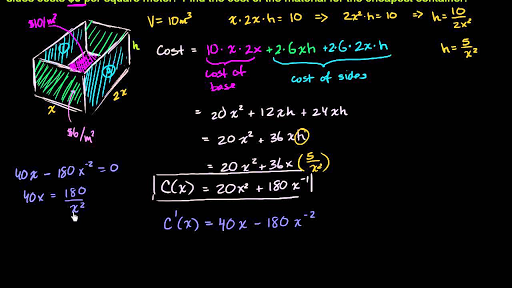
The process of minimizing material for a given volume is fundamental in designing everything from storage tanks and chemical reactors to packaging, making it a cornerstone of industrial and chemical engineering. The image below shows a similar problem, minimizing the cost to produce a container, which is often directly related to the surface area of material used.
4. Putting It All Together: Maximizing Volume
Let's walk through one more common problem from start to finish, this time without a video. This will solidify the 6-step process.
Problem: An open-top box is to be made from a 16 in. by 30 in. piece of cardboard by cutting out identical squares from each corner and folding up the sides. What size square should be cut out to create a box with the maximum possible volume?
Step 1 & 2: Diagram, Variables, and Objective
Let be the side length of the square cut from each corner. When the sides are folded up, will become the height of the box.
The length of the box will be the original 30 in. minus the two corners, so .
The width will be .
Our objective is to maximize the volume, .
Step 3 & 4: Constraint and Single-Variable Function
Substituting our expressions for length, width, and height, we get the volume as a function of the single variable :
Step 5: Determine the Domain
The side length must be positive. Also, we can't cut more than half of the shorter side (16 in.), otherwise there would be no material left. So, the physically possible values for are in the interval . To find an absolute maximum, we can analyze the continuous function on the closed interval .
Step 6: Use Calculus to Find the Maximum
First, expand the function to make differentiation easier:
Now, find the derivative to locate critical points:
Set and solve for . We can factor out a 4 to simplify:
This doesn't factor easily, so we use the quadratic formula, :
This gives us two potential critical points:
Only is within our domain of . So, this is our only critical point to consider.
Finally, we test the volume at the critical point and the endpoints:
- in³
The maximum volume of approximately 726 in³ occurs when the side of the cut-out square is inches.
Conclusion
In this lesson, you learned how to translate practical problems into the language of calculus to find optimal solutions. This powerful technique is used across engineering, science, economics, and logistics.
Key Takeaways:
- Optimization problems are about finding the absolute maximum or minimum of a function on a given interval.
- A systematic, six-step process is key: define variables, identify the objective function to be optimized and the constraint equation, reduce the objective to a single variable, determine the domain, and use calculus to find and test critical points and endpoints.
- The derivative is the tool that locates potential maxima or minima (critical points where ).
- You must always verify whether a critical point is a maximum, a minimum, or neither, either by checking the endpoints or by using the First or Second Derivative Test.
We have now reached a major milestone in your calculus review, having covered the core concepts and applications of differentiation. In our next lesson, we will pivot to the second major branch of calculus: integration. We will start by defining definite and indefinite integrals and learning the basic rules for finding them. This will open the door to solving an entirely new class of problems, such as calculating the area under a curve or the work done by a variable force.