Hello again. In the previous lesson, you established a baseline: you recorded spontaneous speech and identified fillers, repetitions, disruptive hesitations, and restarts. You also practiced a brief breathing-and-grounding routine to reduce the feeling of urgency before speaking.
Now we will work on one highly visible moment: the silence immediately after someone asks you a question. Instead of filling that moment with “um,” “uh,” or “you know,” you will use a deliberate one-to-two-second pause. The goal is not to sound rehearsed or slow. It is to give yourself a small, controlled space to retrieve words and choose how to begin.
This lesson is about 30–35 minutes in total, but it is designed so you can complete it in two or three short sessions of roughly 15 minutes.
Silence is not a failure to speak
Many speakers use fillers because silence feels risky. In a meeting, an unfamiliar person asks a question; you start searching for vocabulary; and “um…” comes out before you have decided what to say.
The important correction is this: a brief silence is usually more comfortable for the listener than a filler is for the speaker. To you, one second may feel conspicuous. To the other person, it usually registers as a normal moment of thought.
A deliberate pause tells the listener:
- “I heard the question.”
- “I am considering my answer.”
- “I am not rushing to say the first thing that appears.”
It also gives the listener a moment to finish processing the question. Continuous speech is not automatically confident speech. Controlled speech includes brief, purposeful gaps.
Watch this short segment from How to Avoid Filler Words by Alexander Lyon Communication Coach. It explains why quietness helps the listener, then gives two practical substitutes for a filler: mentally marking a “pause” and taking a breath.
Watch How to Avoid Filler Words by Alexander Lyon Communication Coach for a concise reframing of silence: the pause is not empty space to hide, but useful thinking and listening time.
Start with embracing quietness, which explains why brief silence can make speech easier to follow. Then watch the pause substitute for a rehearsal technique: replacing a filler with an internal cue such as “pause.” Finish with a breath to see how a quiet breath can create a natural break. Focus on the principle, not on copying the presenter’s exact delivery.
A useful rule for this course is:
Question ends → lips close → silent pause → answer begins.
The pause comes before your first word. Saying “Well, um…” and then pausing does not give you the same benefit, because the filler has already taken over the thinking space.
What a deliberate pause looks and sounds like
A one-to-two-second pause is not a dramatic performance. It is a small physical habit.
- Let the question finish. Do not begin answering while the other person is still speaking.
- Close your lips lightly. This simple action makes it physically harder to produce “um.”
- Keep your face and posture neutral. You can maintain eye contact on a video call or look naturally toward the person speaking.
- Think one small step ahead. Find the first few words of your answer, rather than trying to compose everything.
- Begin. Speak once you have a workable opening.
During practice, count silently:
- One second: “one one-thousand”
- Two seconds: “one one-thousand, two one-thousand”
This count is only a training tool. In real conversation, you will not count; you will recognize the physical feeling of a short, calm pause.
A pause is different from a disruptive hesitation. Compare these responses to the question, “What are you focused on this week?”
| Response | What the listener hears |
|---|---|
| “Um, I’m, uh, focused on the client update.” | The speaker is searching aloud. |
| One-second silence. “I’m focused on the client update.” | The speaker is considering, then answering. |
| Five seconds of silence, looking away repeatedly. “I… I’m not sure.” | The speaker may appear stuck or uncertain. |
For this lesson, aim for one to two seconds. That is long enough to interrupt the automatic filler habit, but short enough to keep the conversation moving.
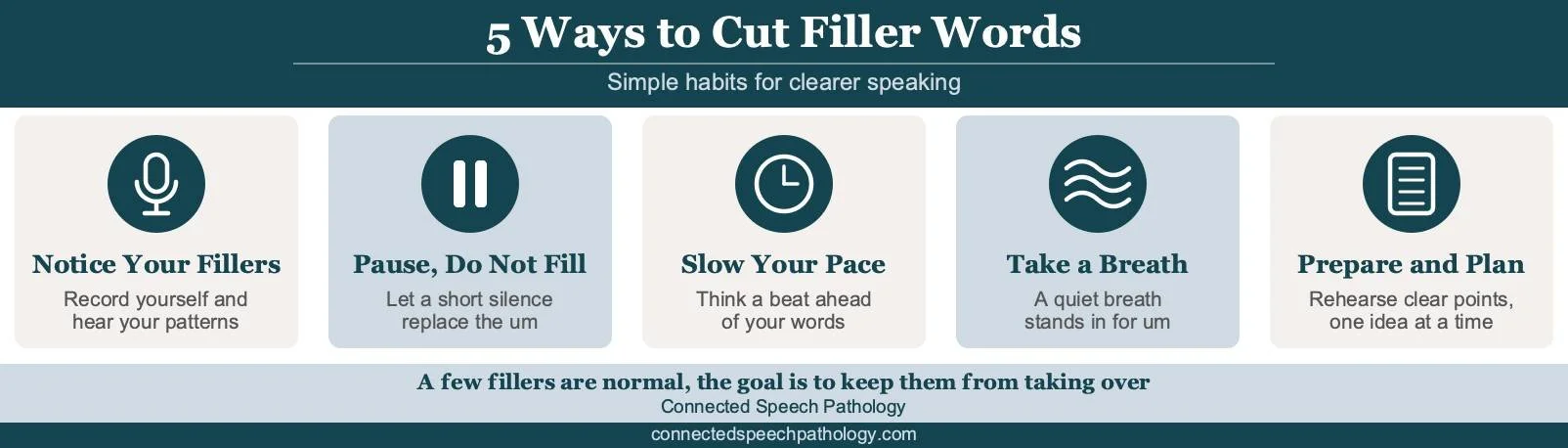
The infographic’s most useful suggestion for today is “Pause, Do Not Fill.” Its other ideas support that habit. Slowing your pace makes pauses easier; a quiet breath can replace an “uh”; and noticing your patterns helps you catch the filler before it leaves your mouth.
Build the replacement habit before using it under pressure
You are not trying to eliminate every natural conversational word. Words such as “well” or “actually” can sometimes have a real meaning. The immediate target is the vocal filler: a sound or word you use mainly to cover thinking time, such as “um,” “uh,” “er,” or a repeated “you know.”
Habits are easier to change when you provide a specific replacement. Here, the replacement is not “speak more perfectly.” It is:
When I feel an “um” beginning, I close my mouth and pause.
Try a short calibration before you answer questions.
Calibration: feel one second, then two
Record these three lines on your phone. Leave the indicated silence between the sentences.
-
“I have heard the question.”
Pause for one second.
“Now I will answer.” -
“I have heard the question.”
Pause for two seconds.
“Now I will answer.” -
“I have heard the question.”
Pause for one second.
“I have one clear idea to share.”
Listen back once. Most learners discover that the two-second pause sounds shorter and more natural than it felt while recording. This matters: do not judge the pause from inside your own nervousness. Judge it from the recording or from the listener’s experience.
If you accidentally say “um,” stop briefly, reset, and repeat the line. This is not a mistake to hide; it is the moment when you train the new response.
The five-question pause drill
You will now answer five short professional questions. The purpose is narrow: practice putting a silent pause between the question and your answer.
Keep each answer to roughly 15–25 seconds. You do not need an impressive answer, advanced vocabulary, or detailed structure. The only essential action is the pause.
Set up
Use your phone’s voice recorder. If possible, write the five questions on separate pieces of paper, fold them, and choose them one at a time. This creates a little uncertainty without making the task overwhelming.
Before each answer:
- Read the question aloud.
- Close your lips.
- Pause silently for one or two seconds.
- Begin your answer.
- If you lose a word during the answer, pause again rather than filling the gap.
Questions
- What is one priority you have this week?
- What part of your work do you find most interesting?
- What makes a meeting productive?
- What is one skill you would like to improve professionally?
- What do you enjoy learning about outside work?
Use ordinary, truthful answers. For example, after the question “What makes a meeting productive?” your sequence might be:
Question ends.
Silent pause.
“A productive meeting has a clear purpose. People should know what decision or next step they need by the end.”
Notice that the pause gives you time to locate just the first phrase: “A productive meeting…” You do not need to plan every sentence before opening your mouth.
A practical recording sequence
Complete the drill in three passes:
| Pass | What to do | What to notice |
|---|---|---|
| 1. Rehearsal | Answer Questions 1–2 without recording. | Can you physically close your lips instead of saying “um”? |
| 2. Full recording | Record answers to all five questions. | Did each answer begin with a one-to-two-second silent pause? |
| 3. Review | Listen only to the first five seconds after each question. | Is the pause audible? Is there a filler before the answer begins? |
Do not restart an entire answer just because you use one filler. Finish it. A restart can turn a small habit slip into a pressure spiral. Instead, make a brief note and give yourself another opportunity on the next question.
Use this simple review grid in your notes:
| Question | Silent pause before answer? | Filler before answer? | One observation |
|---|---|---|---|
| 1 | Yes / No | Yes / No | |
| 2 | Yes / No | Yes / No | |
| 3 | Yes / No | Yes / No | |
| 4 | Yes / No | Yes / No | |
| 5 | Yes / No | Yes / No |
A successful first attempt is not necessarily five perfect answers. It is five genuine attempts to substitute silence for the old filler habit.
Transfer the skill to real conversations
The phone drill teaches the physical sequence. Your next task is to carry it into one real interaction: a meeting, a short phone call, or an informal conversation.
Choose one low-risk target:
- Pause before answering the first question you receive in a meeting.
- Pause before responding when a colleague asks for your opinion.
- Pause before answering a casual question such as “How is your week going?”
Do not announce that you are pausing. Do not apologize for it. Let it be ordinary.
If a confident English speaker asks a question and you feel rushed, use the smallest version of last lesson’s reset:
Slow exhale. Feel your feet. Pause. Begin.
You may still feel nervous. That is acceptable. Confidence here means acting deliberately even when the conversation has some pressure.
Takeaway and next step
A one-to-two-second silent pause is a practical replacement for “um” and “uh.” It works because it gives you thinking time without making the listener hear your search for words.
For each answer, use this sequence:
- Let the question end.
- Close your lips.
- Pause silently for one or two seconds.
- Begin when you have the first phrase of your answer.
Your goal for the five-question drill is simple: create five deliberate pauses before answering, then review whether a vocal filler appeared in that space.
Next, you will build on this pause by learning to begin an unexpected answer with one complete, direct sentence at a controlled pace.