Hello. In the previous lesson, you recorded a spontaneous 90-second response and counted fillers, disruptive pauses, repetitions, and sentence restarts. That recording gave you evidence about where pressure affects your speech.
This lesson addresses the moment just before pressure begins: the seconds before you join a phone meeting, introduce yourself to someone new, answer a difficult question, or disagree with a confident colleague. The aim is not to eliminate nervousness. It is to lower your physical urgency enough that you can access the ideas and English you already have.
By the end, you will have a brief, discreet routine you can use in under a minute before a pressured conversation.
Why prepare the body before preparing the words?
When a conversation feels high-stakes, your attention often moves into prediction:
- “What if I forget a word?”
- “What if they speak too quickly?”
- “What if I make a grammar mistake?”
- “What if I disagree badly?”
At the same time, the body may become tense: raised shoulders, shallow breaths, a tight jaw, restless hands, or a faster pace. This matters for speaking because you are trying to listen, retrieve vocabulary, organize an idea, and monitor the other person’s reaction at once. If your body feels rushed, it becomes easier to rush your speech—or to fill a moment of thinking with “uh,” “um,” or a sentence restart.
A short routine helps create a useful gap between feeling pressure and reacting to pressure. It does not need to be dramatic, visible, or perfect. You are simply giving yourself a steadier physical starting point.
The first component is breathing. The goal is not an unusually large breath; it is a slower, lower, more relaxed pattern. Let your abdomen and lower ribs expand naturally rather than lifting your shoulders toward your ears.
BREATHING EXERCISES FOR CONFIDENT PUBLIC SPEAKING
Watch “BREATHING EXERCISES FOR CONFIDENT PUBLIC SPEAKING” by Dominic Colenso for a practical distinction between tense upper-chest breathing and a more relaxed, lower breathing pattern.
Watch low breathing to notice the physical difference: one hand on the upper chest and one lower on the abdomen can make the pattern easier to feel. Then watch the count for a simple counted rhythm. Focus on keeping the shoulders loose and the abdominal wall relaxed; you do not need to force a deep inhale.
The 50-second pre-conversation routine
Use this routine while waiting for a meeting to begin, standing outside a networking event, or just before you unmute on a call. It should be subtle enough to do without attracting attention.
1. Settle your posture: 5 seconds
Put both feet on the floor if you are seated. Let your shoulders drop slightly. Unclench your jaw and rest your hands on your lap, desk, or phone.
This is not about achieving a “confident pose.” It is a simple signal to stop adding unnecessary muscular tension.
2. Use two slow breath cycles: about 30 seconds
Complete two rounds:
- Inhale slowly for a count of four.
- Hold gently for a count of four, only if that feels comfortable.
- Exhale slowly for a count of six.
Count silently. The exhale is slightly longer than the inhale, so do not rush to take the next breath.
The American Psychological Association offers this same -- pattern as a way to reduce physiological arousal, together with physical grounding through awareness of contact and surroundings.
Read the American Psychological Association’s short guidance to understand the two ingredients of this routine: slowing the breath and bringing attention back to physical sensations.
In the “Calm yourself” section, read the breathing guidance. Then move to “Ground yourself” and read the grounding guidance. For a real conversation, you will use just two cycles rather than all ten repetitions.
If breath-holding makes you uncomfortable, remove it. Use a simple -count inhale and -count exhale instead. The routine should make you feel more available, not as though you are struggling to follow instructions.
Avoid forcing the breath, and return to normal breathing if you feel dizzy or uncomfortable. If you have a respiratory or health condition that makes breath exercises unsuitable, use the grounding portion alone.
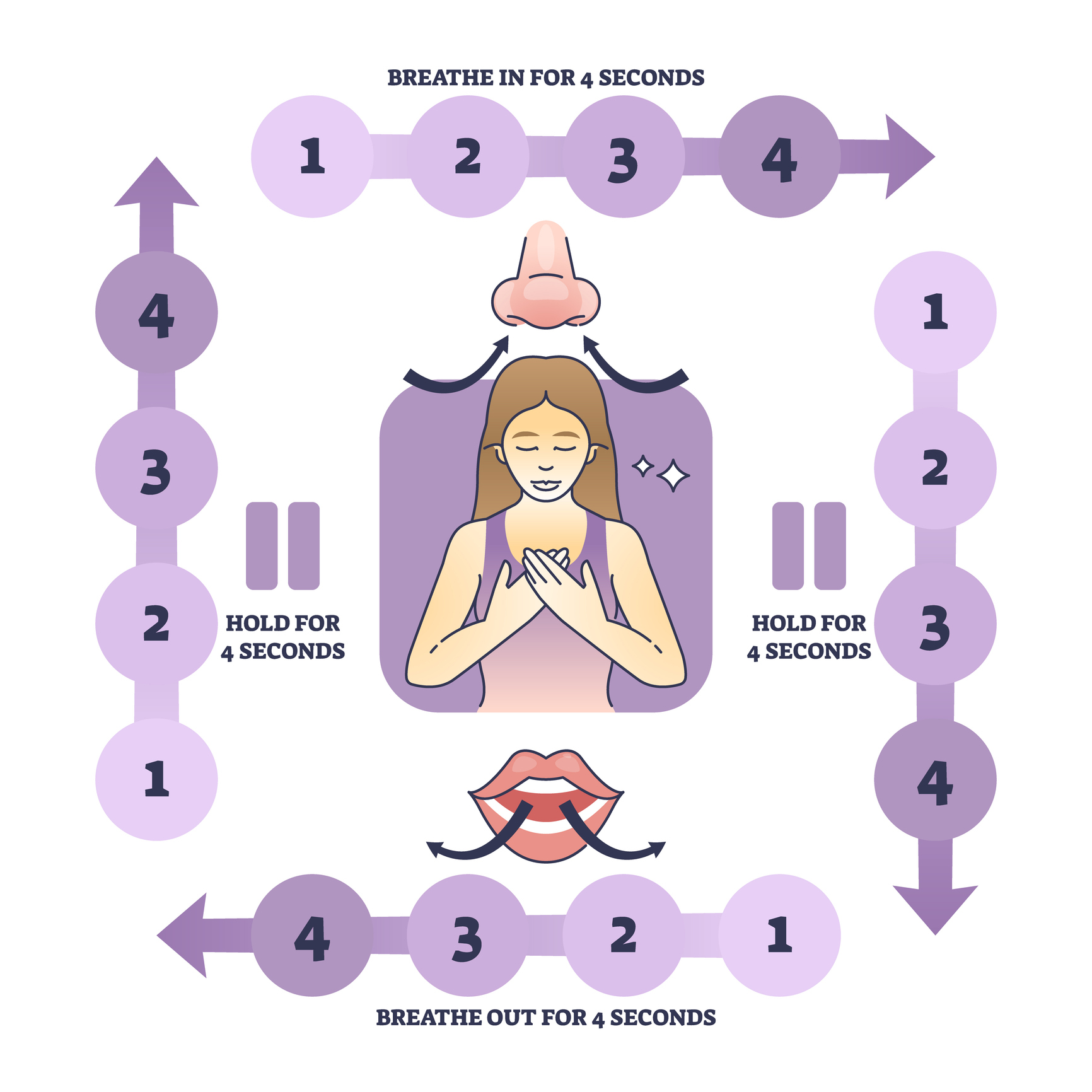
The image below shows a related --- “box breathing” cycle. It is a valid alternative once you know which count feels more comfortable. For this course, begin with the -- pattern because the longer exhale is easy to remember and fits a short pre-call reset.
3. Ground in three physical facts: 10–15 seconds
Immediately after the second exhale, move your attention away from predictions about the conversation and toward what is physically true right now. Notice three facts:
- Contact: “My feet are on the floor.”
- Support: “My back is against the chair,” or “My hands are resting on the desk.”
- Environment: “The room is cool,” “I can hear the air conditioner,” or “This pen feels smooth.”
Do not try to think positively. Grounding is not a motivational speech to yourself; it is noticing reality with enough detail to interrupt the mental loop of “What might go wrong?”
How to do Grounding Exercises for Anxiety and Overwhelm | CAMH
Watch “How to do Grounding Exercises for Anxiety and Overwhelm” from CAMH for a quiet, practical model of grounding through posture, touch, and sensory attention.
Follow posture and touch: notice the support under your feet, take a measured breath, and press your hands together lightly. Then watch sensory grounding for the shift from worrying thoughts to nearby objects, sounds, and the floor beneath you. In a workplace setting, choose only one or two of these cues so the routine remains brief.
4. Choose one task, not a perfect performance: 5 seconds
Finish with a practical internal instruction:
- “Listen for the question.”
- “Speak one idea at a time.”
- “Start calmly.”
- “I only need to contribute one clear point.”
Avoid a vague demand such as “Do not make mistakes.” That keeps your attention on mistakes. A small task directs attention toward what you can actually do next.
Make the routine fit real professional situations
The routine is most useful when it is linked to a predictable trigger. Decide in advance when you will use it.
| Situation | Your cue to begin | Discreet version |
|---|---|---|
| Phone or video meeting | One minute before joining | Feet down, two breaths, hands on desk |
| Networking event | Before entering the room | Two breaths while checking your name badge or phone; notice your feet |
| Difficult conversation | While waiting for the other person | Relax shoulders, one or two breath cycles, identify the chair or floor supporting you |
| Unexpected question in a meeting | As the person finishes the question | One slower exhale and feel both feet on the floor |
For an unexpected question, you will not always have 50 seconds. That is why it is useful to rehearse the full routine before conversations: eventually, one slower exhale plus physical grounding can become a smaller version of the same habit. In the next lessons, you will pair that steadier start with a deliberate silent pause and a clear opening sentence.
A short rehearsal plan
Use the routine today in two conditions: once with no pressure, and once immediately before a short speaking task.
Rehearsal A: learn the sequence
Take two minutes in a quiet place.
- Sit with both feet supported.
- Relax shoulders, jaw, and hands.
- Do two -- breath cycles.
- Notice three physical facts.
- Say one task cue quietly: “Start calmly.”
The point is to remember the sequence without needing to read it.
Rehearsal B: apply it before speaking
Immediately after the routine, record a 30-second answer to this practical prompt:
“What is one priority I need to communicate clearly this week?”
Do not script the answer. The recording is not a new baseline and you do not need to count fillers. Simply notice whether you started at a more controlled pace than usual.
When you next have a real English call, use the routine before joining. Afterward, write just one sentence in your notes:
- “I used the routine before ___; my first minute felt ___.”
Use observable language where possible: “slower,” “less tense,” “still nervous but able to listen,” or “I began without immediately saying ‘um.’” This is more useful than judging the conversation as a success or failure.
When the routine does—and does not—help
A breathing and grounding routine cannot supply missing information, solve a conflict, or make an intimidating person easier to talk with. It is not a substitute for preparation when preparation is possible.
What it can do is give you a more controlled starting condition. That is valuable because many pressured speaking problems begin in the first few seconds: a rushed first sentence, a filler before the main point, or an attempt to say too much at once.
If you forget the whole sequence, use the minimum version:
Exhale slowly. Feel your feet. Choose one task.
That is enough to interrupt automatic rushing.
Takeaway and next step
Before a pressured conversation, use a brief sequence:
- Settle your shoulders, jaw, hands, and posture.
- Breathe for two slow -- cycles, adapting the hold if needed.
- Ground yourself in physical contact and one nearby sensory detail.
- Direct attention to one immediate speaking task.
The objective is not to feel completely calm. It is to become calm enough to listen, think, and begin deliberately.
Next, you will use that steadier moment to replace vocal fillers with a purposeful one-to-two-second silent pause while answering short questions.