Hello! Welcome to the final lesson of our first module, "Foundations of Visual Storytelling."
So far, we've explored the essential building blocks of narrative: you've learned about the universal 3-act structure, how to break a story into specific narrative beats, and how to organize those beats into scenes (story units) and shots (camera units).
Today, we'll bring all these concepts together. Your goal for this lesson is to write a concise outline for a 1-minute video story. This outline will serve as the practical blueprint for your first AI video project. Having a solid plan before you start generating clips is crucial; it saves you time, ensures your story is coherent, and helps you focus your creative energy on telling a great story rather than just making cool, disconnected visuals.
Let's get started on creating your first story blueprint.
Step 1: Find Your Core Story with the Five-Line Method
When faced with a blank page, it's easy to get lost in details. The best way to start is by capturing the absolute essence of your story. A simple and powerful tool for this is the "five-line story method." It forces you to define the emotional core of your narrative before you think about anything else.
To learn this method, let's watch a video from filmmaker Tim Runia.
The ONLY 5 Lines You Need To Tell Any Story
This video introduces the 'five-line story method' as a blueprint to create a story with a heart. It's an excellent way to simplify your idea down to its most critical components.
Watch from 01:51 to 04:21. Pay close attention to the definition of each of the five lines and how they are applied to a well-known story like The Lion King.
As you just saw, any story can be broken down into these five essential lines:
- The Situation: Where and when are we? Who is the main character and what is their world like at the start?
- The Desire: What does the character want? What is their goal?
- The Conflict: What obstacle or antagonist stands in their way?
- The Change: What is the key turning point? This could be an action, a decision, or a realization that shifts the story's direction.
- The Result: How does the story end? What is the new reality for the character?
Writing these five lines first ensures you have a complete narrative arc.
Step 2: Structure Your Story for a 1-Minute Timeline
Now that you have the core of your story, how do you fit it into just 60 seconds? This is where the 3-act structure we learned about comes back into play, but this time with a stopwatch.
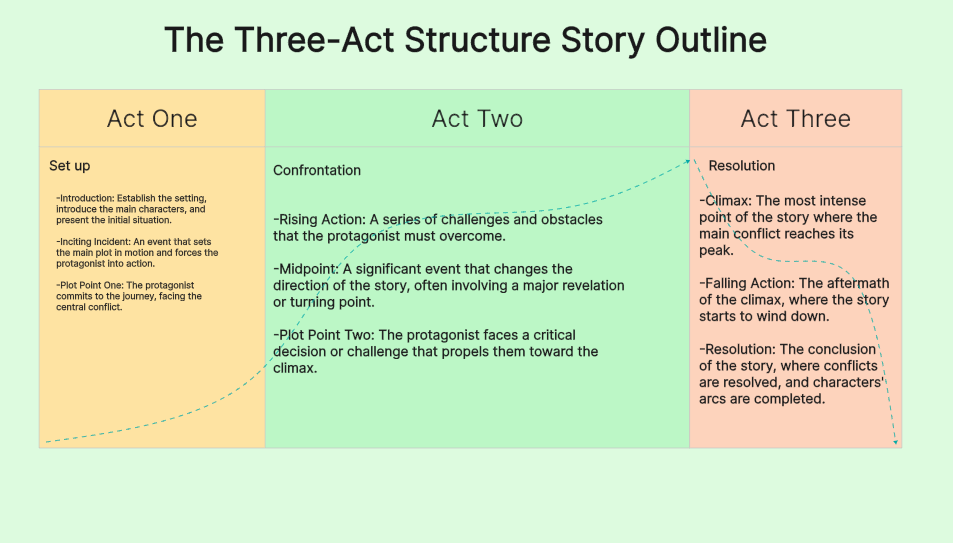
For short films, these acts can be surprisingly brief. A resource from Open Screenplay provides a fantastic breakdown of how to allocate time.
Short Film Story Outline Structure
This article, 'Short Film Story Outline Structure', explains how the classic 3-act structure scales down to even very short films. The key takeaway for us is in its time allocation table.
Read the sections titled '3 Act Story Structure for Short Films' and 'Acts and Lengths'. Focus on the table that shows the time breakdown for a 1-minute screenplay. You don't need to memorize it, just internalize the proportions.
The article gives us a clear and practical guide for a 1-minute video:
- Act 1 (Setup): ~12 seconds
- Act 2 (Confrontation): ~36 seconds
- Act 3 (Resolution): ~12 seconds
Now we can map our five lines directly onto this timeline:
- Act 1 (~12s): Introduce the Situation.
- Act 2 (~36s): Show the character's Desire, introduce the Conflict, and build to the Change (the turning point).
- Act 3 (~12s): Deliver the Result and the story's conclusion.
This structure gives your 1-minute story a clear beginning, a substantial middle where the main action happens, and a quick, satisfying end.
Step 3: Write Your Scene-by-Scene Outline
You have your five core story points and a timeline. The final step is to flesh this out into a simple scene-by-scene outline. This document connects your story beats to your scenes and timing.
Let's use our friend Bolt, the lonely robot from the last lesson, as an example.
1. Bolt's Five-Line Story:
- Situation: A lonely robot, Bolt, sits sadly in a massive, quiet junkyard.
- Desire: He wants a companion, so he decides to build a friend from scrap parts.
- Conflict: The newly built friend is complete but lacks a power source and won't activate.
- Change: Bolt spots a blinking light on a distant, unstable junk pile and heroically decides to climb it to retrieve the power source.
- Result: He successfully powers up his new friend, and the two share a moment of connection, ending Bolt's loneliness.
2. Bolt's 1-Minute Outline:
Here is how we can translate that into a practical outline:
| Act | Scene(s) | Key Beats / Actions | Est. Time |
|---|---|---|---|
| Act 1 | Scene 1: Bolt's Corner | - Bolt sits alone, looking sad. - He looks at a pile of junk, an idea forms. - He begins gathering parts. |
12 sec |
| Act 2 | Scene 1: Bolt's Corner (cont'd) | - Bolt puts the finishing touches on his new robot friend. - He tries to activate it; it doesn't work. He looks defeated. |
18 sec |
| Scene 2: The Junk Pile | - Bolt's eyes catch a blinking light in the distance. - He looks from the light to his friend (the decision). - He begins his dangerous climb. |
18 sec | |
| Act 3 | Scene 1: Bolt's Corner (revisited) | - Bolt returns with the power source and plugs it in. - The new robot's eyes light up. - They look at each other. |
12 sec |
| Total | 60 sec |
This outline is your roadmap. It tells you what happens, where it happens, and for how long. It's the perfect bridge between your idea and the list of shots you'll eventually need to generate.
Test your understanding!
Now it's your turn to think of a simple story. It can be about anything: a cat trying to steal a fish, an astronaut discovering a strange flower on Mars, or a magician whose trick goes wrong.
Task: Using the five-line method, write down the core story for a 1-minute video idea you have. Just the five lines: Situation, Desire, Conflict, Change, and Result. This is the first and most important step to creating your outline.
Show answer
There's no single right answer here, but a good response will have five distinct points that create a full story arc.
For example, for the story of "a cat trying to steal a fish":
- Situation: A housecat, Ginger, is lazing in the sun while her owner prepares a salmon fillet on the kitchen counter.
- Desire: Ginger desperately wants to eat that delicious salmon.
- Conflict: The owner is in the kitchen, and the counter is too high for a simple jump.
- Change: Ginger notices a stack of cookbooks on a stool, creating a makeshift staircase. She decides to attempt the stealthy climb.
- Result: She successfully reaches the counter, grabs the fish, and dashes away just as the owner turns around, leaving the owner bewildered.
Notice how this sets up a clear, simple, and visual story that can easily be told in one minute.
Conclusion
You've now completed the foundational module of this course and have a complete, end-to-end process for creating a story blueprint.
Here are your key takeaways from this lesson:
- Start any story idea with the five-line method (Situation, Desire, Conflict, Change, Result) to define its core.
- Structure your 1-minute video using the 3-act timing guide: roughly 12 seconds for the setup, 36 for the confrontation, and 12 for the resolution.
- Combine these into a scene-by-scene outline that lists the key actions and timings. This document is the final blueprint you'll need before you start thinking visually.
In our next lesson, we will move into Module 2, "Visual Blueprint: Storyboarding and Shot Planning." You'll learn how to take your new outline and begin translating it into a visual language by selecting appropriate shot types (like wide, medium, and close-up) to tell your story with maximum impact.